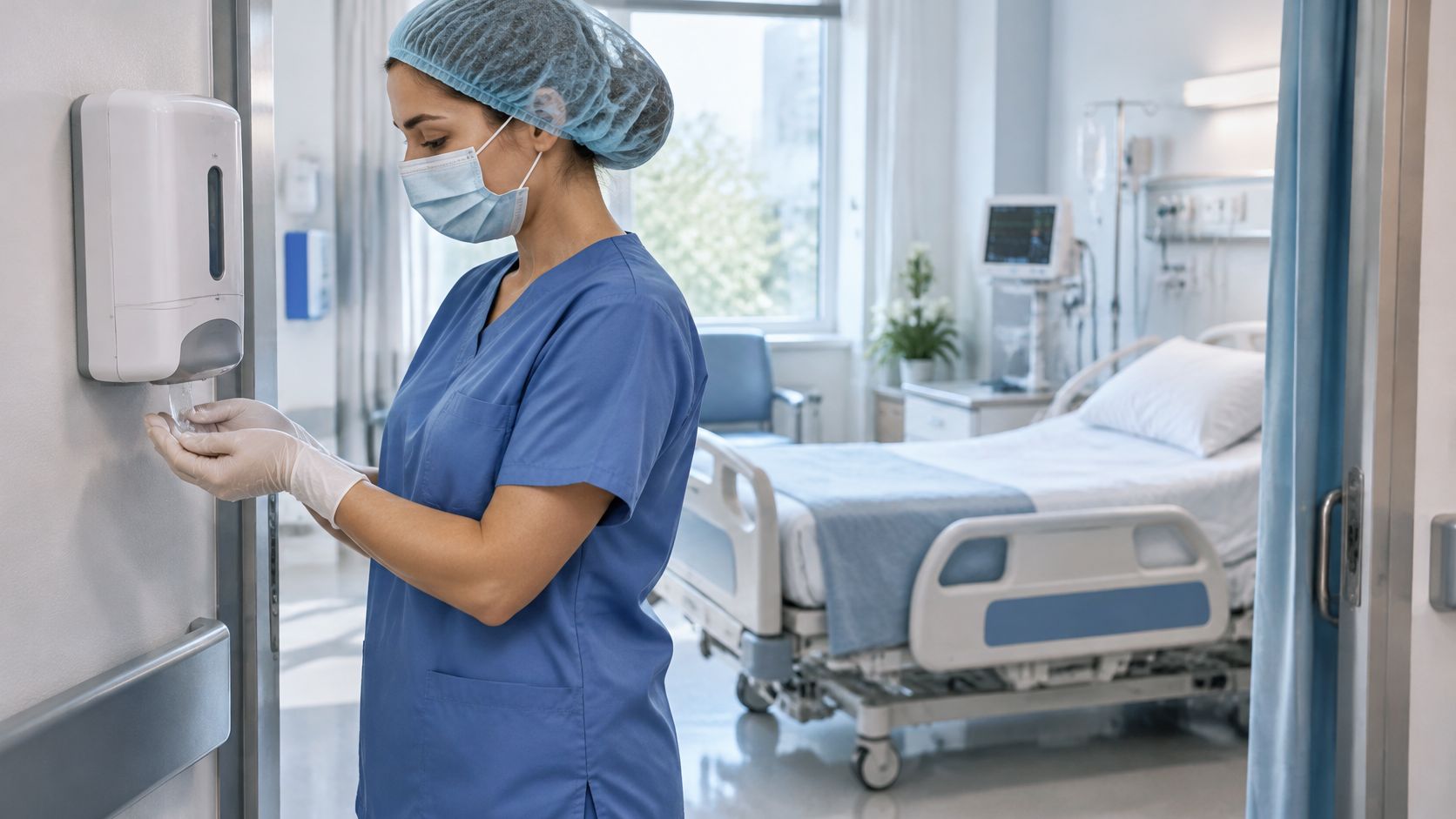
An estimated 40% of healthcare facilities in the Eastern Mediterranean Region lacked basic hygiene services, according to WHO's hand-hygiene overview. That changes how we should discuss hospital infection control procedures. Before asking whether someone cleaned their hands correctly, ask whether they had working sinks, soap, water and handrub available when care required them.
The Core Procedures and What Each One Prevents
| Procedure | What It Prevents | Who Applies It |
|---|---|---|
| Hand hygiene | Transfer of microbes between patients, staff and surfaces | Every staff member at each moment of care |
| Standard Precautions | Exposure to blood, body fluids, mucous membranes and nonintact skin | Everyone, for every patient interaction |
| Transmission-Based Precautions | Spread by the specific route of a suspected or confirmed pathogen | Staff caring for patients with an identified route, such as influenza |
| Environmental disinfection | Indirect spread through high-touch surfaces and equipment | Cleaning staff working to the label contact time |
| Surveillance and feedback | Undetected clusters of infection and repeated gaps in practice | Infection prevention team with frontline leaders |
| Safe injection practices | Bloodborne transmission during injections | Clinicians preparing and giving injections |
The WHO global report on infection prevention and control, published in 2022, found that approximately 7 of every 100 acute-care hospital patients in high-income countries and 15 of every 100 in low- and middle-income countries acquire at least one healthcare-associated infection, and estimated that approximately 70% of HAIs could be prevented through properly implemented programs and recommended practices. Its 2021–2022 assessment found that only 4 of 106 countries, or 3.8%, met all minimum requirements for a national infection-prevention and control program.
Match the control to the exposure
These procedures address different opportunities for transmission. Hand hygiene interrupts transfer during care; environmental disinfection addresses contaminated surroundings; safe injection practices protect medication preparation and delivery. Surveillance helps staff discover where those defenses aren't working.
For injections, use a new sterile needle and syringe for each patient and maintain a clean medication-preparation area. Never assume that changing the needle makes a used syringe safe.
Virus education also requires clear distinctions. Human Immunodeficiency Virus Type 1 (HIV-1), Hepatitis B Virus (HBV) and Hepatitis C Virus (HCV) aren't interchangeable with Influenza A Virus (H1N1), Influenza A2/305/57 Virus (H2N2), Avian Influenza Virus (H5N1), SARS-Related Coronavirus 2 (SARS-CoV-2) or Human Coronavirus.
The same care with identification applies to Herpes Simplex Virus 1 (HSV-1), Herpes Simplex Virus 2 (HSV-2), large non-enveloped viruses such as Human Rotavirus, and small non-enveloped viruses such as Feline Calicivirus, Norovirus (Norwalk Virus), Rhinovirus Type 14 and Rhinovirus Type 39. Duck Hepatitis B Virus (DHBV) and Bovine Viral Diarrhea Virus (BVDV) belong in broader virology education, not a presumed list of human hospital infections.
The procedures work as a set. Choosing a product or precaution requires identifying the actual clinical risk, not just recognizing the word virus.
Standard and Transmission-Based Precautions Explained
Standard Precautions are the building's foundation. Transmission-Based Precautions are the additional layer fitted to a particular route of spread. A patient doesn't need a positive test before the foundation applies.
The CDC isolation-precautions guidance distinguishes these tiers and specifies Standard plus Droplet Precautions for influenza. Standard Precautions include hand hygiene, exposure-based protective equipment and safe injection practices across healthcare settings.

Make the decision before starting care
Begin by applying Standard Precautions to every patient. Anticipate what your hands, clothing, eyes and face might contact during the task.
Choose gloves when contact with blood, potentially infectious materials, mucous membranes or nonintact skin is reasonably anticipated. Choose a gown for likely clothing contamination, and mask and eye protection or a face shield when the exposure assessment calls for them. Protective equipment should match the task, not a general impression that a patient looks infectious.
Then follow this sequence:
- Identify the suspected route. Consider whether the presentation requires contact, droplet or airborne measures while assessment continues.
- Add the matching controls. Arrange appropriate placement, equipment and protective supplies before staff enter.
- Confirm the stopping criteria. Record who will review precautions and what clinical conditions must be met.
The CDC summary recommendations also recognize that immunocompromised patients may need longer viral Transmission-Based Precautions because prolonged shedding can occur. That calls for organism-specific assessment, not indefinite isolation based on immune status alone.
Practical rule: Choose protection for the exposure you're about to encounter, then check whether the organism requires anything additional.
A common misunderstanding is that gloves make every task safe. They don't authorize moving from a contaminated task to a clean procedure without changing gloves and cleaning hands. Routine measures remain universal; additional controls follow the organism and how it moves.
Hand Hygiene Steps and the Moments That Count
A useful hand-hygiene observation starts with availability, not an accusation. Check water, soap, working sinks, accessible alcohol-based handrub and waste services during every shift. An empty dispenser is a supply failure; a blocked sink is an access failure.
Once those essentials are available, observe the actual care sequence. Our guide to hand hygiene in healthcare offers additional context for building these actions into everyday work.
Follow the routine at the point of care
- Identify the moment. The WHO hand-hygiene framework identifies action before touching a patient, before a clean or aseptic procedure, after body-fluid exposure risk, after touching a patient and after touching the patient's surroundings. These are opportunities defined by care, not by whether hands look dirty.
- Inspect your hands. Check for visible soil or body-fluid contamination before selecting a method. Don't automatically reach for handrub when washing is required.
- Apply enough handrub when appropriate. Cover palms, backs of hands, fingers, fingertips and thumbs. Too little product may leave untreated areas even when the rubbing motion looks correct.
- Complete the rubbing technique. Work between fingers and around thumbs, and include fingertips. Stopping while parts of the hands remain untreated defeats the purpose of starting.
- Use soap and water when required. Wash all surfaces, rinse thoroughly and dry completely. Don't substitute a quick splash for a complete wash.
- Clean hands after removing gloves. Glove removal doesn't complete hand hygiene. Make the next required action possible by placing supplies close to where gloves come off.

Use the correct method and timing
The WHO hand-hygiene guidance specifies 20–30 seconds until dry for alcohol-based handrub, 40–60 seconds for soap-and-water washing, and generally effective alcohol formulations containing 60–80% alcohol.
| Method | Use When | Duration | Key Requirement |
|---|---|---|---|
| Alcohol-based handrub | Hands are not visibly soiled | 20–30 seconds until dry | Formulation with 60–80% alcohol and enough product to cover all surfaces |
| Soap and water | Hands are visibly soiled or contaminated with body fluids | 40–60 seconds | Thorough rinsing and complete drying |
Missed thumbs, untreated fingertips and premature stopping are technique failures. Correct them with demonstration and observed practice. A staff member who can't reach functioning supplies needs an operational fix before technique coaching can help.
WHO's multimodal approach combines point-of-care supplies, education, monitoring, feedback, reminders and institutional leadership. Availability alone doesn't guarantee adherence, but education alone can't replace availability.
For example, if handrub is accessible but staff repeatedly miss the moment before an aseptic task, investigate task sequencing and provide feedback. If handrub is empty and the nearest sink is unusable, restore access first and then reassess performance.
Environmental Cleaning and Contact Time
A disinfectant must remain wet on the surface for its label contact time. Wiping it on and immediately drying it off doesn't deliver the same exposure.
The CDC disinfection guideline defines contact time as the period of direct contact, ending when the surface dries; many hospital labels specify 10 minutes, some products are labeled for 1–3 minutes, and evidence summarized for several products shows substantial microbial reduction with 30–60 seconds of contact. Those shorter research findings aren't permission to shorten a product's labeled instructions.
Build wet time into the workflow
- Select the right product. Use an EPA-registered disinfectant whose label covers the relevant organism, intended setting and surface. Check equipment instructions too, particularly for monitors and other sensitive devices.
- Read the label before application. Identify the required contact time, any precleaning instructions and protective equipment. Remove visible contamination as directed rather than treating disinfection as a substitute for cleaning.
- Apply sufficient solution. Keep the surface visibly wet throughout the required interval. With disinfecting wipes, replace a wipe when it can no longer deliver enough liquid for the area being treated.
- Track the interval. Use a timer or a standardized sequence that reliably preserves wet contact. Don't estimate from how long the room feels as though it's been closed.
- Complete the process as directed. Don't dry the surface prematurely. Follow any label requirements for rinsing, drying or returning equipment to use.
Applying too little product, wiping it away early and allowing rapid evaporation all reduce the exposure delivered to microbes. A surface that looks freshly wiped may still have received an incomplete disinfection process.
A wipe is an application tool, not proof that disinfection is complete.
Assign surfaces and verify completion
Bed rails, call buttons, doorknobs and noncritical patient-care equipment need named cleaning responsibilities. A shared blood-pressure cuff shouldn't fall into a gap between nursing and environmental services because each team assumes the other handles it.
For shared sanitary spaces, Renue Systems Four Points' resource on commercial restroom deep cleaning provides related operational context. Hospital teams should still use their own infection-prevention procedures and approved product instructions rather than substituting a general commercial cleaning service description for clinical guidance.
Our explanation of contact time for disinfectants helps distinguish application from completed exposure. When purchasing wipes, compare their organism claims, surface compatibility and achievable wet time, not just convenience.
Ask a staff member to demonstrate cleaning a frequently touched item. Time the wet interval against the label and check whether the workflow supports the required exposure.
Isolation and Droplet Precautions for Influenza
Suspected influenza changes patient placement and staff workflow before laboratory confirmation. Seasonal influenza, including H1N1, calls for Droplet Precautions in addition to routine measures.
The CDC healthcare influenza guidance states that precautions should continue for the longer of 7 days after illness onset, or until at least 24 hours after fever has resolved without fever-reducing medication and respiratory symptoms have improved. Both elapsed illness time and clinical improvement matter.
Apply the rule to an actual timeline
Consider a hypothetical patient whose illness begins on day 1 and whose fever resolves without medication on day 6 while respiratory symptoms improve. Staff must still meet the full elapsed-time requirement; reaching the calendar label day 7 doesn't necessarily mean that a full week has elapsed since onset.
If fever returns or respiratory symptoms haven't improved, the clinical criteria remain unmet. Document onset and fever-resolution times clearly enough that another clinician can reproduce the decision.
A private room is preferred where available. If cohorting is necessary, check that patients have the same infection and compatible precautions; grouping everyone with a cough can expose them to a different pathogen.
Staff should wear the medical mask required for droplet care and add eye protection according to anticipated exposure and facility policy. Procedures that generate aerosols require additional assessment and controls rather than assuming the routine droplet arrangement is sufficient.
Documentation check: Record why precautions can stop, not merely the planned removal date.
For necessary transport, have the patient wear a mask when tolerated, use respiratory hygiene and alert the receiving team. Keep transport purposeful so the patient doesn't wait unnecessarily in shared areas.
Close the review by checking for these errors:
- Stopping by calendar alone. A scheduled endpoint doesn't override persistent symptoms or renewed fever.
- Using discharge as the endpoint. Discharge planning and discontinuation of healthcare precautions answer different questions.
- Cohorting without organism review. Similar respiratory symptoms don't establish that patients can safely share a room.
Surveillance, Audits and Feedback That Improve Results
A completed training record shows that someone attended training. It doesn't show that a dispenser worked during a busy shift, a shared device was disinfected correctly or staff recognized a developing infection cluster.
Surveillance is an active procedure, not a report distributed after the opportunity to intervene has passed. The historical Study on the Efficacy of Nosocomial Infection Control helped establish the value of connecting infection detection with trained personnel, active control and feedback to clinicians.

Close the monitoring loop
- Detect infections. Use consistent case definitions and reporting pathways.
- Analyze patterns. Review findings by unit, procedure and relevant exposure rather than treating every infection as an isolated event.
- Return usable feedback. Tell frontline teams what happened, where the gap occurred and what needs attention.
- Correct and remeasure. Assign an owner, implement the change and check whether practice and outcomes improve.
Track observed hand-hygiene opportunities alongside dispenser access, high-touch cleaning verification and device-associated infections. Record missed procedures without automatically assigning personal blame. A useful incident description explains what staff needed, what was missing and what workaround occurred.
Separate activity from protection
Suppose a unit reports strong observed hand-hygiene compliance, but soap runs out each weekend. Observations made only during well-stocked weekday shifts could conceal a recurring availability problem.
Training attendance and completed forms are process measures. Infection outcomes help assess whether patients are experiencing less harm, although teams must interpret them alongside case mix, surveillance consistency and changes in exposure.
Use infection-control training for healthcare workers to address demonstrated practice gaps, not as the automatic response to every adverse result. For patients navigating wound care during respiratory outbreaks, the Vein and Wound Institute's discussion of managing wounds during the pandemic offers related patient-facing context, not a replacement for hospital surveillance definitions.
Where resources are constrained, protect reliable hand hygiene, cleaning and appropriate isolation while documenting unresolved shortages. WHO's Western Pacific infection-prevention review emphasizes stronger monitoring and evaluation alongside these foundational practices. Paper compliance shouldn't conceal an unsafe workflow.
Applying Procedures in ICU, Surgical and Outpatient Settings
Hospital infection control procedures need the same disciplined implementation across settings, but the immediate work differs. An ICU team manages repeated device access; a surgical team protects an operative site; an outpatient team must identify respiratory risk while patients move rapidly through shared spaces.
ICU priorities
- At device contact. Clean hands before aseptic access and avoid moving from contaminated care directly to a catheter or central line.
- During ongoing treatment. Apply catheter and central-line care bundles, including review of whether each device remains necessary.
- At daily review. Reassess isolation indications and ensure staffing and supplies support consistent practice rather than rushed workarounds.
Critically ill patients often need complex, closely sequenced care. Place supplies where staff can reach them without leaving an aseptic task unfinished.
Surgical ward priorities
- Before the procedure. Perform the required preoperative hand antisepsis and prepare the working area.
- During the procedure. Maintain aseptic technique and correct a break when it occurs rather than continuing with a compromised field.
- After the procedure. Conduct surgical-site surveillance and return findings to surgeons and ward teams.
Feedback should identify a correctable practice or exposure. An infection count without clinical review gives the team little direction.
Outpatient clinic priorities
- At entry. Screen for relevant symptoms and make masks available for respiratory source control.
- Between patients. Assign examination-room and shared-equipment cleaning, allowing the product's required workflow.
- At care locations. Position handrub at entrances and examination-room doors while maintaining access to washing facilities.
Facility layout deserves the same attention as staff technique. Pacific Mobile Structures, Inc.’s discussion of the benefits of modular medical facilities is relevant when considering additional clinical space, but any layout still needs infection-prevention review.
Consider a clinic whose sinks are blocked by stored boxes during clinic hours. Repeating a handwashing lesson won't remove the obstruction. Restore access, verify water, soap and waste services, and then assess whether staff can perform the required technique during real appointments.
Confirm Your Facility's Gaps Before Your Next Audit
A useful audit identifies what needs to change and who can change it. Before the next review, walk through a real patient-care journey rather than checking documents alone.
- Confirm access. Place hand-hygiene supplies within reach of each patient zone, and verify stocked soap and usable water supplies.
- Test disinfection workflows. Check whether teams can achieve each product's labeled contact time between patients.
- Review precaution decisions. Ensure signs, influenza stopping criteria and route-specific instructions are available and followed.
- Return surveillance feedback. Establish at least a monthly frontline review as a local improvement practice, with named owners for corrective actions.
- Inspect every shift. Confirm that sinks, water and waste services remain functional outside routine audit hours.
When choosing disinfecting wipes, buy for the relevant organism claim, surface compatibility and wet time your team can reliably achieve. Repeat the checklist after corrective action so the next audit measures change, not just completed paperwork.
Our Education articles offer practical tips for staying safe, cleaning effectively and recognizing common risks. Bring questions or feedback about viruses or our content to the VirusFAQ.com Contact page, where we welcome collaboration and discussion. Start today by testing one patient zone and correcting its first unresolved gap.
Leave a Reply