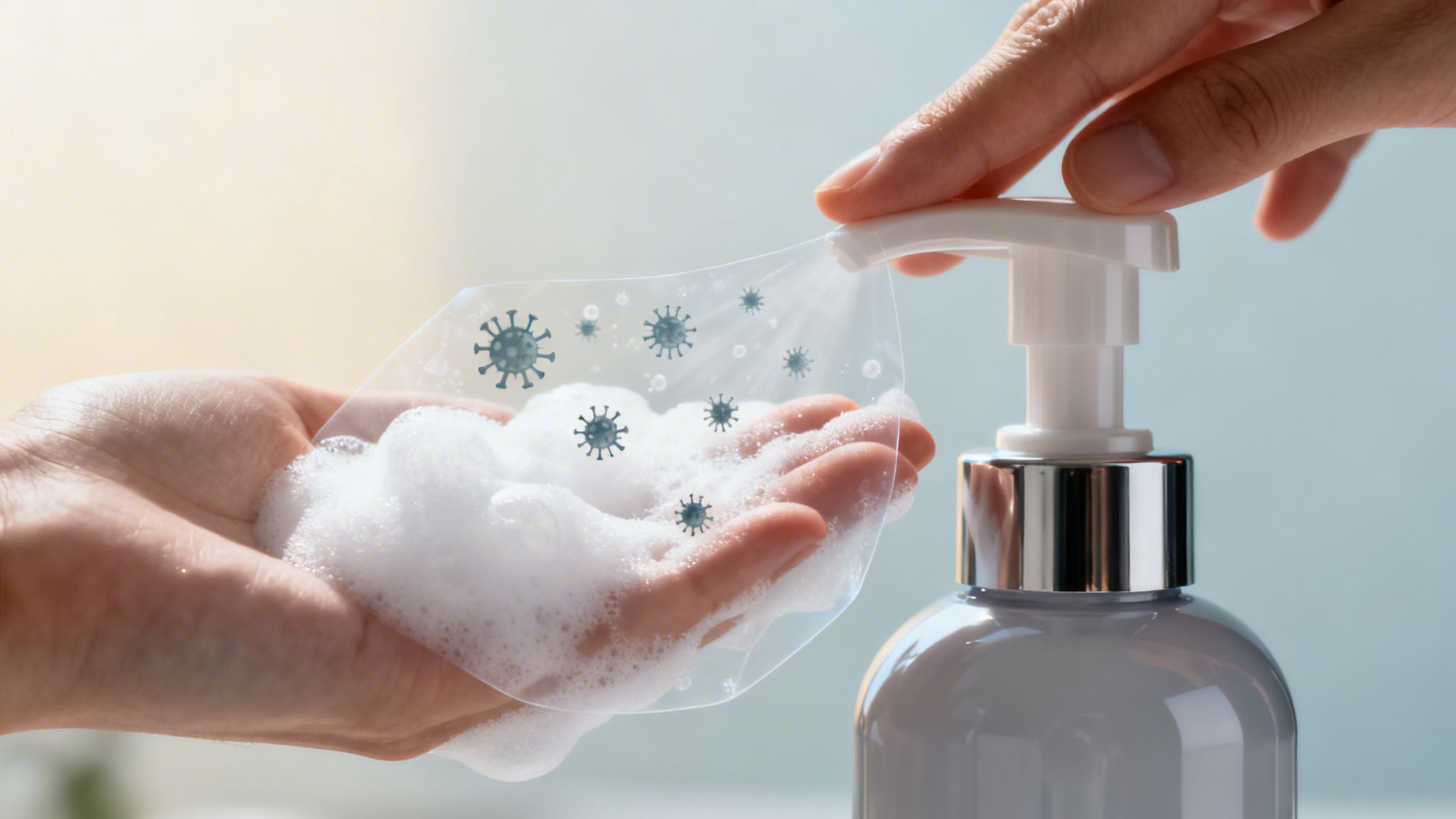
You’ve probably seen it everywhere—in hospitals, office buildings, and school hallways. That light, airy foam that seems to disappear into your hands almost instantly. But what exactly is it, and how does it keep us safe from viruses like Influenza or SARS-CoV-2?
Hand foam sanitizer is essentially a waterless hand antiseptic delivered as a mousse-like foam. Unlike traditional gels that can feel heavy or sticky, foam sanitizers use a special pump that mixes the liquid formula with air, creating a controlled dose that spreads easily and dries quickly.
What Is Hand Foam Sanitizer and How Does It Work?

The foam itself isn’t just for show. This aerated texture is a unique delivery system. It ensures the sanitizer doesn't drip or run off your hands, allowing for an even application that covers the entire surface of your skin, including under your nails and between your fingers.
The result is a clean, refreshed feeling without the sticky residue that often comes with gels. But the real magic is happening at a microscopic level, where the sanitizer is designed to inactivate specific types of viruses.
Let's take a quick look at the key features of hand foam sanitizer.
Hand Foam Sanitizer at a Glance
| Attribute | Description |
|---|---|
| Form | Aerated, mousse-like foam. |
| Primary Ingredient | Alcohol (typically 60% to 95% ethanol or isopropanol). |
| Mechanism | Alcohol dissolves the outer lipid layer of enveloped viruses. |
| Feel | Lightweight, non-sticky, and quick-drying. |
| Key Use Case | Rapid disinfection when soap and water are not available. |
This table provides a snapshot, but the science behind how it works is what really matters for effective hand hygiene.
The Science of Viral Inactivation
The powerhouse in most hand foam sanitizers is alcohol, usually ethanol or isopropanol. For a sanitizer to be effective against a broad range of germs, it needs an alcohol concentration between 60% and 95%.
Many of the viruses we worry about—like Influenza A (H1N1) and SARS-CoV-2 (the virus that causes COVID-19)—are what scientists call "enveloped viruses." Think of them as tiny, delicate packages wrapped in a fatty outer layer, or an "envelope." This lipid layer is essential for the virus to survive and infect human cells.
Alcohol works by acting as a solvent. It breaks down and dissolves this fatty envelope, causing the virus structure to collapse. In short, it dismantles the virus’s protective shell, rendering it harmless.
This mechanism is incredibly effective against a wide variety of enveloped viruses, including:
- Human Immunodeficiency Virus Type 1 (HIV-1)
- Influenza A2/305/57 Virus (H2N2)
- Hepatitis B Virus (HBV) and Hepatitis C Virus (HCV)
- Herpes Simplex Virus 1 (HSV-1) and Herpes Simplex Virus 2 (HSV-2)
Acknowledging Viral Challenges
However, not all viruses are built the same. Some are much tougher customers.
Non-enveloped viruses, like the notorious Norovirus and Human Rotavirus, don't have that fragile fatty envelope. Instead, they’re protected by a tough protein shell called a capsid. This makes them far more resistant to alcohol-based sanitizers.
While a high-concentration alcohol foam isn't useless, it’s significantly less reliable against these hardy pathogens. This is exactly why public health experts consistently say that washing with soap and water is the best defense during norovirus outbreaks—the physical friction of scrubbing literally removes the virus from your skin.
Some foam sanitizers use other active ingredients, like benzalkonium chloride. These formulations can be effective against certain bacteria and enveloped viruses, but their performance against tough non-enveloped viruses is often limited.
It's crucial to understand these distinctions for a complete hygiene plan. Hand sanitizer is an excellent tool for on-the-go situations, but it’s just one piece of the puzzle. It’s also important to remember that hand sanitizers are formulated for skin, not surfaces. To kill germs on countertops, doorknobs, or your phone, you need a product specifically designed for that job, like disinfecting wipes for hard, non-porous surfaces. This two-pronged approach—clean hands and clean surfaces—is the key to breaking the chain of transmission.
The Science Behind Killing Viruses with Foam

To see why hand foam sanitizer is such a powerful tool, we need to look at the invisible battle happening on your skin. Not all viruses are built the same. They generally fall into two categories based on their structure, and this difference is everything when it comes to killing them.
Think of it like a fight between an opponent in a delicate silk robe and another in a full suit of armor.
The first group is made up of enveloped viruses. These germs, like Influenza A (H1N1) and SARS-CoV-2, are wrapped in a fragile outer lipid (fatty) layer. This envelope is their greatest weakness—it's the key they use to enter and infect our cells, but it’s also easily destroyed.
Alcohol-based foam sanitizers are specialists at taking down this group. The alcohol acts as a solvent that instantly dissolves that fatty membrane, causing the virus to literally fall apart and become harmless. This is why alcohol-based products are so effective against many of the viruses we worry about most.
The Challenge of Enveloped Viruses
Viruses that depend on this lipid envelope are behind many well-known illnesses, and a good alcohol foam is a proven way to stop them.
- Influenza Viruses (H1N1, H2N2, H5N1): The flu virus's fatty coating is easily broken down by alcohol, which is why hand hygiene is a cornerstone of flu prevention.
- Coronaviruses (SARS-CoV-2, Human Coronavirus): Just like the flu, these viruses are enveloped, making them vulnerable to the effects of alcohol-based sanitizers.
- Hepatitis B Virus (HBV) and Hepatitis C Virus (HCV): These bloodborne pathogens are also enveloped, so an alcohol sanitizer can effectively inactivate them on hands.
- Herpes Simplex Viruses (HSV-1, HSV-2): These common viruses have a lipid envelope, leaving them exposed to alcohol's destructive action.
For a deeper dive into how different sanitizers work, check out our guide on whether hand sanitizer kills viruses. It gives you even more detail on this microscopic showdown.
This mechanism is incredibly effective, but it only works against viruses with this specific weak point. Other germs are a much tougher fight.
Facing the Non-Enveloped Opponents
The second group, non-enveloped viruses, are the "armored knights" of the viral world. Instead of a soft lipid layer, they are protected by a tough protein shell called a capsid. This structure makes them far more resistant to disinfectants, including alcohol.
A protein capsid is like a hardened shield, providing a strong defense against chemical attacks. Breaking it down requires more than just a solvent; it demands the right formulation and, critically, sufficient contact time.
Examples of these tough non-enveloped viruses include:
- Norovirus (Norwalk Virus): Famous for its resilience, Norovirus can survive for days on surfaces and is notoriously hard to kill with hand sanitizer alone.
- Human Rotavirus: A common cause of severe diarrhea in children, this virus has a rugged protein coat.
- Rhinovirus (Types 14 & 39): The main culprit behind the common cold, its resistance is why colds spread so easily.
- Feline Calicivirus: Often used in scientific studies as a stand-in for Norovirus due to its similar, hardy structure.
While alcohol-based hand foam can have some impact on these germs, it's not nearly as reliable. For these stubborn viruses, the simple act of washing your hands with soap and water is often the better choice. The friction helps physically scrub the germs off your skin and wash them down the drain.
This distinction brings up a critical point for any real-world hygiene plan. Your hands are just one stop for a virus. Tough non-enveloped viruses can linger on doorknobs, keyboards, and phones for days. Hand sanitizer is made for skin—it's not designed to disinfect your environment. For complete protection, you need to clean high-touch surfaces with a proven disinfecting wipes for hard, non-porous surfaces to eliminate pathogens before they ever get to your hands.
Choosing Your Tool: Foam vs. Gel vs. Soap
When it comes to hand hygiene, there’s no single "best" option. The right choice between hand foam sanitizer, gel, and good old-fashioned soap and water really depends on the situation—where you are, what you’re doing, and what kind of viral threats you’re up against.
Deciding what to use means looking at the pros and cons of each method. You have to consider how well they work against different viruses, how they feel on your skin after repeated use, and even how cost-effective they are for a busy workplace.
Getting this right is about building a smart hygiene strategy. It’s not about picking one tool and sticking to it forever. It's about knowing when to grab the foam, when the gel makes more sense, and when absolutely nothing beats a thorough hand wash.
A Head-to-Head Comparison
So, how do these three hygiene heavyweights actually stack up? Each one has its moment to shine, whether you’re a healthcare worker constantly on the move or just trying to avoid catching the flu.
| Feature | Hand Foam Sanitizer | Gel Sanitizer | Soap and Water |
|---|---|---|---|
| Effectiveness | Highly effective against enveloped viruses (e.g., Influenza, SARS-CoV-2). Less reliable for non-enveloped viruses. | Similar to foam; highly effective against enveloped viruses. Performance varies against non-enveloped viruses. | Gold standard. Physically removes all types of viruses, including tough non-enveloped ones like Norovirus. |
| Application | Controlled, no-drip pump. Spreads easily for full coverage and dries quickly. | Can be messy or drip. May require more effort to spread evenly before it dries. | Requires a sink and water source. The process takes longer (20 seconds of scrubbing). |
| Feel & Residue | Lightweight and airy. Typically leaves no sticky or tacky feeling on the hands. | Can feel thick or sticky. Sometimes leaves a residue that builds up with repeated use. | Leaves hands feeling clean, but can be drying to the skin without proper moisturization. |
| Best For | High-frequency use in fast-paced settings like hospitals, clinics, and offices where convenience is key. | General-purpose use and portability in personal-sized bottles. Widely available for consumers. | Visibly dirty or greasy hands, after using the restroom, and during known Norovirus outbreaks. |
What this shows is that foam’s biggest win is the user experience. The light, non-sticky feel is a game-changer in places where people need to clean their hands dozens of times a day.
Cost and Convenience in High-Traffic Areas
When you’re outfitting a school, office, or hospital, the economics of hand hygiene suddenly become a big deal. This is where hand foam sanitizer often makes a strong argument for being more cost-effective. The foaming pump aerates the liquid, so a single pump gives you a full dose of sanitizer while using less product than a pump of gel.
Over thousands of uses, those small savings add up. For a facilities manager, that means dispensers need refilling less often, which cuts down on both product and labor costs. Plus, the no-drip foam means less mess to clean up off the floor—a common headache with gel dispensers.
The global hand sanitizer market, valued at USD 6.13 billion in 2026, is a competitive space where foam is quickly gaining ground. While gels still hold about 50% of the market share, foam sanitizers are projected to grow faster, with an estimated CAGR of 7% from 2020 to 2034. That growth is being fueled by better economics in commercial settings and much happier users.
Making the Right Choice for the Right Task
The most important thing to remember is that these tools aren’t interchangeable—they're specialized. For visibly dirty hands or when you're dealing with tough non-enveloped viruses like Norovirus, soap and water are irreplaceable. The physical scrubbing and rinsing action is simply unmatched in those scenarios. You can dive deeper into this in our detailed article on how to use hand washing foam effectively.
Alcohol-based sanitizers, whether foam or gel, are built for one job: disinfecting already clean hands when you can’t get to a sink. The foam just happens to offer a better experience, which encourages people in busy environments to use it more often. Understanding how products like no-rinse foam cleansers fit into the picture can also help you choose the best tool for the job.
Finally, a critical reminder: hand sanitizers are for skin only. They aren't designed or tested for disinfecting surfaces. To clean your environment—like doorknobs, phones, or desks—you need to use products made for that purpose, like EPA-approved disinfecting wipes for hard, non-porous surfaces. A complete hygiene plan protects both you and the world around you.
How to Use Foam Sanitizer for Maximum Effect
Picking up a bottle of hand foam sanitizer is the easy part. But if you’re just giving your hands a quick, mindless rub, you’re not getting the protection you think you are. Using it correctly is what makes the difference between neutralizing viruses and just spreading them around.
Proper technique isn't just about a fast application. It’s about using the right amount, covering every single part of your hands, and giving the sanitizer enough time to actually work. Let's walk through how to do it right.
The Right Amount and Right Technique
First things first: the dose. Most foam dispensers are designed so that one full pump gives you the perfect amount for a pair of adult hands. You should have a good-sized mound of foam in your palm, not a tiny little puff.
Once you have the foam, follow these steps. This is the same method recommended by health authorities like the WHO and CDC for a reason—it works.
- Palm to Palm: Start by rubbing your hands together to spread the foam evenly.
- Back of Hands: Place one palm over the back of the other hand and rub, interlacing your fingers. Then switch.
- Between Fingers: Go back to palm-to-palm, but this time interlace your fingers and rub them together.
- Back of Fingers: Clasp your hands by interlocking your bent fingers and rub the backs of your fingers into the opposite palm.
- Thumbs: Grab your left thumb with your right hand and rub it in a circular motion. Repeat for your right thumb.
- Fingertips: Finally, rub the tips of your fingers in the palm of your opposite hand, moving in a circle. This step is crucial for getting under your nails.
This step-by-step process is designed to make sure you don't miss any spots, giving you total coverage.
The magic number here is 20 to 30 seconds. You need to keep rubbing until your hands are completely dry. If you wipe your hands on your pants or shake them dry, you’re stopping the disinfection process cold and leaving live viruses behind.
If you're ever unsure whether sanitizer is the right call in the first place, this decision tree is a great little guide.

As you can see, soap and water are your best bet for visibly dirty hands. Sanitizers are the convenient alternative for when your hands are already clean but need disinfecting.
Common Mistakes That Reduce Efficacy
Even with a top-notch product, a few simple mistakes can make it almost useless. This is especially true against tougher, non-enveloped viruses like Rhinovirus or Rotavirus, which need that full contact time to be inactivated.
Watch out for these common errors:
- Using Too Little Product: A tiny dab of foam just isn't enough. It won't cover your entire hand surface, leaving safe havens for viruses to survive.
- Wiping It Off Too Soon: The sanitizer has to stay wet on your skin for that full 20-30 seconds. Wiping it off early removes the active ingredient before it can finish its job.
- Missing Key Areas: It’s easy to miss spots. The most common culprits are the thumbs, fingertips, wrists, and the webs between your fingers. Be deliberate and thorough.
And remember, hand sanitizer is for one thing only: your hands. To kill viruses on surfaces like doorknobs, keyboards, or your phone, you need a product made for that job, like an EPA-registered disinfecting wipes for hard, non-porous surfaces. Using hand sanitizer on objects won't work and just wastes the product.
How to Read a Sanitizer Label (and What to Avoid)
Not all hand sanitizers are created equal. When you’re standing in the hygiene aisle staring at a wall of options, it’s easy to get overwhelmed. But learning how to decode the label on a hand foam sanitizer is the best way to make sure you’re getting a product that’s both safe and effective.
Forget the flashy marketing claims on the front of the bottle. The real story is on the back. Flip it over and head straight for the ingredients list—that’s where you’ll find out what’s actually inside.
What to Look For on the Label
A good foam sanitizer does more than just kill viruses; it also takes care of your skin. That’s why you’ll often see emollients like glycerin or aloe vera in the formula. These ingredients help counteract the drying effects of alcohol.
This is especially important for anyone who sanitizes their hands frequently, like teachers or healthcare workers. Using a harsh, drying sanitizer over and over can lead to cracked skin, which ironically makes it easier for viruses and bacteria to enter.
If you have sensitive skin, look for formulas that skip common irritants. Some people find that products like a Sulfate Free Unscented Foam Cleanser for Sensitive Skin are gentler on their hands. A well-made hand foam sanitizer should strike a balance between viral inactivation and ingredients that keep your skin healthy.
You’ll also see alcohol-free options on the shelf, which typically use benzalkonium chloride as the active ingredient. While these can work against some bacteria and enveloped viruses, they often fall short against tougher non-enveloped viruses like Norovirus when compared to alcohol-based foams.
Understanding Regulatory Standards
Thankfully, you don’t have to figure this all out on your own. Regulatory bodies like the U.S. Food and Drug Administration (FDA) set the rules for hand sanitizer safety and effectiveness.
For alcohol-based sanitizers, the FDA recommends a concentration of 60% to 95% ethanol to be effective against a wide range of germs. We dive deeper into why this is the gold standard in our guide on why you need a hand sanitizer with at least 60% alcohol.
One of the biggest safety red flags the FDA warns about is methanol (wood alcohol). This stuff is toxic if it’s absorbed through your skin or ingested, and it should never be in a hand sanitizer. If you’re ever unsure about a product, check the FDA's "do-not-use" list.
By knowing what to look for—and what to run from—you can choose a hand foam that keeps you safe without wrecking your skin. It also reminds us of a simple rule: use the right tool for the job. Sanitizer is for your hands, but you’ll still need dedicated disinfecting wipes for hard, non-porous surfaces to clean the high-touch surfaces around you.
Got a question about foam sanitizer? You're not alone. When you’re trying to keep your hands clean and avoid viruses, it’s only natural to wonder if you’re using the right product in the right way. Let's clear up a few of the most common questions people ask.
Is Foam Hand Sanitizer Effective Against Norovirus?
This is a fantastic question because it gets right to the heart of how different viruses work. Norovirus—the notorious "stomach flu" bug—is what’s called a non-enveloped virus. Think of it like a tiny, tough nut without a fragile outer shell. This makes it incredibly resilient, far tougher to crack than enveloped viruses like the flu or coronaviruses.
While a foam sanitizer with at least 70% alcohol can have some effect, it's not the best tool for the job. If it's your only option, you have to be incredibly thorough, using enough product to keep your hands wet for the full contact time listed on the bottle. But honestly? The CDC is clear on this one: your number one weapon against norovirus is washing your hands with good old soap and water.
And a quick but important side note: never use hand sanitizer on surfaces to try and kill norovirus. It’s not a disinfectant. You’ll need to use a proper disinfecting wipes for hard, non-porous surfaces that’s specifically rated to kill norovirus.
Can I Use Foam Sanitizer on My Phone or Keyboard?
Definitely not. It's easy to think "it kills viruses on my hands, so it should kill viruses on my phone," but it's a bad idea. Hand sanitizer is formulated specifically for skin. It contains extra ingredients like moisturizers and softeners that feel great on your hands but will leave a sticky, gummy film on your electronics.
That residue doesn't just look bad; it attracts dust and grime, and it can even damage the sensitive coatings on your screens or the finish on your keyboard. For high-touch surfaces like phones, doorknobs, and keyboards, stick to products made for the task, like EPA-approved disinfecting wipes for hard, non-porous surfaces designed for hard surfaces.
Does Hand Foam Sanitizer Expire?
It sure does. Like a carton of milk or a bottle of vitamins, hand sanitizer has a shelf life. You’ll typically find an expiration date printed on the bottle, usually about two to three years from the date it was made.
The reason is simple: the active ingredient, most often alcohol, is volatile. Over time, especially after a bottle is opened, the alcohol slowly evaporates. As the alcohol content drops, so does the sanitizer's power to kill viruses.
The hand sanitizer market's trajectory was profoundly shaped by the COVID-19 pandemic, creating unprecedented demand that altered consumer behaviors. The global hand sanitizer market was valued at USD 7.43 billion in 2025 and is projected to reach USD 11.1 billion by 2036, driven by sustained hygiene awareness. Read more about the hand sanitizer market's evolution and future projections.
Using an expired sanitizer is like fighting a fire with a leaky hose—you're just not getting the protection you think you are. Always give the bottle a quick check for the date, and help it last by storing it out of direct sunlight and away from extreme heat.
Leave a Reply