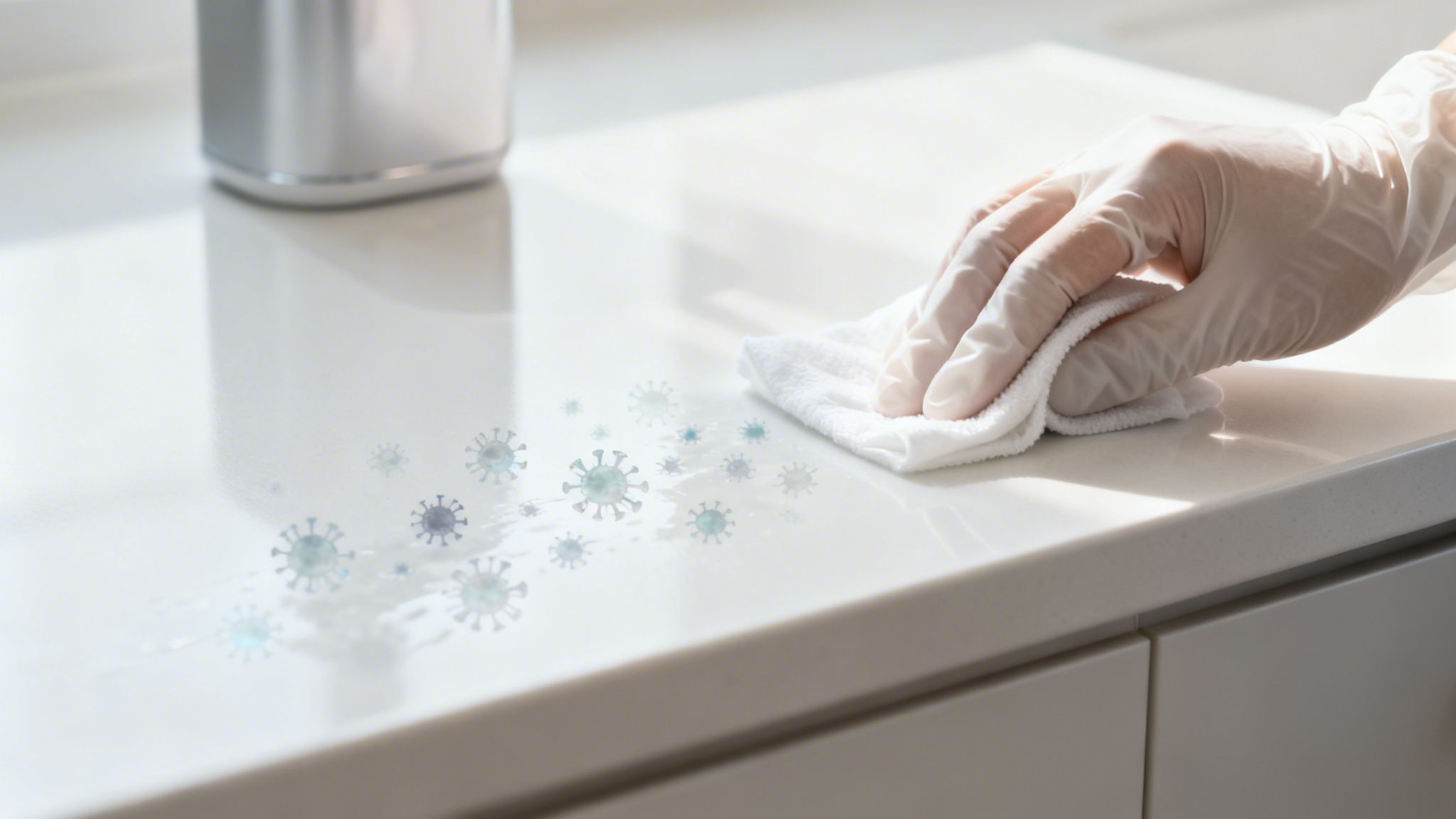
When you grab a canister of Clorox wipes, you’re probably thinking about cleaning up a mess. But if the label says “germicidal,” you’re holding something far more powerful than a simple cleaning tool. These wipes are designed to do one thing exceptionally well: kill microscopic threats like viruses and bacteria on surfaces.
The term "germicidal" isn't just marketing—it's a scientific benchmark. It means the product contains active ingredients registered with the Environmental Protection Agency (EPA) to destroy pathogens, going way beyond just wiping away dirt. Understanding how to use these wipes effectively is a critical step in preventing the transmission of viruses like Human Immunodeficiency Virus (HIV-1), Influenza, Hepatitis B (HBV), and SARS-CoV-2.
What Makes Clorox Wipes Germicidal?

So, what really sets a germicidal wipe apart? Think of it like this: a regular cleaning wipe is like a dust mop, great for physically picking up dirt and some germs. But a germicidal Clorox wipe is a specialized tool, designed to chemically dismantle and eliminate the pathogens you can't even see.
This is a critical distinction. Germicidal products don't just push germs around. They are formulated to inactivate viruses and bacteria on contact, which is what separates a true disinfectant from a standard cleaner.
The Power of Disinfection
The main job of these wipes is to disinfect hard, nonporous surfaces. Disinfection is a much higher bar to clear than just sanitizing. While sanitizing lowers the number of germs to a safe level, disinfection aims to destroy or permanently inactivate nearly all of them.
When you use a germicidal wipe correctly, you’re not just cleaning a sticky spot on the counter. You’re applying a solution proven to be effective against tough-to-kill viruses and bacteria, including:
- Influenza A Virus (H1N1)
- SARS-Related Coronavirus 2 (SARS-CoV-2) (the virus that causes COVID-19)
- Human Coronavirus
- Herpes Simplex Virus 1 & 2 (HSV-1, HSV-2)
- Hepatitis B Virus (HBV) & Hepatitis C Virus (HCV)
The demand for this level of protection is undeniable. The global market for disinfecting wipes was valued at US$ 6.7 billion in 2023 and is on track to nearly double by 2033. This surge reflects a growing public understanding of the need for fast, reliable disinfection.
A common question is whether these powerful wipes use bleach. While Clorox is famous for its bleach products, many popular germicidal wipes rely on other active ingredients. You can learn more about which Clorox wipes contain bleach in our detailed guide.
Cleaning vs. Disinfecting
Getting the difference between cleaning and disinfecting right is the first step to preventing the spread of viruses. One removes grime, the other neutralizes threats.
Here's a simple breakdown of how they compare.
Germicidal Wipes vs. Cleaning Wipes At a Glance
| Feature | Germicidal Clorox Wipes | Standard Cleaning Wipes |
|---|---|---|
| Primary Goal | To kill viruses and bacteria | To remove dirt, dust, and grime |
| Active Agents | EPA-registered disinfectants | Soaps or detergents |
| Outcome | A disinfected surface | A visually clean surface |
| Mechanism | Chemically inactivates pathogens | Physically lifts and removes debris |
As the table shows, their jobs are fundamentally different. Cleaning is about appearance, while disinfecting is about health and safety.
Ultimately, germicidal Clorox wipes are a key part of any serious hygiene plan. Their formula provides a reliable way to target and eliminate specific pathogens from the high-touch surfaces in your home, school, or office—breaking a critical link in the chain of transmission.
How Germicidal Wipes Actually Destroy Viruses

When you pull a disinfecting wipe from its container, you’re holding more than just a wet towelette. You're unleashing a chemical demolition crew designed to take apart viruses at a microscopic level. It’s a fast and effective process, but how does it actually work?
The power is packed into the active ingredients. Many germicidal Clorox wipes get their cleaning muscle from a class of chemicals called quaternary ammonium compounds, or "quats" for short. These molecules are the workhorses doing the heavy lifting.
To really get it, you have to know a little about what viruses look like. Many of the ones that make us sick—like Influenza, SARS-CoV-2, or HIV-1—are what scientists call enveloped viruses. This means their genetic core is wrapped in a delicate outer layer made of lipids, which is basically a fatty membrane.
The Quat Demolition Crew
Think of that fatty envelope as the virus’s Achilles' heel. Quats are perfectly designed to attack it. Each quat molecule has a positively charged head that's drawn to the negatively charged surface of a virus.
Once attached, the molecule’s long, fatty tail goes to work. It pierces the virus's outer membrane, breaking it apart and exposing the fragile machinery inside.
This process works a lot like how soap cuts through grease on a dirty pan. The quats in the wipe dissolve the virus’s protective envelope, causing it to fall apart. Once that happens, the virus is completely neutralized and can no longer infect you.
This destructive action is what makes a product truly germicidal—it's not just moving germs around, it's actively destroying them. For a deeper dive, our guide explains what makes a product germicidal and why that distinction is critical for true disinfection.
Why This Mechanism Matters for Different Viruses
Not all viruses are created equal, and this chemical attack works differently depending on the target.
- Enveloped Viruses: Pathogens like Influenza A (H1N1), SARS-CoV-2, and Herpes Simplex Virus (HSV-1, HSV-2) are sitting ducks. Their soft, fatty envelopes are easily dismantled by the quats in most germicidal wipes. This group also includes more complex viruses like Hepatitis B (HBV), Hepatitis C (HCV), and even Human Immunodeficiency Virus (HIV-1).
- Non-Enveloped Viruses: On the other hand, viruses like Norovirus and Rhinovirus are much tougher opponents. They lack that vulnerable outer layer and instead have a hard, protein-based shell (capsid), making them more resilient and harder to kill. This category includes viruses like Human Rotavirus and Feline Calicivirus.
This is exactly why reading the product label is so important. A wipe might kill the flu virus in just 15 seconds, but it could take several minutes of contact time to be effective against a hardy bug like Norovirus, which can survive on surfaces for up to two weeks.
EPA Registration: The Stamp of Approval
You don't have to guess if a product works. In the United States, any disinfectant claiming to kill viruses must be registered with the Environmental Protection Agency (EPA).
Before germicidal Clorox wipes can hit store shelves with claims that they kill specific germs, the manufacturer has to prove it with hard science. They submit extensive data showing the product effectively kills every single virus listed on its label, from common culprits like Rhinovirus Type 39 to serious public health threats like Avian Influenza Virus (H5N1).
That EPA registration number on the package is your guarantee that the claims are backed by rigorous, independent testing. It confirms the product works as advertised against everything from the common cold to serious threats like SARS-CoV-2—but only when you follow the directions. Adhering to the label's instructions is what turns a simple wipe into a powerful tool for keeping your environment safe.
Why the Timer on Your Disinfectant Wipe Matters
Think using a disinfecting wipe is as simple as a quick swipe and toss? Think again. True disinfection isn't about speed; it's a science of timing. To get the full power out of your germicidal Clorox wipes, you have to look at the label like a pro, focusing on two key details: the specific viruses it kills and the all-important contact time.
Contact time is the non-negotiable window a surface must stay visibly wet to actually kill a pathogen. If you just wipe and let it dry instantly, you're not getting the job done. The active ingredients need that time to get to work, breaking down and neutralizing viruses.
This is the detail that separates simple cleaning from true disinfection. If you don't hit that required contact time, you might just be moving germs around, leaving active viruses behind and completely defeating the purpose of using a germicidal wipe.
Why Different Viruses Have Different Kill Times
Not all viruses are created equal. Their structures vary, and that means the time it takes to destroy them varies, too. Some viruses, like SARS-CoV-2, have a delicate outer "envelope" that's easily torn apart by disinfectants. Others, like the notoriously rugged Norovirus, are protected by a tough protein shell that needs a much longer chemical attack.
This is exactly why you'll see a whole range of kill times on a product's label. It’s a direct reflection of how resilient a specific virus is.
- Enveloped Viruses: Viruses like Influenza A (including strains like H1N1 and H2N2), Human Coronavirus, and SARS-CoV-2 are wrapped in a fatty lipid layer. This outer layer is a major weak point, making them highly vulnerable to disinfectants. Contact times for these are often very short—sometimes as little as 15 seconds.
- Non-Enveloped Viruses: Viruses like Norovirus or Rhinovirus don't have this fragile envelope. Their tough protein shell acts like armor, making them much harder to kill and forcing the surface to stay wet for several minutes. This group includes both large non-enveloped viruses like Human Rotavirus and small non-enveloped viruses like Feline Calicivirus.
It's no surprise that the market for effective surface disinfectants has exploded, reflecting a sharp rise in public awareness. The global surface disinfectant wipes market hit a value of USD 5,832.5 million in 2026, and North America accounted for over 30% of that share. Projections show that number will keep climbing, driven by concerns over viruses that cause healthcare-associated infections (HAIs)—which the CDC estimates impact about 1 in 31 U.S. hospital patients. In this environment, brands are making sure to highlight their EPA-registered wipes proven to work against viruses like coronavirus. You can explore more data on the disinfectant wipes market to see these trends for yourself.
Virus Kill Times for Germicidal Clorox Wipes
To make sure your wipes are working with precision, you need to know the specific contact times for the germs you're trying to eliminate.
The table below breaks down the EPA-registered kill times for common viruses for a popular germicidal Clorox wipe formula. But remember to always check your specific product's label, as these times can differ between wipe types.
| Virus Type | Common Name / Associated Illness | Required Contact Time |
|---|---|---|
| SARS-CoV-2 | COVID-19 | 15 Seconds |
| Influenza A Virus (H1N1) | Swine Flu | 15 Seconds |
| Human Coronavirus | Common Cold | 30 Seconds |
| Rhinovirus Type 14 & 39 | Common Cold | 1 Minute |
| Herpes Simplex Virus 1 & 2 (HSV-1, HSV-2) | Cold Sores, Genital Herpes | 1 Minute |
| Human Rotavirus | Gastroenteritis (Stomach Flu) | 2 Minutes |
| Norovirus (Feline Calicivirus surrogate) | Gastroenteritis (Stomach Flu) | 4 Minutes |
This data reveals something crucial: killing the common cold virus (Rhinovirus) can take four times longer than killing SARS-CoV-2. A "one-wipe-fits-all" approach simply doesn't guarantee you're actually disinfecting.
When you understand these timelines, you can confidently move beyond just cleaning. It's a good reminder of just how long viruses can stick around, a topic we dive into in our guide on how long viruses live on surfaces. By using enough wipes to keep a high-touch spot like a doorknob or light switch wet for the full time, you’re ensuring the "demolition crew" of active ingredients has enough time to do its job and break the chain of transmission.
A Practical Guide to Effective Disinfection
So, we've covered the science. Now, let's get practical. How do you actually use these wipes to get the job done right? Just swiping a Clorox wipe across a countertop and calling it a day isn't enough to kill serious pathogens like Human Coronavirus, Influenza, or SARS-CoV-2.
To truly disinfect, you need a method. This isn't just about cleaning; it's about turning a simple wipe into a powerful tool for public health.
The most important rule? Clean first, then disinfect. Think of it like trying to paint a dirty wall—the paint won't stick properly. Disinfectants work the same way. They can't kill germs they can't reach.
The Essential First Step: Cleaning
Dirt, crumbs, grease, and other grime create a physical shield that protects viruses and bacteria from the active ingredients in your wipe. Before you even think about disinfecting, you have to get rid of that mess.
Grab a cloth with soap and water or an all-purpose cleaner and wipe the surface down. This first pass removes the gunk, clearing the battlefield so the disinfectant can make direct contact with the microscopic enemies you’re targeting. This step is non-negotiable for messy areas, like kitchen counters after dinner or bathroom sinks.
This simple, three-step process is the key to real disinfection.

As you can see, it’s about more than just a quick wipe. It’s about cleaning first and respecting that all-important contact time.
Proper Wiping Technique and Contact Time
Once the surface is clean, it's time to pull out the germicidal wipe. But how you wipe is just as critical as the wipe itself. Wiping haphazardly can just smear germs around.
- Follow the 'S' Pattern: Start at one edge of the surface and wipe in a continuous "S" motion until you reach the other side. This simple technique prevents you from dragging germs back over an area you've already disinfected.
- Use Enough Wipes: A single wipe won't cut it for a big surface like a dining table. Your goal is to get the surface visibly wet and keep it that way for the entire contact time. If the wipe starts to feel dry, grab a new one.
- Let It Air Dry: This is the most-missed step. Do not dry the surface with a towel. The magic happens while the surface is wet. Allowing the disinfectant to air dry ensures it works for the full required time—from 15 seconds for SARS-CoV-2 up to 4 minutes for a tough bug like Norovirus.
Proper technique is what separates a surface that looks clean from one that is microbiologically clean. Following a deliberate pattern and letting the surface air dry are what make disinfection truly effective.
A solid disinfection routine is one piece of the puzzle. To create a truly hygienic kitchen, it's also worth learning how to prevent cross-contamination in the first place.
Safety and Storage Protocols
Using germicidal Clorox wipes is straightforward, but a few safety rules are key. Always wash your hands thoroughly with soap and water after you’re done. These are chemical products and aren't meant for your skin.
To keep your wipes effective, always snap the lid shut tightly after each use. If they dry out, they lose their germ-killing power.
Since the pandemic, disinfecting wipes have become a household staple. Market data predicts sales will continue to grow by 6% annually, with 70-80% of homes now keeping them on hand. With so many of us using these products daily, knowing how to use them correctly has never been more important for both safety and effectiveness.
Common Myths and Limitations of Disinfecting Wipes
As useful as germicidal Clorox wipes are, they aren’t a magic bullet. To get the most out of them, you need to understand their limits just as much as how to use them. Let's clear up some common mistakes to make sure you're disinfecting effectively and not just getting a false sense of security.
One of the biggest errors we see is people trying to disinfect a huge area, like an entire kitchen counter, with a single wipe. Wipes only hold so much disinfectant solution. Once it starts to feel dry or gets visibly dirty, it stops killing germs and can actually start spreading them around.
Myth: One Wipe is Enough for Everything
A single wipe is designed for a small, specific area. The goal is to get the surface visibly wet and make sure it stays wet for the entire contact time listed on the label. If you're cleaning a large countertop or a tabletop, you're going to need more than one wipe.
Think of it like trying to paint a wall with a small art brush dipped in paint only once. You just won't have enough paint to cover the surface. The same exact principle applies here—you need enough disinfectant liquid to fully saturate the area to kill pathogens.
Wipes Are Not a Substitute for Handwashing
This is a critical point that often gets missed. Disinfecting wipes are made for hard, nonporous surfaces. That's it. They should never be used on your skin or as a stand-in for hand sanitizer or washing your hands.
The chemicals in germicidal Clorox wipes are formulated to destroy tough pathogens on objects, not for use on your body. Using them on your skin can lead to significant irritation or other adverse reactions.
The single most effective way to clean your hands and get rid of viruses like Influenza A (H1N1) or SARS-CoV-2 is by washing with soap and water for at least 20 seconds. Nothing replaces this fundamental hygiene practice.
Surfaces Where Wipes Fall Short
Another major limitation is the surface you’re trying to clean. Germicidal wipes are only proven to work on hard, nonporous materials. They are the wrong tool for the job on many common surfaces.
- Porous Surfaces: Wipes are not designed for fabrics, carpets, untreated wood, or clothing. These materials soak up the disinfectant before it has a chance to work, and their uneven textures give germs plenty of places to hide.
- Dirty Surfaces: As we've covered, disinfectants can't work through a layer of dirt and grime. Wipes are far less effective on visibly soiled surfaces because the dirt acts like a shield, protecting the germs underneath.
- Specialized Microbes: While chemical wipes are incredibly powerful, a well-rounded hygiene strategy might also involve looking into natural mould killer options for specific kinds of microbial growth on certain surfaces.
Here's another way to think about it: you can’t effectively clean a sponge with a wipe. The very nature of the sponge—its porosity—makes it impossible to reach every nook and cranny where microbes thrive. The same logic applies to fabrics and unfinished wood.
Understanding the Role of Germicidal Wipes
It’s best to see germicidal Clorox wipes as one key player on a bigger hygiene team, not the entire solution. They are a powerful partner to other essential practices, but they can't do it all.
What Wipes Do Well:
- Quickly disinfecting high-touch, nonporous surfaces like doorknobs, light switches, and faucets.
- Conveniently disinfecting items like remote controls, phones, and office equipment (always follow the device manufacturer's guidelines).
- Breaking the chain of transmission for specific viruses and bacteria when used with the correct contact time.
What Wipes Don't Do:
- Replace proper handwashing.
- Clean large or heavily soiled areas.
- Disinfect porous surfaces like upholstery or wood.
- Sterilize surfaces (sterilization is a separate, more absolute process that eliminates all microbial life).
By understanding both the strengths and weaknesses of disinfecting wipes, you can use them more intelligently. They are an essential tool for targeted disinfection, helping protect against the spread of germs when applied correctly and as part of a complete cleaning strategy.
Your Questions About Germicidal Clorox Wipes, Answered
Even when you know the science behind germicidal Clorox wipes, practical, real-world questions always pop up. Here are some of the most common queries we get, with straightforward answers to help you use these tools correctly and safely.
Can I Use Germicidal Clorox Wipes on My Phone or Laptop?
Yes, but you have to be smart about it. Your phone and laptop are high-touch surfaces crawling with germs, so disinfecting them is a good idea. The trick is to avoid moisture damage.
The hard, nonporous surfaces of most electronics are fine to wipe down, according to The Clorox Company. Just be careful.
- Power it down. Always turn your device completely off before you start.
- Squeeze the wipe. Wring out any extra liquid until the wipe is just damp, not soaking wet.
- Wipe gently. Clean the screen, keyboard, and casing, but stay far away from ports, speakers, or any other openings. Never saturate a device.
- Let it air dry. The surface needs to stay wet for the required contact time to kill germs. Wait until it's completely dry before powering it back on.
Before you do anything, it's always a good idea to check your device manufacturer’s cleaning guidelines. Some have specific recommendations.
Are Wipes Safe for Food-Preparation Areas?
You can use them on kitchen counters, but there’s a non-negotiable final step: you must rinse the surface with water afterward.
These wipes are EPA-registered as disinfectants, not as sanitizers specifically cleared for food-contact surfaces. This means after you’ve wiped down your sealed granite, laminate, or stainless-steel counter and let it air dry for the full contact time, you need to rinse away any chemical residue.
Just grab a clean cloth, wet it with fresh water, and wipe down the entire area you just disinfected. This ensures the surface is ready for food prep. Skipping this step could mean transferring disinfectant chemicals to your food.
What Is the Difference Between Disinfecting and Sanitizing?
People often use these terms interchangeably, but they mean very different things according to the EPA. Knowing the difference helps you pick the right tool for the job.
Sanitizing reduces the number of bacteria on a surface to a safe level, as defined by public health standards. This process typically cuts down bacteria by 99.9%.
Disinfecting is a much more powerful process. It’s designed to kill or completely inactivate nearly 100% of the specific viruses, bacteria, and fungi listed on the product’s label.
Germicidal Clorox wipes are true disinfectants. They’ve been put through rigorous testing to prove they can eliminate tough pathogens like Influenza A, SARS-CoV-2, and Norovirus, giving you a higher level of protection on hard, nonporous surfaces.
Should I Wear Gloves When Using Disinfecting Wipes?
We strongly recommend it. The active ingredients that are so tough on germs—like quaternary ammonium compounds—are not meant for your skin.
Repeated contact can lead to dryness, irritation, or even an allergic reaction. A simple pair of gloves creates a necessary barrier. When you’re done cleaning, take off the gloves and give your hands a good wash with soap and water.
How Long Does a Canister of Wipes Last Once Opened?
Most canisters of germicidal Clorox wipes have a shelf life of about one year. But once you crack that seal, their longevity is all about storage.
The most important thing you can do is keep the canister sealed tight. If the lid is left open, the disinfectant solution will evaporate, and the wipes will dry out. A dry wipe is a useless wipe—it has zero germ-killing ability.
Always snap the lid shut firmly after you grab a wipe. As long as you do that, the wipes should stay moist and effective right down to the very last one.
Can I Flush Germicidal Wipes Down the Toilet?
Absolutely not. These wipes are not like toilet paper or wipes specifically marked as "flushable." They’re made of tough, synthetic fibers that simply do not break down in water.
Flushing disinfecting wipes is a guaranteed way to cause clogs in your home’s plumbing. Worse, they contribute to massive blockages in municipal sewer systems known as "fatbergs," which are a nightmare to remove.
Always, always throw used wipes in the trash. It’s a simple step that protects your pipes and your community's infrastructure.
Leave a Reply