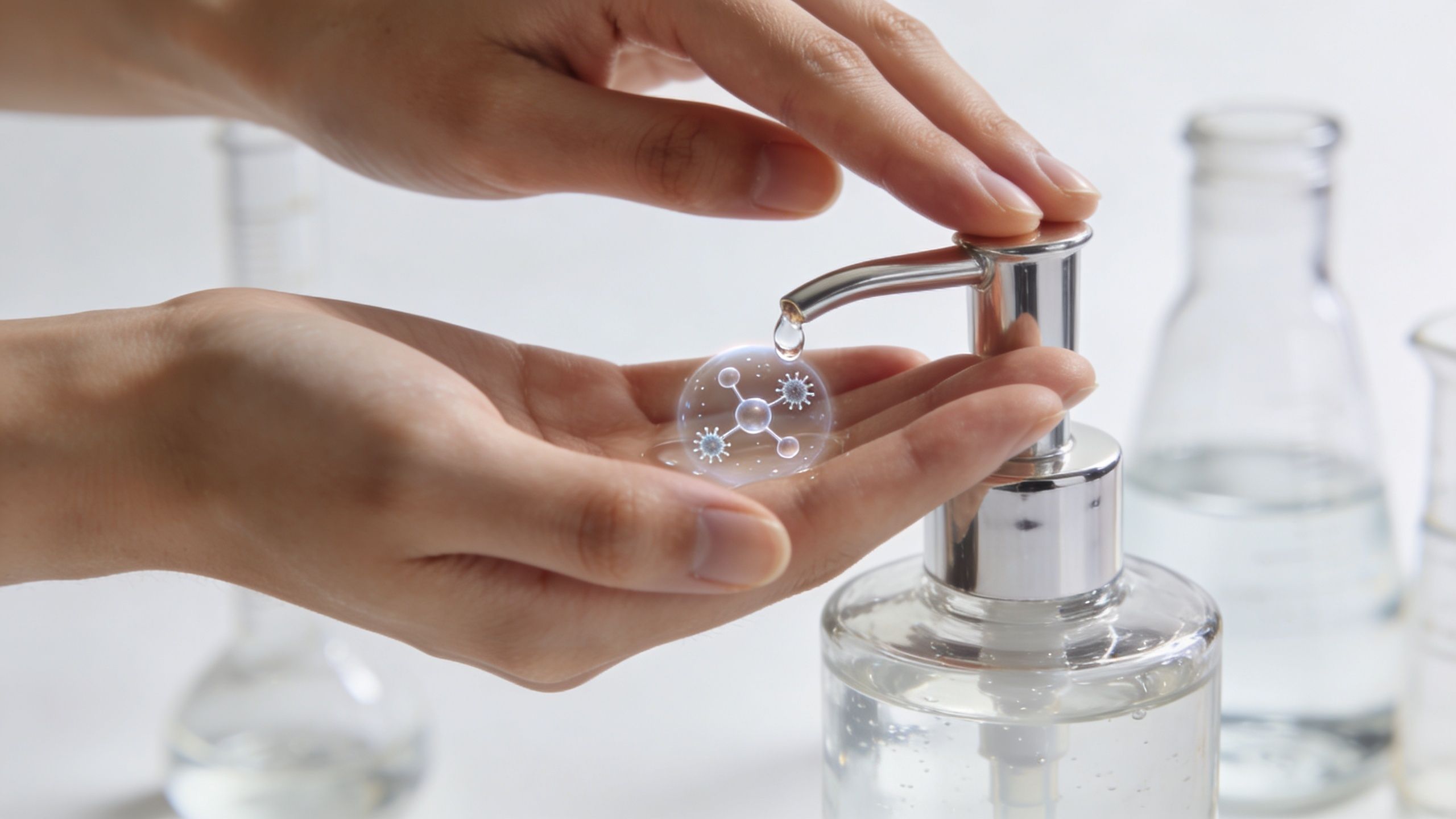
In busy public spaces, hand sanitiser has become ordinary enough to disappear into the background. Yet the market behind that small bottle is large. Analysts at Precedence Research estimate the global hand sanitizer market at billions of dollars and project continued growth over the next decade. Those figures reflect more than shopping habits. They show how strongly fast hand hygiene is now built into daily life in homes, schools, clinics, transport hubs, and workplaces.
That popularity can also create confusion.
Hand sanitiser alcohol gel has a specific job. It reduces many germs on your hands when soap and water are not available. It does not replace cleaning visibly dirty hands, and it does not do the separate job of disinfecting desks, phones, door handles, or kitchen counters. Public health guidance from the WHO and CDC draws that line clearly, and it is one of the most useful distinctions to understand if you want a practical guide to stopping the spread of germs.
A helpful way to frame it is to treat hand gel as one link in a chain. Hand hygiene, respiratory habits, staying home when sick, and cleaning high-touch surfaces each cover a different route germs use to spread. Alcohol gel can interrupt one route well. It cannot cover all of them.
Used with that in mind, sanitiser becomes much more than a convenience product. It becomes a precise tool, used in the right place, for the right purpose.
The Role of Hand Sanitiser in Modern Hygiene

The CDC recommends alcohol-based hand sanitiser with at least 60% alcohol when soap and water are not available. That single threshold helps explain why small dispensers became common in hospitals, schools, airports, shops, and offices. They solve a simple public health problem. People touch shared surfaces constantly, but a sink is often several steps away.
That convenience has a clear role, but it also has clear limits.
Hand sanitiser alcohol gel is designed for skin. Its job is to reduce many germs on your hands between handwashing opportunities. It does not clean dirt off your hands, and it does not do the separate job of disinfecting desks, phones, counters, or door handles. That distinction is easy to miss because the same bottle often sits near high-touch surfaces. Public health guidance from the WHO and CDC keeps the boundary clear. Hand sanitiser is for hands. Surface products are for surfaces, including situations that call for effective superbug disinfection.
Gel became the default format for practical reasons. It is easy to dispense, easy to spread across the hands, and familiar enough that people will often use it without much prompting. In shared settings, that matters. A hygiene step only helps if people do it.
The best way to place sanitiser in modern hygiene is to see it as one tool in a wider system. A seat belt comparison works well here. Wearing a seat belt reduces one kind of risk, but it does not replace brakes, traffic lights, or safe driving. In the same way, alcohol gel helps interrupt transmission from contaminated hands, while respiratory etiquette, staying home when ill, and cleaning high-touch surfaces address other routes germs use to spread. If you want a fuller routine, this guide on how to stop spreading germs puts hand hygiene into that larger picture.
Practical rule: Use hand sanitiser when your hands are not visibly dirty and soap and water are not readily available. Use cleaning and disinfection products for the objects and surfaces around you.
Used that way, hand sanitiser stops being a catch-all hygiene symbol and becomes something more useful. It is a fast, evidence-based tool for your hands, and only your hands.
How Alcohol Gels Inactivate Viruses and Bacteria

At the microscopic level, alcohol doesn't "wash away" germs the way water helps remove dirt. It chemically damages key parts of many microbes.
The simplest mental model is a demolition crew. Many viruses and bacteria depend on intact structures to stay infectious. Alcohol attacks those structures. It unravels proteins and, for many viruses, disrupts the outer fatty coating they need to infect cells.
The demolition crew analogy
A protein works because it has a precise shape. Change that shape and the protein can stop working, much like bending a key until it no longer fits the lock. This process is called protein denaturation.
Alcohol also disrupts lipid membranes. For enveloped viruses such as coronaviruses, that outer layer is like the walls of a house. Damage the walls badly enough and the virus can't function properly.
The CDC states that alcohol-based hand sanitizers need 60% to 95% alcohol to effectively kill germs, and this range is critical for inactivating enveloped viruses like coronaviruses. The same CDC summary notes that sanitizers in this range can achieve 4 to 6 log reductions in bacterial and fungal species within 15 to 30 seconds, while products below 60% alcohol may fail against many pathogens, as outlined in the CDC's hand sanitizer facts and stats.
Why some viruses are easier targets
Not all viruses are built the same way. Enveloped viruses have that vulnerable outer lipid layer. Some other viruses don't. Their outer shell is tougher and gives alcohol fewer weak points to exploit.
That is why people sometimes overestimate what hand sanitiser alcohol gel can do. It's highly useful, but it isn't equally powerful against every pathogen in every setting.
A good way to think about it is this:
- Enveloped viruses: Often more vulnerable because alcohol can damage the outer membrane.
- Many bacteria and fungi: Often reduced effectively when the formula is in the proper alcohol range.
- Some non-enveloped viruses: Harder to inactivate, so you need to be more cautious about assuming protection.
For readers trying to match virus type to hygiene strategy, this explainer on whether hand sanitizer kills viruses helps sort out the differences.
Surface contamination creates a separate problem from contaminated hands. For shared objects and high-touch environments, a dedicated guide to effective superbug disinfection is useful because hand gel isn't designed to disinfect phones, desks, rails, or bathroom fixtures.
Choosing an Effective Hand Sanitiser Gel

Standing in front of a shelf full of hand gels, shoppers frequently examine scent, bottle size, or whether the label indicates "moisturising." The most important detail is much less glamorous. Check the active ingredient and its concentration.
The key names to look for are ethanol and isopropyl alcohol. Labels may also use terms such as ethyl alcohol or IPA. These are the ingredients doing the germ-killing work.
What to look for on the label
Use this short checklist:
- Alcohol type: Look for ethanol or isopropyl alcohol as the active ingredient.
- Alcohol concentration: Choose a product in the 60% to 95% range.
- Clear ingredient list: Avoid products that make bold claims but make the active ingredient hard to identify.
- Intended use: Make sure it's a hand sanitiser, not a cosmetic gel with fragrance taking center stage.
People often ask whether higher is always better. Not necessarily. More alcohol doesn't automatically mean better performance in real use. The product still needs enough water to support protein denaturation, and it needs to stay on the skin long enough to work.
Why people talk about 70 percent
In everyday discussions, you'll often hear that 70% is a "sweet spot." That's a reasonable practical shorthand because it sits comfortably within the effective range and balances potency with usable contact time. What's most important for a buyer, though, is not chasing a magic number. It's avoiding products that fall below the effective threshold.
If the label doesn't clearly tell you the alcohol type and concentration, treat that as a warning sign, not a minor omission.
A few label details can distract from the core question. Aloe, glycerin, fragrance, and skin-feel claims matter for comfort, but they don't replace the active ingredient. A beautifully branded gel with vague alcohol information is a poor choice compared with a plain bottle that clearly states the formulation.
Proper Use and Critical Limitations

A strong formula can still fail in practice if you use too little, miss half your hand, or wipe it off too soon. Technique matters.
People commonly squirt a small blob into the center of the palm, rub twice, and stop. That leaves thumbs, fingertips, nail folds, and the backs of the hands under-treated. If you're going to use hand sanitiser alcohol gel, it needs to reach the full hand surface.
How to apply it properly
A simple routine works well:
- Put enough gel in one palm to coat both hands.
- Rub palms together.
- Rub over the backs of both hands.
- Interlace fingers and work gel between them.
- Rub around both thumbs.
- Focus on fingertips and around the nails.
- Keep rubbing until your hands are dry.
Don't wave your hands in the air to speed drying. Let the product do the job through full coverage and rubbing time.
When sanitiser is the wrong tool
This is the part many public messages skip. Hand sanitiser doesn't solve every hygiene problem.
If your hands are visibly dirty, greasy, or contaminated with grime, soap and water are the better choice. Dirt and organic material can block the alcohol from making proper contact with the microbes you're trying to reduce. Think of mud on a windshield. Spraying cleaner over thick dirt isn't the same as washing it off.
Just as important, hand sanitiser is not a surface disinfectant for everyday objects. Your phone screen, keyboard, steering wheel, shopping basket handle, and doorknobs are environmental surfaces. They need products intended for surface cleaning or disinfection, not leftover gel from your hands.
Clean hands can pick up microbes again the moment they touch a contaminated surface.
That is why hygiene is a two-part problem. You need to reduce what is on your hands, and you need to reduce what is on the objects your hands keep touching. If you only do the first part, you leave an obvious route for recontamination.
A complete routine in real life
A practical example makes this clearer. You sanitise your hands after using public transport. Good step. Then you pick up a phone case, touch a shared desk, or open a refrigerator handle that hasn't been cleaned. Your hands may not stay clean for long.
Use hand gel for your skin. Use the right cleaning or disinfecting product for shared surfaces. That division of labor is what makes a hygiene routine realistic rather than symbolic.
Making Sanitiser at Home The WHO Way
Homemade sanitiser sounds simple until you look at what a reliable formula requires. People often imagine it's just alcohol plus a thickener. In reality, formulation is technical, and small mistakes can produce a gel that's unpleasant, unstable, or ineffective.
The broad WHO approach to local production exists for a reason. It provides structured formulations for settings that need controlled manufacture. That is very different from casual kitchen mixing.
Why formulation is harder than it looks
A proper gel isn't only about adding alcohol. It also needs the right supporting ingredients so the alcohol is evenly distributed, the product spreads across the hands, and the skin tolerates repeated use.
The technical formulation guidance from Biogrund describes a gel process using HPMC thickener like Tylopur DG-4T at 1 to 2%, glycerin at 5 to 10%, and a staged mixing method that starts with 60% of the alcohol, then water, then the remaining alcohol. That process yields a shear-thinning viscosity above 5000 cP for even spread. The same document notes that FDA and EMA specifications mandate ethanol at least 62% or IPA at least 70%, and lower levels can cause a 20 to 50% efficacy loss against non-enveloped viruses, according to this technical hand sanitizer gel formulation document.
Those details show why DIY projects often go wrong. Precision matters.
The hidden risks of DIY
A homemade batch can fail in several ways:
- Too little alcohol: The gel may feel fine but won't perform as intended.
- Poor mixing: Active ingredients may not distribute evenly.
- Skin problems: A badly balanced formula can dry or irritate the skin.
- False confidence: The biggest risk is assuming protection when the formulation isn't reliable.
One common misconception is that thickness means quality. It doesn't. A pleasant gel texture says very little about microbiological effectiveness.
A hand sanitiser that smells clean or feels luxurious can still be the wrong product if the chemistry is off.
For readers who want a deeper look at the practical side of DIY, this article on how you make homemade hand sanitizer is worth reading. For most households, though, regulated commercial products are the safer choice because they remove the guesswork.
Safety Storage and Common Myths
Hand sanitiser is useful, but it isn't risk-free. The main safety issue is straightforward. Alcohol-based products are flammable, so storage matters.
Keep bottles away from open flames, hot surfaces, and high-heat storage conditions. Don't leave them carelessly near stoves, candles, or in places where children might treat them as toys. Sensible storage prevents avoidable accidents.
Safe handling rules that matter
A few habits go a long way:
- Store it away from heat: Alcohol can ignite.
- Keep containers sealed: This helps preserve the product and reduces spill risk.
- Supervise young children: Use should be guided, not casual.
- Don't transfer it into food or drink containers: Misidentification is an obvious hazard.
Another reason to buy reputable products is quality control. During periods of rapid demand, some unsafe products entered the market. Consumers should prefer clearly labeled, regulated products rather than improvised or suspicious alternatives.
Three myths worth clearing up
Myth one: Hand sanitiser makes handwashing unnecessary.
It doesn't. Soap and water remain the better option when hands are visibly dirty or greasy.
Myth two: Alcohol-free products are automatically better because they sound gentler.
Gentler isn't the same as more effective. The strongest evidence base for routine rapid hand disinfection centers on alcohol-based formulations in the effective range.
Myth three: Hand sanitiser alone can manage all contamination problems.
It can't. It addresses contamination on hands. It doesn't replace proper cleaning and disinfection for objects and surfaces.
Use the right tool for the right target. Skin needs hand hygiene products. Shared objects need surface cleaning or disinfection products.
This myth matters because people often substitute one for the other. That's how a routine starts to look hygienic without fully interrupting transmission.
Frequently Asked Questions About Hand Sanitiser
Below is a quick reference for the practical questions people ask most often.
| Question | Answer |
|---|---|
| Does hand sanitiser expire? | It can lose reliability over time, especially if stored poorly or left unsealed. Check the product label and replace old bottles if the smell, texture, or packaging seems off. |
| Is gel better than foam? | Not universally. What matters most is the active ingredient and effective alcohol concentration. Gel is popular because many people find it easy to spread and use consistently. |
| Can I use hand sanitiser on my phone or keyboard? | It's better not to treat hand gel as a general surface disinfectant. Electronics and shared objects need cleaning methods intended for surfaces and device compatibility. |
| Should I use sanitiser when my hands look dirty? | No. If your hands are visibly dirty, greasy, or grimy, use soap and water. |
| Does more gel always mean better protection? | Not always. You need enough to cover all hand surfaces, but effectiveness depends on full coverage and rubbing until dry, not on wasteful excess. |
| Is ethanol different from isopropyl alcohol? | Yes, they are different alcohols, but both can be effective in properly formulated hand sanitiser products. |
| Can hand sanitiser replace disinfecting wipes? | No. They do different jobs. Sanitiser is for hands. Wipes or other surface products are for the objects and touchpoints around you. |
The simplest takeaway is easy to remember. Hand sanitiser alcohol gel is excellent for hands when used correctly, but it doesn't disinfect your environment. If you're trying to reduce transmission in daily life, that distinction is one of the most useful things you can learn.
If you'd like more evidence-based explainers on viruses, hygiene, and practical prevention, explore the latest educational guides at VirusFAQ.com.
Leave a Reply