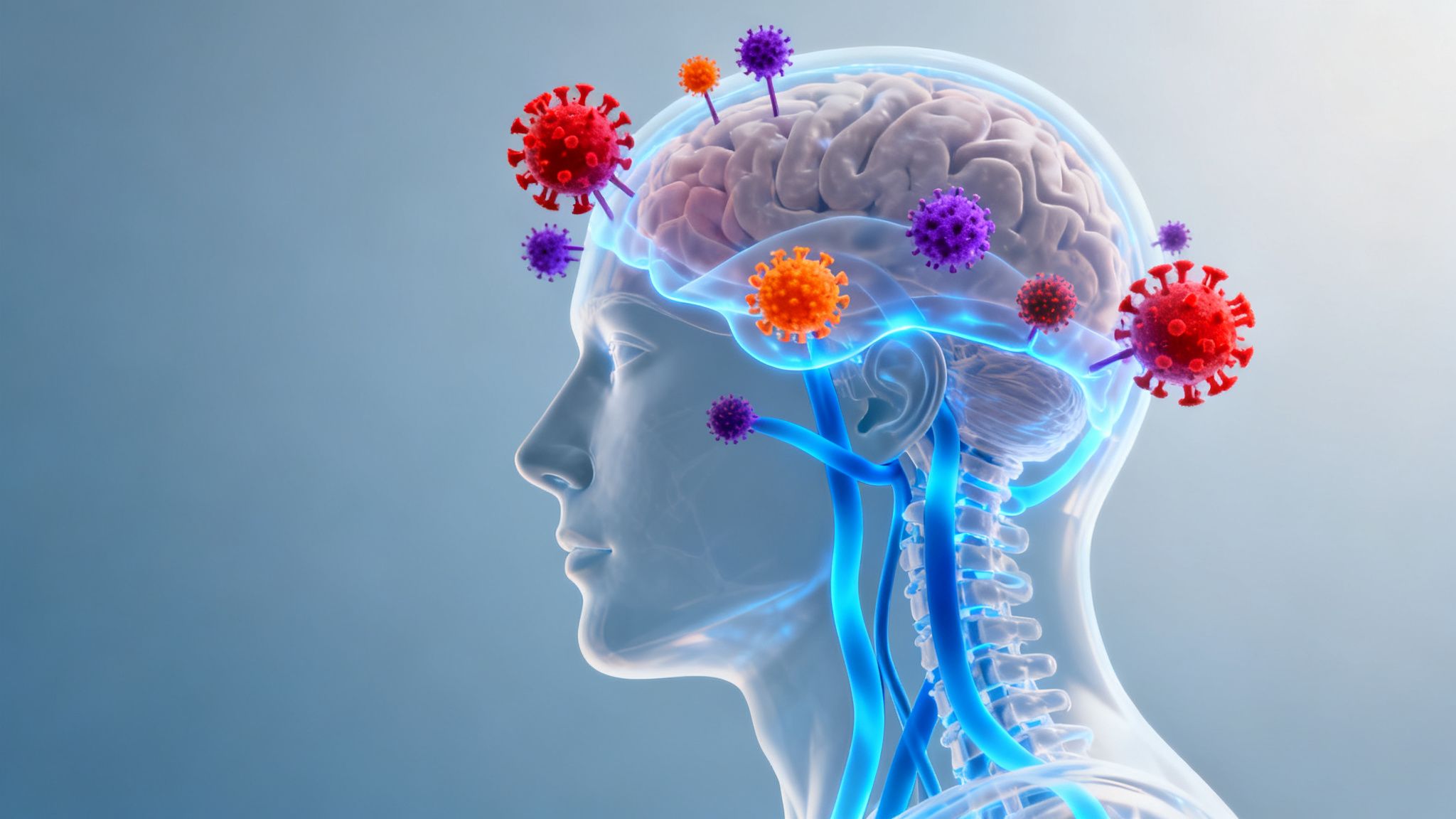
When you hear "viral meningitis," it's easy to picture a virus directly attacking the brain. But the story is a bit more complicated than that. At its core, viral meningitis is an inflammation of the meninges—the delicate, multi-layered membranes that act like a protective bubble-wrap for your brain and spinal cord.
The inflammation itself isn't directly caused by the virus chewing away at these tissues. Instead, it’s the result of your body's own immune system waging war against a viral invader that has breached this critical defense system.
Understanding the Viral Invasion

Think of your brain and spinal cord as the command center of your body, protected by those three layers of meninges. Their main job is to keep threats out. Viral meningitis happens when a virus slips past security.
It all starts with a common infection. A virus gets into your body, usually through your nose, mouth, or digestive tract, and starts making copies of itself. Most of the time, your immune system handles it right there, and you just end up with a cold or a stomach bug. You can learn more about how a wide range of common virus infections operate in our detailed guide.
But every so often, the virus manages to escape the initial infection site and hitches a ride in the bloodstream. The bloodstream is like a superhighway, giving the virus access to every part of your body. If it can dodge the immune cells patrolling this highway, it might find its way to the brain and cross the highly selective blood-brain barrier to infiltrate the meninges.
The Body's Inflammatory Response
Once the virus is detected inside this protected zone, your immune system sounds the alarms and launches a massive counterattack. It floods the area with white blood cells and other inflammatory agents to hunt down and destroy the intruder.
This fierce battle is what causes the meninges to swell up and become inflamed, triggering the hallmark symptoms of meningitis.
The pounding headache, stiff neck, and extreme sensitivity to light aren't caused by the virus itself. They're the collateral damage from your body's own powerful immune response creating pressure and irritation within the skull.
This is a really important point. Viral meningitis is less about the virus directly harming brain tissue and more about the chaos caused by the body's own defense mechanisms in such a sensitive area.
This inflammatory reaction is usually much less severe than what happens during bacterial meningitis, which is why the viral version is often considered "milder." But the pathway—from initial infection to immune system showdown—is similar. Grasping this process is key to understanding how so many different viruses can all end up causing the same condition.
Enteroviruses: The Most Common Cause of Viral Meningitis

When we talk about what causes viral meningitis, one group of viruses stands head and shoulders above the rest: enteroviruses. This massive family of viruses, which includes common pathogens like Rhinovirus and Norovirus, is the single biggest culprit behind the condition, making them a crucial piece of the puzzle.
You can almost think of enteroviruses as the "common cold" of the meningitis world. They're incredibly widespread, especially during certain times of the year, and most of the time, they only lead to a mild illness. But in a small fraction of cases, things can take a more serious turn.
Globally, enteroviruses are to blame for more than 90% of all viral meningitis cases. The two most common offenders in this family are echovirus and coxsackievirus, which really hit their stride in the warm summer and autumn months.
How Enteroviruses Spread
The reason enteroviruses are so successful is because they spread so easily. Understanding how they travel from person to person is the first step in stopping them in their tracks.
These viruses have perfected a couple of key transmission routes:
- The Fecal-Oral Route: This is the primary way enteroviruses get around. The virus is shed in the stool of an infected person and can end up on surfaces, in food, or in water. All it takes is for someone to touch a contaminated doorknob and then touch their mouth, or to eat food prepared by someone who didn't wash their hands properly.
- Respiratory Droplets: Just like a cold, an infected person can also spread the virus by coughing or sneezing. Those tiny airborne droplets can be inhaled by anyone nearby, passing the infection along.
This explains why we see a huge spike in cases in late summer and early fall. It’s no coincidence that this is when kids head back to school and daycare, creating the perfect environment for viruses to spread through close contact and shared surfaces.
Connecting Transmission to Everyday Life
So, how does this science translate to your daily routine? An enterovirus is surprisingly tough and can survive on objects like toys, countertops, and faucets for hours or even days. This makes high-touch surfaces in shared spaces—think homes, classrooms, and public bathrooms—prime real estate for transmission.
For example, a child with an enterovirus infection uses the bathroom but doesn't do a great job of washing their hands. They then run off to play with a shared bin of toys, leaving the virus behind. A little while later, another child picks up the same toys and can easily become the next host.
This is exactly why good, old-fashioned hygiene is so powerful. Thoroughly washing hands with soap and water after using the restroom or changing a diaper isn't just a suggestion—it's one of the most effective ways to break the chain of infection. If you're curious about the nuts and bolts of how these tiny invaders are built, our guide on the different types of viral genomes is a great place to start.
Because these viruses are so common and resilient, regularly using disinfecting wipes on frequently touched surfaces becomes a critical line of defense for your family’s health. By understanding how these viruses operate, we can put up a much stronger fight against the leading cause of viral meningitis.
Herpesviruses: The Persistent and Recurring Threat
While enteroviruses come in seasonal waves, another group of viruses plays by a completely different set of rules. Herpesviruses don’t just infect you and leave; they take up permanent residence in your body, creating a persistent threat that isn’t tied to any particular season.
Unlike viruses that spread through more casual contact, these agents establish a lifelong, latent infection. Think of it like a squatter who moves into your nerve cells and goes dormant for years, or even decades. Under certain conditions—like stress or a weakened immune system—the virus can suddenly wake up and cause new problems, including meningitis.
Herpes Simplex Virus: The Latent Instigator
The Herpes Simplex Virus (HSV) family is probably the most well-known member of this group. While many people connect Herpes Simplex Virus 1 (HSV-1) with cold sores and Herpes Simplex Virus 2 (HSV-2) with genital herpes, both are capable of causing serious neurological complications.
Herpes simplex virus type 2 (HSV-2) is a sneaky but significant cause of viral meningitis, especially in adults. It might only account for a small percentage of total cases, but it’s a leading trigger in certain demographics. The virus, which spreads through sexual contact, often sparks its first bout of meningitis during the initial genital infection. You can find more details about the role of HSV-2 in adult viral meningitis on MedLink.
A uniquely troubling feature of HSV-2 meningitis is its tendency to return. This condition, known as Mollaret's meningitis, involves recurring episodes of severe headache, fever, and neck stiffness. These attacks can happen months or even years apart, triggered by the virus reactivating within the nervous system.
This pattern of lying dormant and then reawakening is what sets herpesviruses apart from the "hit-and-run" nature of enteroviruses, making them a year-round potential cause for viral meningitis.
Varicella-Zoster Virus: From Chickenpox to Shingles
Another major player in the herpesvirus family is the Varicella-Zoster Virus (VZV). This is the very same virus responsible for two completely different illnesses that pop up at different stages of life.
Your first encounter with VZV is usually in childhood, when it causes chickenpox. Once that initial infection is over, the virus doesn't actually disappear. Instead, it retreats into the nerve tissue near your spinal cord and brain, where it stays inactive.
Decades later, that same virus can reawaken. It travels down a nerve to the skin, causing a painful, blistering rash known as shingles. For most people, shingles is just a localized skin issue. But in some cases, the reactivated virus can spread to the meninges and lead to viral meningitis.
This pathway highlights a critical point: the trigger for viral meningitis isn't always a new infection. Sometimes, it’s an old one coming back to life. This is especially true for VZV, where meningitis is a potential complication of shingles—a condition that stems from a virus you likely caught many years ago. Understanding these persistent threats is key to recognizing the full spectrum of what causes viral meningitis.
Mosquito-Borne Viruses and The Vector Connection
While plenty of viruses spread from person to person through a cough or a sneeze, another major pathway involves an intermediary. Sometimes, the cause of viral meningitis isn't a contaminated doorknob but the bite of an insect. This is where arboviruses come in—a category of viruses transmitted by arthropods like mosquitoes and ticks.
Think of the mosquito as a tiny, flying shuttle service. It picks up a virus from an infected animal (often a bird) and delivers it directly to a human. This is called vector-borne transmission, and it completely changes the risk factors involved.
Unlike the enteroviruses that thrive in crowded indoor spaces, arboviruses are a seasonal, outdoor threat. Their activity spikes during warmer months when mosquito populations are booming, connecting your risk directly to your local environment.
The Role of Geography and Environment
Because these viruses depend on specific mosquito species and animal hosts, your risk can change dramatically depending on where you live or travel. Understanding the threats in your area is key. For those curious about regional risks, digging into local mosquito-borne illnesses can offer a clearer picture of what's buzzing around your backyard.
West Nile Virus (WNV) is a perfect example of this vector connection in action. It's one of the most well-known arboviruses, circulating between birds and certain types of mosquitoes. Humans are just "accidental" hosts—we can get sick from a bite, but we don't typically pass the virus on to other people.
Found on every continent except Antarctica, WNV has caused major outbreaks across the globe. The good news? About 80% of infections cause no symptoms at all. The bad news? For a small fraction of people—roughly 1 in 150 cases—the infection can escalate into severe neurological diseases like meningitis or encephalitis. You can learn more about the global impact of these viruses on Meningitis.org.
This vector connection means prevention shifts from handwashing and indoor hygiene to outdoor environmental and personal protection. The fight against these viruses is waged in your yard, not just inside your home.
How to Protect Yourself from Mosquito-Borne Viruses
You can’t exactly disinfect your entire backyard, so stopping these viruses requires a different toolkit. The goal is to break the transmission cycle by making yourself a less appealing target for mosquitoes and eliminating places where they can breed.
Here are three simple but powerful steps you can take:
- Use Effective Insect Repellent: When you're outdoors—especially at dawn and dusk when mosquitoes are most active—apply an EPA-registered insect repellent. Look for products containing proven ingredients like DEET, picaridin, or oil of lemon eucalyptus.
- Wear Protective Clothing: Cover up exposed skin with long-sleeved shirts, long pants, and socks. For extra protection when walking through grassy or wooded areas, tuck your pants into your socks. It might not be a fashion statement, but it works.
- Remove Standing Water: Mosquitoes lay their eggs in stagnant water. Make it a habit to empty water from flowerpots, buckets, birdbaths, and old tires around your property. It doesn’t take much—some species can breed in a pool of water as small as a bottle cap.
Distinguishing Viral From Bacterial Meningitis
When you hear the word "meningitis," it’s easy to feel a jolt of alarm. But it's critical to know that not all meningitis is the same. The most important distinction is between the two main types: viral and bacterial. One is usually a manageable illness, while the other is a true medical emergency that can turn deadly in a hurry.
The heart of the matter comes down to severity and speed. Bacterial meningitis is the one that deserves its fearsome reputation. It can escalate with terrifying speed, potentially causing permanent disability or death if not treated immediately with powerful antibiotics.
On the other hand, viral meningitis is typically much less severe. In most cases, the body's immune system can fight it off without medical intervention, and recovery usually involves simple supportive care like rest and pain relief.
Key Clinical Differences
At first glance, the symptoms can look frustratingly similar—fever, a pounding headache, and a stiff neck are common to both. This overlap is why clinicians have to play detective, looking for subtle but critical clues to tell them apart.
A definitive answer almost always comes from a spinal tap, where a small sample of cerebrospinal fluid (CSF) is collected. This fluid, which surrounds the brain and spinal cord, holds the key. Analyzing the CSF allows doctors to see exactly what’s happening inside—identifying the invader and seeing how the body is responding. To dig deeper into how the body signals different types of infections, it's helpful to understand how different immune cell responses, like high neutrophils and low lymphocytes, indicate specific types of immune activity. You can also learn to spot the warning signs by reading our detailed comparison of viral vs. bacterial infection symptoms.
Think of it this way: bacterial meningitis is like a raging forest fire that demands an immediate, overwhelming response to put it out. Viral meningitis is more like a contained brush fire—still serious, but something the body's own firefighting crew can usually handle. The urgency and the tools needed are completely different.
This is also why preventing infections in the first place, especially from things like mosquito bites, is so important.

As the infographic shows, personal protection and managing your environment are your strongest lines of defense against the viruses that hitch a ride on vectors like mosquitos.
Viral vs. Bacterial Meningitis Key Differences
To make the distinctions even clearer, let's break them down side-by-side. The differences in causes, treatment, and what doctors find in the spinal fluid are night and day.
| Feature | Viral Meningitis | Bacterial Meningitis |
|---|---|---|
| Common Causes | Enteroviruses, herpesviruses, arboviruses | Streptococcus pneumoniae, Neisseria meningitidis |
| Severity | Usually less severe, self-resolving | Medical emergency, potentially fatal |
| Treatment | Supportive care (rest, fluids, pain relief) | Immediate intravenous antibiotics |
| Typical CSF Findings | Increased lymphocytes, normal glucose | High neutrophils, low glucose, high protein |
This table highlights why a quick and accurate diagnosis is so essential.
Ultimately, you can't self-diagnose meningitis. If you or someone you know has symptoms—especially that classic trio of a severe headache, high fever, and stiff neck—the only safe move is to seek medical help immediately. It's always better to be safe than sorry.
Common Questions About Viral Meningitis
We've covered a lot of ground, from the specific viruses that cause meningitis to how they spread. It can feel like a lot to take in. To tie it all together, let's walk through some of the most common questions people have about this illness, its prevention, and what recovery looks like.
Can You Get Viral Meningitis More Than Once?
Yes, unfortunately, you can get viral meningitis multiple times. Think of it like the common cold—catching one virus doesn't make you immune to all the others. If you recover from meningitis caused by an enterovirus, for example, you're still susceptible to getting it from a completely different bug, like a herpesvirus.
On top of that, some viruses are known for causing repeat performances. HSV-2 (Herpes Simplex Virus Type 2) is a key example. The virus can lie dormant in the body and reactivate later, triggering recurrent bouts of meningitis over a person's lifetime.
How Can I Protect My Family from Meningitis Viruses?
Protecting your family really comes down to a multi-layered defense targeting the specific ways these different viruses get around. Since enteroviruses are the most common culprit, good old-fashioned hygiene is your first and best line of defense.
- Practice Diligent Handwashing: This is non-negotiable. Wash hands thoroughly with soap and water, especially after using the bathroom, changing diapers, or before you prepare or eat food.
- Disinfect High-Touch Surfaces: Regularly wipe down things everyone touches—doorknobs, remote controls, toys, and kitchen counters—with a good disinfecting wipe. These are hotspots where viruses can hang out waiting for their next host.
- Stay Up-to-Date on Vaccinations: The MMR vaccine is a powerhouse, protecting against mumps and measles, both of which can lead to meningitis. Keeping your family's immunizations current is the single best way to block these preventable causes.
- Prevent Mosquito Bites: When it comes to arboviruses, the goal is to not get bitten. Use an EPA-registered insect repellent when you're outdoors and get rid of any standing water around your home where mosquitoes love to breed.
What Are the Long-Term Effects of Viral Meningitis?
The good news is that for most healthy adults and older kids, viral meningitis usually clears up completely within 7 to 10 days without leaving any lasting problems behind. The outlook is generally very positive.
However, the story can be different for infants and people with compromised immune systems, who are at a higher risk for more serious issues. In these cases, lingering effects can pop up, like persistent headaches, fatigue, memory fog, or trouble concentrating. Even for healthy people, a full recovery can sometimes drag on for weeks or even months, which is why it’s so important to listen to your doctor and get proper rest.
While the acute illness is often short-lived, the recovery period can be longer than expected. Patience and allowing the body adequate time to heal are crucial for minimizing any potential long-term impacts and ensuring a complete return to health.
When Should a Severe Headache Be a Medical Concern?
A bad headache on its own isn't usually a sign of meningitis. The real red flag is when that severe headache shows up with a very specific group of friends.
You need to seek immediate medical attention if a severe headache is accompanied by other classic meningitis symptoms. Look for a combination of signs, especially a stiff neck, high fever, sensitivity to light, confusion, or a rash. This particular cluster of symptoms is an urgent signal to get evaluated, primarily to rule out the much more dangerous bacterial meningitis, which is always a medical emergency. Trust your gut—if something feels seriously wrong, getting it checked out right away is always the safest move.
Leave a Reply