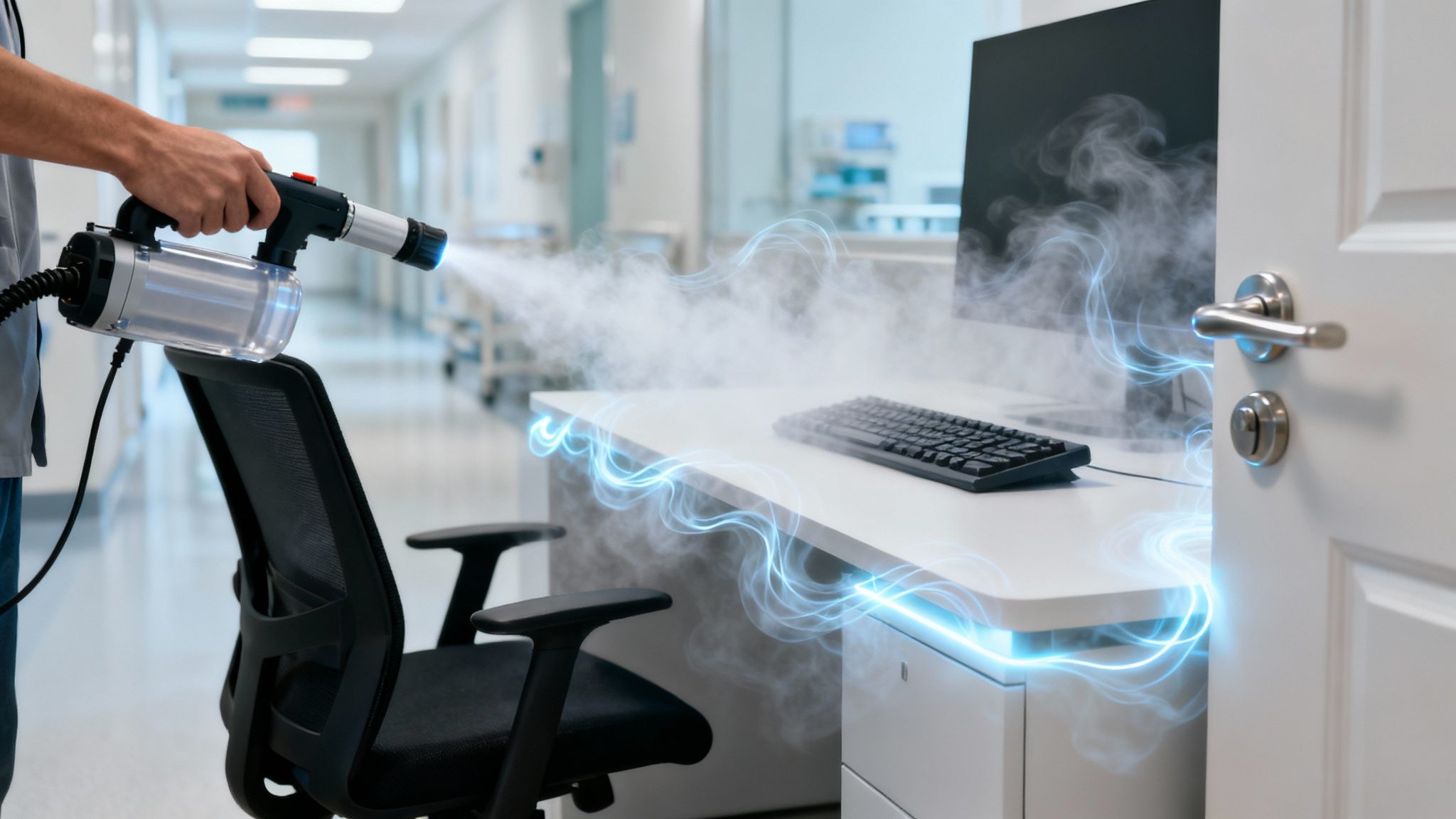
An electrostatic disinfectant spray is a sophisticated cleaning technology that applies an electrical charge to liquid disinfectant. This charge causes the droplets to magnetically cling to and wrap around surfaces, ensuring complete, 360-degree coverage.
Think of the static electricity from rubbing a balloon on your hair, making it stick to a wall. This same principle forces disinfectant droplets to actively seek out and coat every nook and cranny. This unique capability makes it exceptionally effective at sanitizing complex objects and hard-to-reach areas, which is critical for eliminating viruses that can hide in these spots.
The Next Generation of Surface Disinfection
Imagine trying to paint a chair with a standard spray can. You would need to circle it repeatedly, spraying from every angle, and you would likely still miss spots under the seat or between the legs. This is the same challenge faced by traditional disinfection methods—they often leave surfaces only partially treated, creating safe havens for pathogens to persist.
Electrostatic disinfection was engineered to solve this very problem. It provides a more efficient and thorough method for applying sanitizers, guaranteeing that even the most concealed surfaces are fully treated. This level of comprehensive coverage is absolutely essential in high-risk environments where missing a spot is not an option:
- Hospitals and clinics: To combat Healthcare-Associated Infections (HAIs) and control the spread of viruses like Hepatitis B Virus (HBV) and Hepatitis C Virus (HCV).
- Schools and daycares: To reduce the transmission of common pathogens such as Norovirus and Influenza A Virus (H1N1).
- Offices and public transit: To protect employees and commuters from respiratory viruses like SARS-Related Coronavirus 2 (SARS-CoV-2).
- Gyms and athletic facilities: To disinfect intricate equipment with numerous touchpoints where viruses can linger.
A Rapidly Growing Solution
The superior performance of this method has not gone unnoticed. Following the COVID-19 pandemic, demand for electrostatic sprayers surged as organizations sought more reliable disinfection strategies. The global market was projected to reach USD 1.9 billion by 2025, growing at a remarkable 14% annually.
This growth is driven by tangible results. For instance, some North American hospitals reported that adopting electrostatic technology made their disinfection processes up to 70% faster than conventional methods. They also reduced labor costs by half and used significantly less chemical.
By ensuring disinfectants—such as quaternary ammonium compounds or hydrogen peroxide solutions—achieve total surface contact, this technology maximizes their efficacy. It is a proven method for disrupting the transmission of numerous viruses, from resilient non-enveloped viruses like Feline Calicivirus to enveloped viruses like Human Coronavirus, making it a cornerstone of modern infection control.
You can learn more about this technology's market growth and impact in this detailed industry analysis.
How Electrostatic Disinfection Actually Works
The "magic" behind an electrostatic disinfectant spray isn't magic at all—it’s applied physics. The technology is based on the scientific principle of electrostatic induction, which creates the signature "wrap-around" effect and ensures comprehensive coverage.
The process begins inside the sprayer's nozzle. As the disinfectant liquid passes through, it is atomized into an extremely fine mist. Simultaneously, an electrode within the nozzle imparts a strong positive electrical charge to these tiny droplets.
This is where the process becomes highly effective. Most objects in a room—a doorknob, a chair leg, a keyboard—carry a neutral electrical charge. Similar to how opposite poles of a magnet attract, the positively charged disinfectant droplets are drawn directly toward all neutral surfaces in the room.
The Science of Attraction and Coverage
This magnetic-like attraction is powerful enough to overcome gravity. Instead of simply falling to the floor, the charged mist actively seeks out and adheres to surfaces.
This force is what generates the "wrap-around" phenomenon. The droplets do not just land on top of an object; they coat the sides, back, and even the underside with a remarkably even finish. It is this 360-degree coverage that makes electrostatic spraying so effective at eliminating pathogens from every angle.
This diagram illustrates how the sprayer’s positive charge creates the "surface wrap" for complete disinfection.

As shown, the technology's success hinges on charging the disinfectant particles. This creates an active attraction that results in total surface disinfection, leaving viruses and bacteria with nowhere to hide.
Why Uniformity Matters for Killing Viruses
A disinfectant's effectiveness depends not only on its chemical formula but also on contact time, often referred to as dwell time. This is the mandatory period a surface must remain visibly wet for the disinfectant to successfully kill viruses and bacteria. If the product dries too quickly or is applied unevenly, it may fail to work.
Electrostatic application addresses this challenge perfectly.
- Consistent Layer: The spray deposits a thin, uniform film of disinfectant across the entire surface.
- No Pooling or Dripping: Unlike wiping or conventional spraying, the charged droplets disperse evenly, preventing overly saturated spots and dry patches.
- Maximized Dwell Time: By keeping the surface consistently wet, the technology helps the disinfectant meet its required contact time, ensuring it can effectively neutralize pathogens.
By achieving this complete and uniform coating, an electrostatic disinfectant spray ensures the chemical can work effectively against a wide spectrum of viruses. This includes easier-to-kill enveloped viruses like Influenza A Virus (H1N1) and Human Coronavirus, as well as more robust non-enveloped viruses like Rhinovirus Type 14.
This meticulous coverage is what truly distinguishes electrostatic technology from traditional spraying or fogging. Conventional methods almost invariably miss spots, leaving behind pathogens that can continue to spread. With an electrostatic sprayer, every targeted surface is coated, breaking the chain of infection far more reliably. It represents a smarter approach to ensuring everything from desks to medical equipment is thoroughly disinfected.
How Well Does It Actually Work Against Viruses?
The true measure of an electrostatic disinfectant spray is not just its impressive 360-degree wrapping effect—it's whether it can effectively neutralize the pathogens we aim to eliminate. Ultimately, the sprayer is a high-tech delivery system. Its real power lies in the synergy between that advanced delivery and an EPA-approved disinfectant designed to kill specific viruses.
Think of it this way: the sprayer’s role is to ensure the disinfectant reaches every surface, clinging to all sides. This allows the chemical to remain wet for its required dwell time, which is the key to effectively killing viruses. When the technology and the chemistry work in tandem, you achieve higher kill rates and more dependable results.
Taking on Different Kinds of Viruses
Viruses are not all structured the same, and their composition determines their resilience to disinfectants. A quality electrostatic system, when paired with the right chemical, can effectively combat the main viral types.
-
Enveloped Viruses: These are the more vulnerable targets. Viruses such as Influenza A (H1N1), SARS-CoV-2, and Human Immunodeficiency Virus Type 1 (HIV-1) are encased in a delicate fatty layer known as an envelope. Disinfectants can easily break down this layer, causing the virus to disintegrate. The comprehensive coverage from an electrostatic sprayer ensures the chemical attacks this weak point from all angles simultaneously.
-
Non-Enveloped Viruses: These are the heavyweights. Viruses like Norovirus (Norwalk Virus) and Rhinovirus lack this fragile outer layer. Instead, they are protected by a tough protein shell (a capsid) that makes them much more difficult to kill. They can survive for extended periods on surfaces and require stronger disinfectants with longer contact times. This is where the uniform coating from an electrostatic spray is so critical—it eliminates dry spots where these resilient viruses could otherwise survive.
The market for these sprayers has expanded for good reason. Valued at US$351.2 million and growing at a rate of 12.3% annually, their success is built on proven performance. The technology provides up to 75% better droplet adhesion compared to traditional spraying and wiping. In hospitals, where a norovirus outbreak can rapidly infect 20-50% of patients, electrostatic methods have been demonstrated to achieve a log-6 reduction (99.9999% kill rate) of coronaviruses in under five minutes per room. You can explore these market trends and efficacy rates in more detail.
The Power of "Log Reduction" Data
So, how do we quantify "clean"? In the field of disinfection, efficacy is measured in log reductions. This scientific scale indicates the percentage of germs a disinfectant has eliminated. Each "log" represents a 90% reduction.
A 1-log reduction means 90% of germs are eliminated. A 3-log reduction removes 99.9%, and a 6-log reduction—the gold standard for sterilization—kills 99.9999% of germs.
Numerous studies show that electrostatic application helps achieve higher log reductions more quickly than traditional methods. By ensuring the disinfectant completely coats every nook and cranny, the technology gives the active ingredients the best possible chance to perform their function.
The table below details the effectiveness of this method against some common viruses of public health concern.
Electrostatic Sprayer Efficacy Against Common Viruses
This table summarizes the effectiveness of electrostatic disinfection with EPA-approved chemicals against various virus types relevant to public health.
| Virus Type | Example Viruses | Surface Survivability | Reported Efficacy (Log Reduction) |
|---|---|---|---|
| Enveloped | SARS-CoV-2, Influenza A | Hours to Days | >4 to >6-log (99.99% to 99.9999%) |
| Enveloped | Hepatitis B Virus (HBV) | Up to 1 week | >4-log (99.99%) |
| Non-Enveloped | Norovirus | Days to Weeks | >3 to >5-log (99.9% to 99.999%) |
| Non-Enveloped | Human Rotavirus | Up to 60 days | >3-log (99.9%) |
This data clearly demonstrates that when you combine the right disinfectant with a superior application method, you create a powerful defense against both common germs and serious pathogens. This directly translates to a safer environment, whether you are protecting a hospital ward or a daycare center.
One Tool in a Bigger Toolbox
While electrostatic spraying is a major advancement for large-area disinfection, it is not a standalone solution. It cannot replace all other forms of cleaning. For a space to be truly safe, spraying must be integrated into a comprehensive hygiene strategy.
High-touch surfaces like doorknobs, light switches, and keyboards are re-contaminated throughout the day and require frequent, targeted cleaning. Our guide on what kills viruses on surfaces explains why regular cleaning and targeted disinfection are critical first steps. For these immediate needs, tools like disinfecting wipes are indispensable, providing an essential on-the-spot solution for managing germ hotspots between deeper, whole-room treatments.
Choosing the Right Sprayer and Disinfectant Solution
An electrostatic disinfectant spray system is only as effective as its two core components: the sprayer that generates the charge and the chemical that neutralizes the pathogens. Selecting the right combination is key to achieving effective disinfection, ensuring user safety, and maximizing your investment.
The market offers a wide array of options, from compact, agile units for smaller areas to heavy-duty systems for large facilities. The first step is to assess your specific environment. The needs of a small dental office differ significantly from those of a large university campus. This requires a close look at both the hardware and, equally important, the disinfectant you will use with it.
Selecting the Right Electrostatic Sprayer
First, you need to choose the right tool for the job. Electrostatic sprayers are generally available in two main configurations, each designed for different applications.
-
Handheld Sprayers: These cordless, portable units are ideal for smaller, targeted tasks. They are lightweight and easy to maneuver around furniture and equipment, making them perfect for individual classrooms, office cubicles, vehicles, or even home use. While they have smaller tanks requiring more frequent refills, they offer unparalleled agility in complex spaces.
-
Backpack Sprayers: When you need to cover a large area quickly, backpack systems are the preferred choice. Designed for efficiency, they feature much larger tanks that allow you to disinfect thousands of square feet without interruption. This makes them essential for school hallways, hospital wings, gyms, and warehouses where time is of the essence.
When comparing models, look beyond the basic design and examine the technical specifications.
Droplet Size: Measured in microns, this indicates the fineness of the mist. The optimal range is 40-110 microns. Smaller droplets enhance the "wrapping" effect and dry faster, a significant advantage when spraying near sensitive electronics.
Battery Life: This is a critical factor. Ensure the battery can last through a typical cleaning cycle for your facility. Longer battery life means less downtime and a more efficient operation, especially in larger buildings.
Tank Capacity: Match the tank size to the application. A one-liter tank may suffice for a small business, but for commercial-scale disinfection, a multi-gallon backpack unit is necessary.
Choosing a Compatible and Effective Disinfectant
The sprayer is the delivery system, but the disinfectant solution does the crucial work of neutralizing viruses like Herpes Simplex Virus 1 (HSV-1) and Hepatitis C Virus (HCV). Before making a selection, it is beneficial to understand the different types of sanitizer solutions and their properties.
Crucially, not every chemical is safe for use in an electrostatic sprayer. Using an unapproved solution can clog or damage the machine, create safety hazards, or be ineffective. Always use an EPA-registered disinfectant specifically labeled for use in electrostatic sprayers.
Common active ingredients include:
- Quaternary Ammonium Compounds (Quats): These are the workhorses of the disinfection industry. They are effective against a broad spectrum of germs, generally have low toxicity, and are less corrosive than some alternatives, making them a popular choice.
- Hydrogen Peroxide: A powerful oxidizer that decomposes into water and oxygen, making it an eco-friendly option. It is highly effective against tough viruses like Feline Calicivirus but can be corrosive to some metals with repeated use.
- Hypochlorous Acid: A gentle yet potent disinfectant known for being tough on pathogens while remaining safe for use on most surfaces. Learn more in our detailed guide on hypochlorous acid for cleaning.
The adoption of these sprayers in key industries highlights their value. Healthcare leads with 35% market penetration, followed by hospitality and education at 20% each. While the initial investment can range from USD 1,000-5,000 per unit, many facilities recoup this cost within 6-12 months through significant labor savings.
Proper Application for Maximum Safety and Effectiveness

An electrostatic disinfectant spray is a powerful tool, but its effectiveness is unlocked only through proper use. Simply pointing and spraying is insufficient. To achieve the advertised kill rates for resilient pathogens like Human Rotavirus or Hepatitis B Virus (HBV), a methodical approach is required that also protects operators from chemical exposure.
The process is a complete protocol that begins long before the sprayer is activated. Following these steps ensures you achieve the full wrap-around benefit of the technology without taking shortcuts or unnecessary risks.
Preparing for a Successful Application
Proper setup before spraying is non-negotiable. This preparation phase is as crucial as the application itself, creating the optimal conditions for safe and effective disinfection.
-
Personal Protective Equipment (PPE) is a Must: You are working with a chemical mist that can be inhaled or settle on the skin and eyes. At a minimum, operators must wear nitrile gloves, safety glasses or goggles, and a respirator rated for the specific chemical being used.
-
Pre-Clean All Surfaces: Electrostatic disinfection is not a substitute for cleaning. Dirt, dust, and grime create a physical barrier that shields germs from the disinfectant. All surfaces must be thoroughly cleaned with soap or detergent and allowed to dry completely before spraying begins.
-
Ensure Proper Ventilation: The area must be well-ventilated before, during, and after the application. Open windows and doors or use mechanical ventilation systems to help disperse the mist and reduce airborne chemical concentrations.
Mastering the Spraying Technique
Once the area is prepared and the operator is protected, the application itself requires a specific technique to guarantee the complete, 360-degree coverage the technology is known for.
The objective is to apply a uniform, wet layer without oversaturating any single area.
The optimal spraying distance is typically between 2 and 4 feet from the surface. This distance allows the charged droplets to form a proper plume and wrap around objects. Spraying too close can cause pooling, while spraying from too far away may allow droplets to dry before they land.
Move through the space in a systematic pattern, such as an S-shape, working from top to bottom and from one end of the room to the other. This methodical approach prevents missed spots and re-contamination of treated areas. A slight overlap between spray paths will ensure seamless coverage.
Understanding Dwell Time and Re-entry
The most critical part of the process is dwell time. This is the specific amount of time a disinfectant must remain visibly wet on a surface to effectively kill the targeted pathogens. This can range from 30 seconds to 10 minutes, depending on the chemical and the virus.
After spraying is complete, the area must be left unoccupied. This allows the disinfectant to work and the mist to settle. Safe re-entry times are specified by the disinfectant manufacturer and must be strictly followed.
To ensure this is done correctly every time, consult the Safety Data Sheets (SDS) for your chosen disinfectant. For a helpful guide on reading these essential documents, see this article on Mastering Safety Data Sheet Compliance. Adhering to these protocols is the only way to ensure you are killing pathogens and protecting the health of everyone using the space.
Electrostatic Spraying Versus Traditional Disinfection Methods
When tasked with keeping a space free from pathogens like the Avian Influenza Virus (H5N1) or Norovirus, the tools you choose are critical. The ultimate goal is to eliminate germs, but the methods to achieve this vary significantly in speed, thoroughness, and cost.
An electrostatic disinfectant spray has a distinct advantage because it actively charges the disinfectant droplets it releases. So, how does this technology compare to traditional methods? Let’s examine the strengths and weaknesses of each approach.
The Battle for Coverage and Speed
The greatest challenge in disinfection is ensuring the cleaning agent makes contact with every contaminated surface. This is where the differences between technologies become apparent.
-
Manual Wiping: The classic method. While effective for targeted cleaning, it is extremely slow and its efficacy is highly dependent on the operator. It is easy to miss spots, and without frequently changing cloths, there is a risk of spreading germs from one surface to another.
-
Fogging: Foggers create a fine, uncharged mist that drifts down and settles on surfaces below. It is a fast way to cover a large, open room, but gravity is its primary limitation. The mist often fails to coat the sides and undersides of furniture and equipment, leaving significant gaps in coverage.
-
UV-C Light: This method uses powerful ultraviolet light to kill germs without chemicals. However, it is only effective in its direct line of sight. Any object in its path will cast a shadow, creating "UV dead zones" where pathogens can survive untouched.
In contrast, the charged particles from an electrostatic sprayer are actively drawn to surfaces, wrapping around objects to deliver true 360-degree coverage. It disinfects areas that other methods simply cannot reach.
A Side-by-Side Comparison
To provide a clearer picture, let's compare these four popular disinfection methods based on the metrics that matter most to facility managers and cleaning teams.
Here is a look at how electrostatic spraying, fogging, UV-C, and manual wiping stack up.
Comparison of Surface Disinfection Technologies
| Method | Coverage | Speed | Labor Cost | Best For | Limitations |
|---|---|---|---|---|---|
| Electrostatic Spraying | Excellent (360°) | Very Fast | Low | Whole-room disinfection of complex spaces (offices, schools, hospitals). | Higher initial equipment cost; requires pre-cleaning. |
| Manual Wiping | Variable | Very Slow | High | Immediate, targeted cleaning of high-touch points. | Prone to missed spots and cross-contamination. |
| Fogging/Misting | Fair | Very Fast | Low | Large, open areas with minimal complex objects. | Poor coverage on vertical surfaces and undersides. |
| UV-C Light | Poor (Line-of-Sight) | Fast | Low | Supplementing terminal cleaning in controlled environments. | Ineffective in shadowed areas; can degrade materials over time. |
As shown, each tool has its place, but electrostatic technology is the clear leader for comprehensive, room-wide disinfection where complete coverage is essential.
Finding the Right Balance
The comparison makes it evident: electrostatic technology is a game-changer for thorough and efficient disinfection. It reduces labor costs and application time. In fact, some facilities have reported 35% reductions in labor and 75% faster application compared to manual wiping.
However, this does not mean it is time to discard your other tools. An effective infection control plan relies on a combination of strategies.
An electrostatic sprayer can disinfect an entire classroom in minutes, but it cannot replace the immediate need to clean a spill or wipe down a doorknob that is touched hundreds of times a day.
This is where manual methods, such as disinfectant wipes, continue to play a crucial, complementary role. They are the perfect tool for spot-treating high-touch surfaces between deeper cleanings. Think of the electrostatic sprayer as your wide-area defense system, while a disinfecting wipe is your rapid-response tool for immediate threats. You can see how these tools fit into a larger system by exploring our guide on the modern surface cleaning machine and its role in a complete hygiene protocol.
Common Questions About Electrostatic Disinfection
Even after understanding the science, practical questions often arise before implementing an electrostatic disinfectant spray program. This is where theory meets real-world application.
Let's address some of the most common inquiries. This section serves as a quick-start guide to clarify any lingering confusion and ensure you use this technology safely and effectively.
Is Electrostatic Spraying Safe Around Electronics?
Yes, but with an important condition: if done correctly, electrostatic spraying is perfectly safe around computers, keyboards, office equipment, and other electronics.
The key is in the fine mist. The sprayer releases such small droplets that they do not pool or drench surfaces. The electrostatic charge pulls them into a thin, even layer, preventing the liquid damage that a standard spray bottle would cause. Always follow the manufacturer’s guidelines on spray distance and never aim directly into open vents, ports, or between keys.
Can Any Disinfectant Go in an Electrostatic Sprayer?
Absolutely not. This is a critical point. You should only use disinfectants that are EPA-approved and explicitly state on the label that they are formulated for electrostatic sprayers.
Using a chemical not approved for this method can lead to several problems:
- Equipment Damage: The wrong formula can clog the sprayer’s specialized nozzle or corrode internal components.
- Ineffective Disinfection: Not all chemicals can withstand being atomized and electrically charged. They may break down and lose their efficacy against viruses like Rhinovirus or Duck Hepatitis B Virus (DHBV).
- Safety Risks: An unapproved liquid could create hazardous fumes when atomized or interfere with the device's electrical components.
How Is This Different from Fogging?
The key difference is the charge. A fogger or mister simply creates a cloud of fine droplets and relies on gravity. The mist drifts and eventually settles on whatever is below it, primarily horizontal surfaces. The undersides and sides of objects are often left completely untouched.
An electrostatic disinfectant spray is more advanced. It imparts a positive electrical charge to every droplet. Since most surfaces have a neutral charge, the droplets are actively pulled toward them, wrapping around objects to create true 360-degree coverage. This is a capability that a fogger simply cannot replicate.
Disinfection is not a replacement for cleaning. Electrostatic spraying is a powerful final step in a multi-stage process. It is designed to kill pathogens on already clean surfaces, not to remove physical dirt and grime.
You must clean first. Layers of dust or grime act as a shield, protecting germs from the disinfectant. To achieve a truly disinfected space, the surface must be clean before you spray. This is why you will still need to use traditional methods, like disinfectant wipes on high-touch spots, as part of a complete hygiene plan.
Leave a Reply