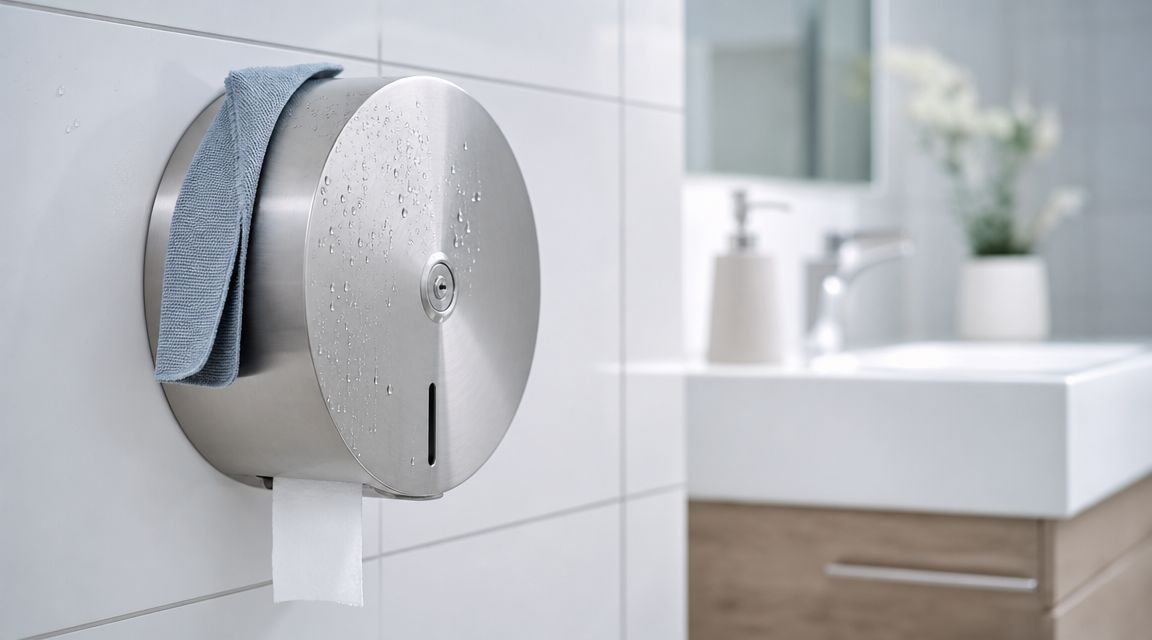
A common approach to cleaning a bathroom involves wiping the sink, scrubbing the toilet, rinsing the tub, and perhaps cleaning the faucet handle and light switch on the way out. The wall mounted toilet paper dispenser often gets skipped because it looks clean. It holds a fresh roll. It doesn't seem messy. It blends into the wall.
From a public health perspective, that's exactly why it matters.
A toilet paper dispenser is a high-touch surface sitting close to one of the most contaminated areas in the home or facility. Hands touch it before and after toilet use. Aerosolized particles from flushing can settle on it. In shared bathrooms, many people contact the same edges, cover, latch, or spindle in a short period of time. If you care about interrupting virus spread, this small fixture deserves more attention than it usually gets.
The Most Overlooked Surface in Your Bathroom
Think about a busy morning at home or in an office restroom. Someone uses the toilet, reaches for paper, adjusts the roll, then heads to the sink. The next person does the same. If the roll jams, users touch the dispenser even more. In many bathrooms, that fixture gets handled repeatedly but cleaned only occasionally.
That pattern creates a classic fomite problem. A fomite is an object that can carry infectious material from one person to another. In bathrooms, fomites matter because viruses don't need a visibly dirty surface to move through a space. They just need the right combination of contamination, survival, and touch.
The scale of the issue is easy to miss because the fixture seems ordinary. But toilet paper holders and dispensers are everywhere. The global toilet paper holder market was estimated at USD 1,624.5 million in 2024, with North America holding over 40% of the market, and the same report projects 7.9% CAGR from 2024 to 2031 according to Cognitive Market Research's toilet paper holder market report. That doesn't tell us infection risk by itself. It does show how widespread these fixtures are across homes, offices, restaurants, schools, and healthcare settings.
Public health lens: When a fixture is nearly universal, even small hygiene mistakes can scale across many bathrooms and many users.
Homeowners often think of a dispenser as a style choice. Facility managers often think of it as a maintenance choice. It's both, but it's also a hygiene control point. The shape, material, location, and cleaning method all affect how easily the surface gets contaminated and how well staff or residents can clean it afterward.
Understanding Dispenser Types and Materials
Some dispensers are easier to keep sanitary than others. The difference isn't just price or appearance. It comes down to touch points, exposed surfaces, seams, and material behavior during cleaning.

Dispenser types change exposure
A basic single-roll holder is simple, but it usually leaves the roll edge exposed and often requires direct hand contact with the roll and arm. In a private home, that may be acceptable if cleaning is consistent. In a shared bathroom, more exposed paper and more hand contact usually means more opportunities for contamination.
A covered or enclosed model protects more of the roll. A jumbo or twin-roll dispenser can also reduce how often people open or handle the unit for refills. Less handling doesn't eliminate risk, but it can lower unnecessary contact.
Touchless designs are the most hygiene-oriented option because they reduce contact with the dispenser body. They're more common in commercial settings than in homes, but the principle is straightforward: fewer shared touch points usually means less opportunity for transfer.
Materials matter more than many buyers realize
For infection prevention, non-porous and easy-to-clean surfaces are usually the safer choice.
| Material | Hygiene advantage | Common drawback |
|---|---|---|
| Stainless steel | Smooth, durable, easy to wipe and disinfect | Can show fingerprints |
| ABS plastic | Light, affordable, common in many units | Scratches and wear can create harder-to-clean areas |
| Chrome-coated metal | Smooth finish when intact | Chips or corrosion can complicate cleaning |
| Wood | Decorative in home settings | Porous or textured finishes are harder to disinfect thoroughly |
Unfinished or textured materials trap residue more easily than smooth ones. That matters because viruses aren't moving on their own. They hitchhike in body fluids, microscopic droplets, and soil left behind by hands. The rougher or more damaged a surface becomes, the harder it is to remove that material completely.
What to choose if hygiene is your priority
If you're choosing a wall mounted toilet paper dispenser mainly for health protection, start with these practical filters:
- Favor smooth surfaces: Stainless steel or high-quality sealed plastic is easier to clean than textured or decorative materials.
- Reduce seams and crevices: Hinges, ornate edges, and deep grooves collect residue.
- Limit paper exposure: Covered designs help shield the roll from splash and settling particles.
- Think about refill behavior: If staff struggle to open or reload the unit, they're more likely to rush or skip cleaning steps.
The best-looking dispenser isn't always the easiest one to disinfect. In bathrooms, cleanability should outrank decoration.
How Dispensers Become Viral Transmission Hotspots
A toilet paper dispenser becomes risky through two main routes. The first is direct hand contamination. The second is settling of aerosolized material in the bathroom environment.

Hand contact is the obvious route
People often touch the dispenser before washing their hands. That simple sequence matters. If someone has contaminated hands after toilet use, the dispenser can receive that contamination before handwashing ever happens. The next user may touch the same lever, edge, hood, lock, or spindle.
This matters especially in spaces where users adjust jammed rolls, pull aggressively, or open covers to check whether paper remains. Each extra contact adds another chance for transfer. If you want a concise refresher on the basic mechanism, VirusFAQ's explainer on fomite transmission in everyday settings is useful background.
Bathroom aerosols can settle on nearby fixtures
The less obvious route is flushing. Flushing can generate aerosols and droplets that don't stay confined to the bowl. In a bathroom, those particles can settle on nearby surfaces, including dispensers, walls, flush handles, grab bars, and sink areas.
From a virology standpoint, that matters because some viruses spread efficiently through contaminated hands and surfaces. In public health discussions, norovirus and rotavirus are often front of mind for this reason. SARS-CoV-2 also pushed many people to think more seriously about shared surface hygiene, especially in enclosed indoor spaces.
A surface doesn't need to look dirty to function as a transmission link.
The dispenser is often located close enough to the toilet to sit inside this contamination zone, especially in compact bathrooms. A covered model can shield some of the roll, but the outer body still needs routine cleaning. An open holder leaves more of the roll and holder exposed.
Why the fixture is easy to ignore
Bathrooms contain many obvious cleaning targets. The bowl looks dirty. The sink gets spots. The mirror shows fingerprints. A dispenser often looks unchanged even after repeated use. That visual quiet can mislead people into under-cleaning it.
For facility teams building stronger restroom hygiene programs, this is one reason some cleaners emphasize high-touch fixtures instead of only visibly dirty ones. If you're reviewing operational restroom practices, Arelli Cleaning solutions offers a useful example of a cleaning framework that pays attention to contact surfaces in a COVID-conscious context.
A dispenser becomes a hotspot when three things overlap: contamination lands on it, the material allows residue to remain, and another person touches it before it's properly cleaned. That chain is preventable, but only if the fixture is treated like a health surface rather than a decorative accessory.
Effective Cleaning and Disinfection Protocols
Cleaning and disinfecting aren't the same task. People often use the words as if they mean one thing, but in infection control they do different jobs.
Cleaning removes soil, residue, and some germs. Disinfecting uses a product designed to inactivate or kill targeted germs on the surface after cleaning. If a dispenser has visible grime, disinfection alone may not work well because the residue can block contact between the disinfectant and the surface.

A simple routine that works
For a wall mounted toilet paper dispenser, use a repeatable process instead of improvising each time.
Prepare supplies
Put on appropriate gloves if your setting requires them. Gather a cleaner, a disinfectant labeled for viral use, fresh cloths or disposable towels, and replacement toilet paper if needed.Remove visible soil first
Wipe away dust, residue, splash marks, and fingerprints. Pay attention to undersides, edges, cover lips, and the part users grip.Apply disinfectant correctly
Use a product according to its label directions. Pre-moistened disinfecting wipes are often practical because they deliver the chemical and wiping action together, especially on small high-touch fixtures.Respect contact time
Many routines fail here. The surface needs to stay visibly wet for the product's stated dwell time. If you wipe it dry too early, you may not get the intended disinfecting effect.Finish cleanly
If the label requires a final wipe or rinse, do that. Then reload paper without contaminating the fresh roll.Wash hands after the task
Gloves don't replace hand hygiene. Clean hands remain one of the strongest barriers against bathroom transmission.
How often should you do it
The right frequency depends on use and vulnerability of the people using the bathroom.
- Private homes: Clean routinely, and disinfect more deliberately when someone in the household is ill, when guests are sharing the bathroom, or when gastrointestinal illness is a concern.
- Public restrooms: High-touch fixtures usually need more frequent attention because many unrelated users contact the same surfaces.
- Healthcare and care settings: Follow site policy and infection prevention protocols, with extra care around shared bathrooms and vulnerable populations.
Practical rule: If many hands touch it, don't wait until it looks dirty.
Why wipes are often a smart choice
For a small, high-touch object with curves, seams, and exposed edges, disinfecting wipes are often easier to use correctly than a spray-and-paper-towel approach. A wipe lets the cleaner control where the product goes, reduces overspray, and helps maintain friction on the surface during cleaning.
That matters for viruses because the goal isn't just to perfume the fixture. The goal is to physically remove contamination and then apply a disinfectant in a way that contacts the surface long enough to work. For many homeowners and busy facility teams, that's one reason ready-to-use disinfecting wipes fit bathroom routines well.
Selecting the Right Dispenser for Different Settings
The best dispenser for a guest bathroom isn't automatically the best one for a school restroom or clinic exam area. The setting changes the hygiene priorities.
Household bathrooms
At home, people often want the fixture to match tile, hardware, or cabinetry. That's reasonable, but hygiene should still shape the choice. A smooth metal or sealed plastic unit is usually easier to maintain than ornate styles with deep grooves or unfinished decorative materials.
If the bathroom is small, a covered model can help protect the roll from nearby splash and settling particles. If you keep disinfecting wipes in the bathroom cabinet, you're more likely to clean the fixture consistently because the task stays convenient.
A recessed model can look tidy in a home. But if the recess creates narrow corners that are awkward to wipe, appearance may come at the cost of cleanability.
Public and commercial restrooms
In offices, restaurants, schools, and retail bathrooms, the priority shifts toward durability, reduced contact, and easy servicing. Covered dispensers with sturdy housings make sense because they shield the roll and tolerate repeated use better than delicate residential holders.
Jumbo or multi-roll formats can also reduce refill interruptions. That has a hygiene benefit because staff can service the unit on a cleaner schedule instead of rushing only when paper runs out. If your restroom strategy includes neighboring hygiene fixtures, it can help to compare toilet paper systems with other wall-mounted products such as wet wipe dispensers for shared spaces.
Healthcare and higher-risk environments
Healthcare settings need a stricter view. The dispenser should be easy to disinfect, resistant to wear from repeated chemical exposure, and designed to minimize unnecessary hand contact. Stainless steel or high-grade sealed materials are often the practical choice here because they support routine cleaning without the same cosmetic breakdown seen in cheaper units.
In these spaces, hidden hygiene costs matter. If a dispenser cracks, rusts, traps residue, or makes staff fight with a latch during room turnover, that design starts interfering with infection control.
| Setting | Best fit | Main reason |
|---|---|---|
| Home | Smooth, simple covered unit | Easy routine cleaning |
| Public restroom | Durable enclosed or jumbo unit | Less exposed paper, easier maintenance |
| Healthcare | Highly cleanable, durable model | Supports strict disinfection practice |
The right wall mounted toilet paper dispenser is the one people can clean easily, use without confusion, and maintain without creating extra contamination points.
Proper Installation and Placement for Hygiene
Placement affects comfort, accessibility, and contamination risk. A dispenser installed in the wrong spot may force awkward reaching, interfere with grab bars, or place the roll where splash and handling increase.

Use established placement standards
The National Kitchen and Bath Association recommends a mounting height of 26 inches (66 cm) from the floor, typically placed 8 to 12 inches in front of the toilet bowl's edge, and ADA-related guidance cited there notes the dispenser centerline should be 7 to 9 inches in front of the toilet according to Zogics' toilet paper holder installation guide.
Those numbers matter because they reduce awkward twisting and improve reach. Better reach isn't just a comfort issue. It lowers the chance that users brace themselves on other surfaces, drag the roll, or touch extra areas while trying to get paper.
For accessible bathrooms, location also needs to work within the user's reach envelope. If you're planning a broader accessible restroom layout, wall-mounted hand sanitizer dispenser placement raises similar questions about reach, interference, and workflow.
Installation decisions that affect hygiene later
A recessed dispenser can save space and keep the fixture out of the traffic path. But it only makes sense if the wall assembly allows a clean installation. In tiled walls, plumbing walls, shallow cavities, or masonry conditions, cutting in a recess may create unnecessary complexity or compromise finish surfaces.
A surface-mounted dispenser is often easier to install and replace. It can also be easier to inspect and clean if the model has accessible edges and doesn't sit too tightly against surrounding trim.
- Choose a wipeable location: Don't crowd the dispenser against trim, shelving, or decorative ledges.
- Avoid unnecessary obstructions: Tight corners make cleaning staff miss surfaces.
- Think beyond drywall: Tile, waterproofing layers, and plumbing chases can limit what's realistic.
- Check user movement: A dispenser should be reachable without over-leaning or twisting.
Good placement supports good behavior. Bad placement creates extra touching, awkward movement, and skipped cleaning.
Small bathrooms need extra planning
Compact bathrooms often force tradeoffs. The nearest open wall may not be the best wall. In homes with wall-hung toilets or tight side clearances, fixture relationships become more important. If you're working with a compact layout, Harrlie Plumbing and Heating's guide to compact wall-hung toilet planning is a helpful design reference because it shows how space-saving choices can ripple into the rest of the bathroom.
The best installation is the one that remains easy to use and easy to disinfect after the renovation dust is gone.
A Final Word on Bathroom Safety
A wall mounted toilet paper dispenser isn't just a holder. It's part of your bathroom's infection-control system. The material affects how well it can be cleaned. The design affects how many hands touch it. The placement affects accessibility and how much unnecessary contact happens during use. The cleaning routine determines whether contamination stays on the surface or gets removed.
That's why small fixture choices matter. A smooth, durable dispenser in the right location, cleaned with a product intended for viral disinfection, can help reduce one more opportunity for transmission in a shared space.
If you're reviewing a bathroom for safety, include fixture layout as well as cleaning supplies. For broader planning, these accessible bathroom design guidelines can help you think through usability and reach in a way that supports hygiene too.
Small upgrades, done consistently, protect families, staff, patients, and guests.
If you want more plain-language guidance on virus transmission, surface hygiene, and practical prevention steps, visit VirusFAQ.com.
Leave a Reply