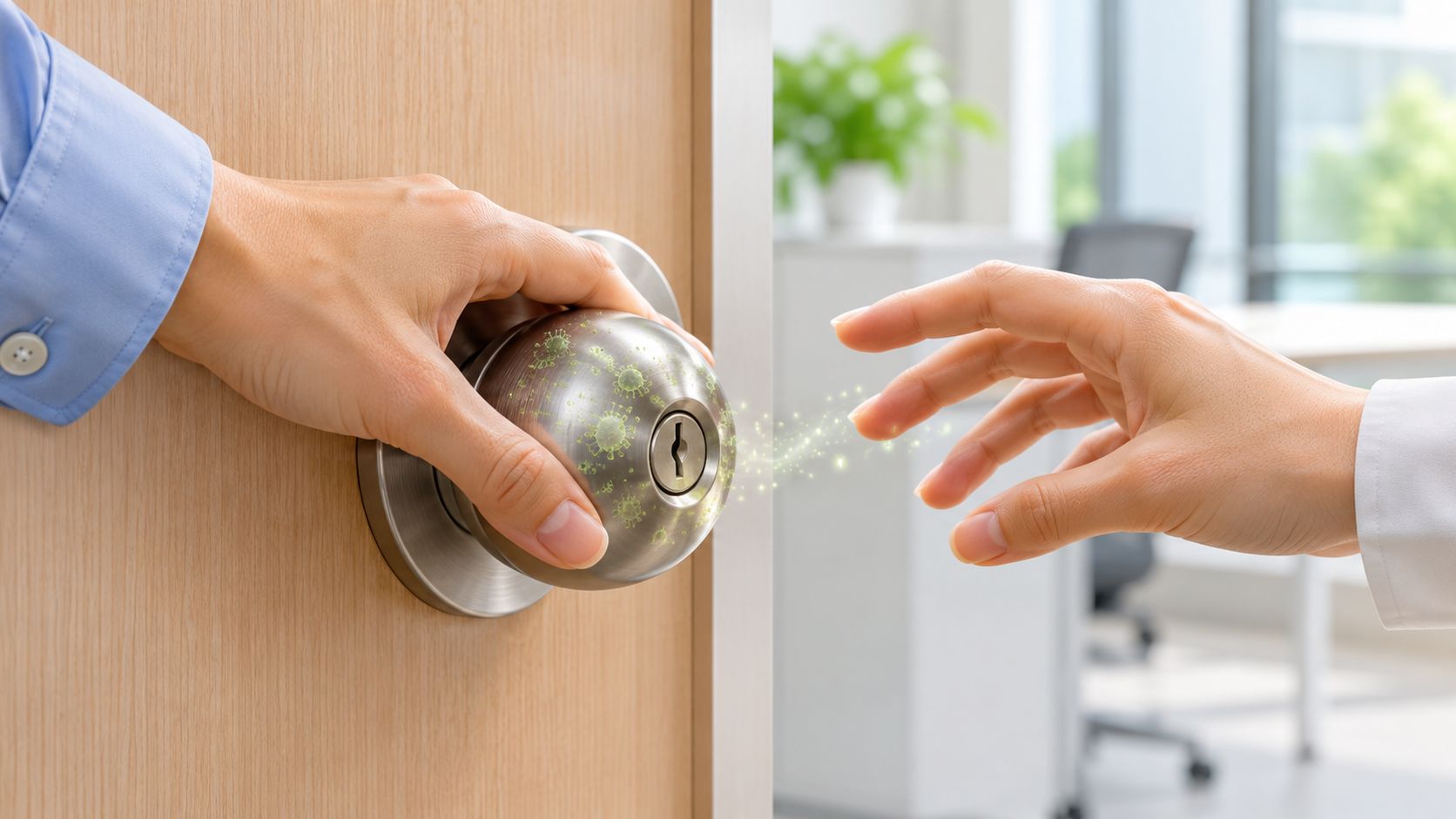
A fomite is any object or surface that can carry infectious germs from one person to another, such as a doorknob. If you've just touched a shared door handle and reached for your face, you've encountered the everyday situation behind the term.
That doesn't mean you've caught anything. Understanding the fomite definition helps you distinguish an object that could carry germs from an exposure that could realistically cause illness.
What a Fomite Is in Plain Language
A fomite is an inanimate object or surface contaminated with an infectious agent that can contribute to transmission.
Say a coworker sneezes into a tissue, gets infectious material on their hand, and touches a doorknob. A colleague later touches that spot and rubs their eyes. The doorknob is the fomite, the nonliving intermediary in a possible transmission pathway.
The tissue and contaminated hand matter, too, but the word describes the object rather than the person or the germ. A clean doorknob isn't automatically a fomite because people touch it.
Why the word means kindling
Italian physician Girolamo Fracastoro used the Latin word fomes, meaning tinder or kindling, in his 1546 work De Contagione et Contagiosis Morbis to describe clothing and wooden objects that could preserve infectious matter, as documented in the historical overview of fomites. His explanation recognized that disease could travel through things, not only through direct contact between people.
The kindling comparison is useful: the object doesn't create the infectious agent, but it may hold it and help pass it onward. Modern usage covers viruses, bacteria, fungi, and other pathogens, not just viruses.
Contamination alone doesn't establish that transmission happened. Try restating the definition using something you share: “A contaminated remote control can be a fomite because it can carry germs between the people using it.”
Everyday Fomites and the Viruses Linked to Them
| Object | Typical setting | Viruses or pathogens linked |
|---|---|---|
| Doorknobs, light switches and handrails | Homes, offices and schools | Rhinovirus and influenza viruses |
| Shared phones and keyboards | Workplaces and clinics | Respiratory viruses such as SARS-CoV-2 |
| Stethoscopes and medical equipment | Hospitals and clinics | Healthcare-associated bacteria and viruses |
| Cutting boards, dishes and food-contact surfaces | Kitchens and restaurants | Norovirus and other enteric viruses |
| Towels, clothing and bedding | Homes and care facilities | Pathogens shed by the person using them |
| Toys and shared play items | Daycares and schools | Norovirus and rhinovirus |
Use this as a sortable mental checklist: group objects by setting, who touches them, or the likely pathogen. These associations identify possible contamination, not equally likely routes of infection.
Door handles and switches can connect contaminated hands with another person's hands. Rhinovirus and influenza viruses can be involved in that pathway, but the table doesn't mean influenza spreads mainly through surfaces.
Medical equipment deserves particular attention because staff may move it between patients. The CDC's indirect-spread teaching materials explicitly use a stethoscope as an example of an object involved in indirect transmission.
Food-contact objects raise a different question: could contamination reach something someone will eat? Norovirus can spread through contaminated food or through surfaces contaminated by vomit or stool residue. Towels and bedding require an illness-specific assessment rather than a universal list of germs.
Object check: Is it touched by many hands, and is the likely pathogen respiratory or enteric?
Enteric means associated with the intestines. That distinction helps you decide whether to focus on shared hand contact, food preparation, bathroom contamination, or respiratory precautions rather than treating every object alike.
How a Contaminated Object Passes Infection to You
- Contamination occurs. An infected person touches an object or deposits infectious droplets or particles on it.
- The virus persists. Some infectious virus remains on the material under the surrounding conditions.
- Another person makes contact. They touch the contaminated spot and pick up some of the virus.
- The virus reaches an entry site. Their hand touches the mouth, nose, or eyes, creating an opportunity for infection.
The illustration separates contact, transfer, and entry into smaller stages.

Transfer isn't all or nothing
In a 2021 virus-transfer study, 20 volunteers completed 360 transfer events involving stainless steel, painted wood, and plastic; mean transfer rates across surfaces and both transfer directions were 0.17, approximately 17%, for Phi6, an enveloped-virus surrogate, and 0.26, approximately 26%, for MS2, a nonenveloped-virus surrogate.
These percentages describe recoverable virus transferred during experimental contact, not the probability of becoming infected. Surrogates are experimental stand-ins, not interchangeable predictions for every human virus.
The difference illustrates why virus structure matters. Transfer also changes with material, contact direction, moisture, humidity, and time since handwashing.
For the broader context, the guide to how viruses spread distinguishes surface transmission from other pathways. Choose an object you've touched today, trace its possible journey through the numbered sequence, and identify where handwashing or cleaning could interrupt it.
Why Contaminated Does Not Always Mean Infectious
The common assumption is simple: a germ on a surface means an infection waiting to happen. In reality, the organism must remain viable, transfer successfully, reach susceptible tissue, and arrive in a sufficient dose.
A laboratory finding that a virus survives on material doesn't establish that people routinely become infected from that material. For SARS-CoV-2 in community settings, surfaces aren't considered a primary transmission route; inhalation deserves more attention.

There's no universal survival clock
A 2024 systematic review of pathogen persistence distinguishes retention of replication capacity on surfaces from demonstrated healthcare-associated infection risk. Persistence changes with the pathogen, starting amount of contamination, material, temperature, humidity, light, drying, and organic soil.
Porous cloth or paper holds contamination differently from smooth steel or glass. Ultraviolet light and repeated handling can shorten persistence under some conditions, but neither provides a dependable household disinfection method.
Detection isn't the same as infectiousness, either. Molecular tests can detect genetic material after infectious particles have degraded, so a positive surface test alone can't tell you whether that surface could cause infection.
For a closer look at these conditions, consult how long viruses live on surfaces.
Practical rule: Prioritize visibly soiled surfaces and shared high-touch objects during illness. Don't let surface cleaning replace ventilation and other respiratory precautions.
Practical Steps to Cut Fomite Risk at Home
A useful routine targets the places where contamination and contact overlap. You don't need to disinfect every possession.
Wash your hands with soap and water. Do this before eating or touching your face, and after handling potentially contaminated shared objects. Handwashing interrupts transfer without requiring you to identify every contaminated surface.
Identify the frequently handled objects. Include door handles, switches, taps, phones, remotes, and fridge handles. Check the manufacturer's cleaning instructions for electronics so you don't damage screens or openings.
Remove visible dirt first. Use detergent and a clean cloth to lift away soil before disinfecting. Organic material can shield germs and interfere with a disinfectant reaching them.
Disinfect selectively during illness. Choose a product whose label names the target pathogen and keep the surface visibly wet for its full stated contact time. A quick swipe followed by immediate drying may not meet those directions.
Handle shared textiles and food surfaces carefully. Separate used towels and cloths from clean ones, and launder them with detergent using suitable fabric settings. Clean and sanitize cutting boards after raw-food preparation to avoid transferring contamination to ready-to-eat food.
Use norovirus-appropriate precautions after vomiting or diarrhoea. Clean up contamination and apply a product labelled effective against norovirus. Alcohol-based hand sanitizers are less reliable against norovirus, so don't substitute them for soap-and-water handwashing or assume an alcohol-based surface product has the necessary claim.

For terminology and technique, use the guide to cleaning and disinfecting. If you manage shared desks or office equipment, the Top Cleaners office sanitising guide provides additional workplace context.
Before relying on any product, including disinfecting wipes, check its pathogen claim, surface compatibility, and wet contact time. Never mix cleaning chemicals.
Confirm Your Cleaning Priorities Before the Next Outbreak
Make a small, specific plan rather than a promise to clean everything. Your priorities should reflect the illness involved and the people sharing the space.
- Identify the current concern. Use local public-health updates and household or workplace illness information to establish which viruses merit attention.
- Choose three to five priority objects. Pick those most often handled by someone who's sick or especially vulnerable, then assign a cleaning time during the illness period.
- Name the person responsible. Decide who handles each object so the task isn't left to assumption.
- Check supplies before buying. Keep a suitable disinfectant or disinfecting wipes available, with the target-pathogen claim and contact time clearly identified.
- Use pathogen-specific guidance. Our norovirus and respiratory-virus guides address different transmission concerns. Our Science articles cover mutation mechanisms, virus-host interactions, disinfection strategies, environmental factors, and real-world applications of virus control.
Write your list of three to five priority objects on paper today, add a responsible person beside each, and check that your chosen cleaning product matches the illness you're preparing for.
Leave a Reply