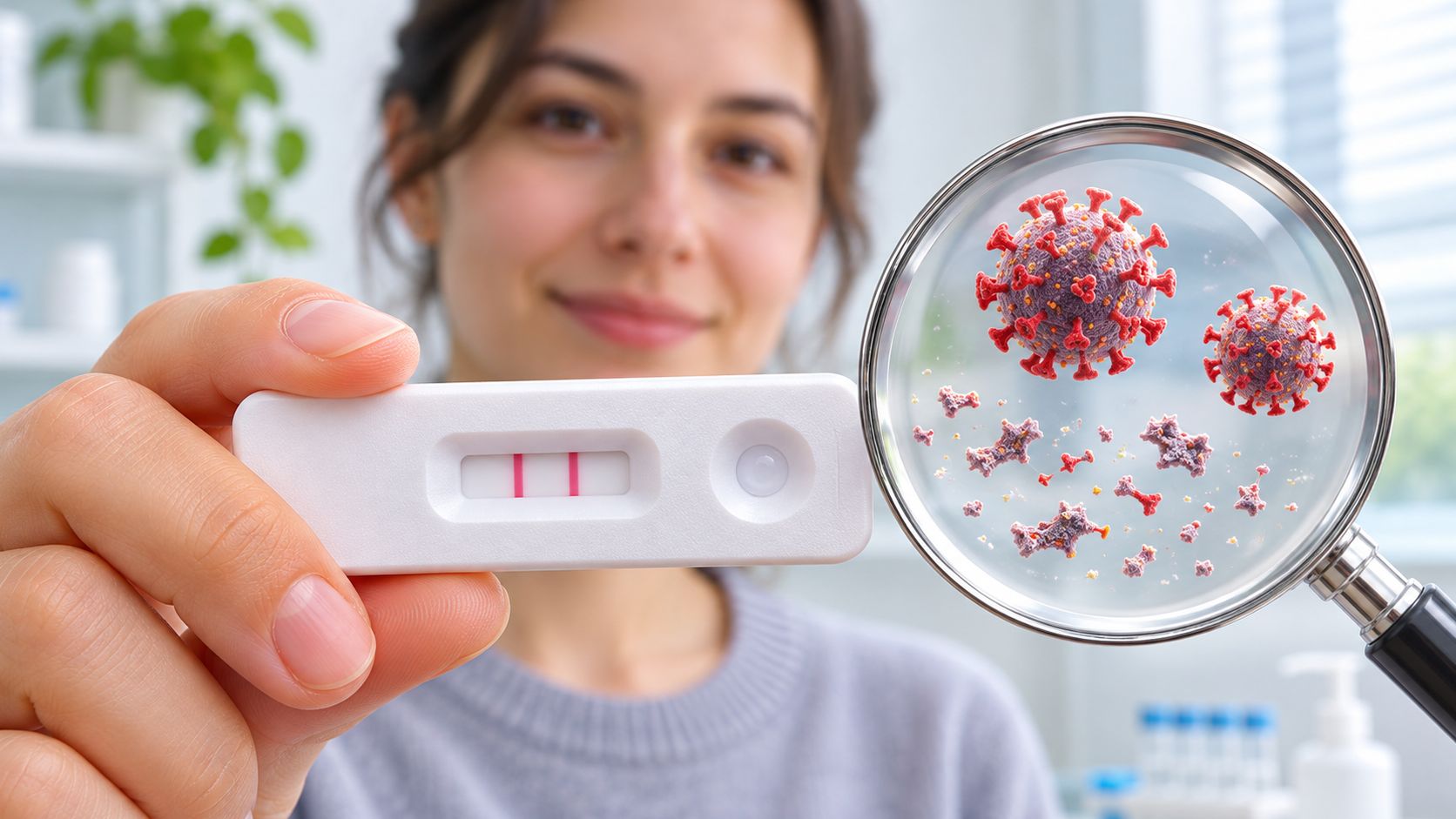
The fever broke on Thursday. By Sunday you felt normal, and by the second week you had stopped thinking about it. Then a home test on day 14 still shows a faint second line. Is that line still able to infect the next person, or is the test only reading history?
Viral shedding is virus, or pieces of virus, leaving an infected person. That release, by itself, does not prove you are still contagious. Reviews of SARS-CoV-2 studies consistently find that live virus disappears from samples well before viral RNA does, often by one to several weeks.
Confusion starts when three events share one name: virus leaving the body, a lab finding its genetic material, and someone else getting infected. They overlap. They do not run on the same clock. A faint line can be leftover fragments, the way smoke hangs in a kitchen after the burner is off, long after nothing there can start a new fire.
What Viral Shedding Means and Whether You Are Contagious
Shedding is the virus going out. The exits are broad: respiratory secretions, saliva, stool, urine, blood, genital secretions, and skin lesions. A person with a streaming nose and a person with a healing lesion are both shedding, and neither fact tells you whether the next person in the room will end up infected.
Shedding is a timeline, not a verdict. It begins, peaks, declines, and then leaves a tail of detectable debris that can outlast the illness by weeks.
Three things people call shedding
- Detecting viral RNA or DNA. A molecular test finds a genetic signature. It picks up whole virions and it also picks up shredded fragments.
- Releasing intact particles. Some of what leaves the body is still assembled, genome and proteins wrapped in one package.
- Releasing replication-competent virus. This is the subset that can dock onto a cell, copy itself, and start a new infection. Contagiousness needs this layer, and only this layer.
The distance between the layers is measurable. In a review of 28 SARS-CoV-2 studies published in Infection Control & Hospital Epidemiology, culturable virus lasted a median of 8 days in hospitalized patients, with an interquartile range of 5 to 11 days and a maximum of 20 days. Viral RNA turned up as late as 92 days after symptoms began. That distance between the layers is what viral shedding meaning comes down to in practice, because culture is a closer measure of replication-competent virus and RT-qPCR isn't.
| Term | What it means | Does it prove contagiousness? |
|---|---|---|
| Viral shedding | Virus or viral material released from an infected person through breath, saliva, stool, urine, blood, genital secretions or skin lesions | Not by itself, because it depends on whether the virus is still infectious |
| PCR or RT-qPCR positive | Viral genetic material (RNA or DNA) was detected, including leftover fragments | No, since RNA can persist for weeks after live virus is gone |
| Viral culture positive | Lab grew replication-competent (live) virus from a sample | Closest lab sign that a person may still be infectious |
| Rapid antigen positive | Viral proteins from actively replicating virus were detected | More closely tied to current infectiousness than a late PCR positive |
| Transmission | Infectious virus reaches and infects a new host | Actual spread, the outcome the other rows only estimate |
So does shedding mean you're contagious? Not automatically. WHO infection prevention and control guidance notes that viral RNA may remain detectable for weeks after symptom onset, while viable virus was not found after day 8 in mild COVID-19 cases, and severe illness can extend that window. Real risk also depends on how much viable virus is present, whether you're coughing or generating aerosols, the type of contact, the other person's immunity, and the masks and ventilation in the room.
Read the result by the clock, not the line. A positive test on day 14 answers a different question than a positive test on day 2, even when both look identical.
Site matters too. Fecal, skin-lesion and genital shedding each follow their own route, and shedding at one site doesn't imply respiratory spread. A herpes lesion on the skin is a contact exposure. Loose stool from a norovirus infection is a hand, food and surface problem. Neither behaves like a cough in a crowded lift.
Why no single cutoff date works
A healthy 30-year-old, a newborn, and a transplant patient on immunosuppressants don't clear virus on the same schedule, so a universal "safe on day X" rule would be wrong. Read any result through four filters: the test type, the day count from symptom onset, the severity of the illness, and the person's immune status.
How Viruses Leave the Body
Think of one infected cell in your airway as a copy machine in a factory with the loading dock open. The virus forces the machine to print its genome and its shell proteins, then assembles the parts into new parcels. Those parcels leave through the dock, and that departure is what we're describing.
Not every parcel that ships is complete. The dock also releases torn labels and empty boxes, fragments of genome and protein that a test still recognizes and that can't infect anyone. In the definition used by a systematic review of SARS-CoV-2 shedding, shedding is the release of virus or virus-derived material through a body site such as the respiratory tract, stool, blood, urine or genital secretions, and a positive molecular test doesn't prove that replication-competent virus is present.

The exit route maps to the spread route
- Respiratory secretions carry influenza, SARS-CoV-2, RSV and rhinovirus out in droplets and fine aerosols, which is why ventilation and masks do the most work here.
- Stool is the exit for norovirus and rotavirus, and the fecal-oral route runs through hands, food, water and surfaces.
- Saliva carries mumps and cytomegalovirus, which is why shared bottles and cups matter more than people expect.
- Skin lesions shed herpes simplex, varicella and mpox, so the exposure is contact with the lesion itself.
- Blood and urine can carry hepatitis B, cytomegalovirus and Zika, which shifts the advice from covering a cough to needle safety and sexual precautions.
Shedding is the virus's exit strategy, and the exit route tells you where hygiene, disinfection and ventilation actually intervene.
How Viral Shedding Is Detected
The test you choose decides which question gets answered.
Molecular tests, meaning RT-PCR and RT-qPCR, hunt for viral RNA or DNA with very high sensitivity. Because they amplify short stretches of genetic code, they stay positive long after your immune system has neutralized the live virus and the remaining fragments are debris.
Viral culture tries to grow replication-competent virus from your sample. It's the closest laboratory sign that you're shedding something infectious, and it's nearly useless at the bedside: it takes days, needs specialized facilities, and is mostly reserved for research and hospital settings.
Rapid antigen tests detect viral proteins from actively replicating virus. They miss more infections than PCR does, but a positive antigen result tracks current infectiousness more closely than a late PCR positive, which is why they feed return-to-work and return-to-school decisions.
What a cycle threshold tells you
PCR results often arrive with a cycle threshold, the number of amplification rounds needed to cross the detection line. A low number means a lot of starting material, a high number means very little, so a Ct of 20 and a Ct of 35 describe different situations even though both read as positive. Lower cycle thresholds generally mean more virus is present, and that's the closest a routine result comes to a quantity. Our explainer on what viral load testing measures covers the units and reporting conventions.
| Method | What it detects | Typical turnaround | What it tells you |
|---|---|---|---|
| RT-PCR / RT-qPCR | Viral RNA or DNA, including residual fragments | Hours to 1 to 2 days | Confirms infection; a late positive doesn't prove live virus |
| Viral culture | Replication-competent (live) virus | Several days, in specialized labs | Closest measure of infectious shedding; rarely used in routine care |
| Rapid antigen test | Viral proteins from active replication | About 15 to 30 minutes | Less sensitive than PCR, but positivity tracks current infectiousness more closely |
Infectious-virus titers for respiratory SARS-CoV-2 are typically highest around symptom onset, according to a Nature Reviews Microbiology overview of viral shedding dynamics, and people who are severely ill or immunocompromised may shed viable virus for longer than everyone else. The same swab can give you a reassuring antigen result and a worrying PCR result on the same afternoon without either one being wrong.
When Shedding Peaks and Fades
Consider how an influenza infection changes around symptom onset. Viral RNA can sometimes be detected before a person feels ill, while the amount of infectious virus usually rises and falls on a shorter timeline.
- Day minus one. CDC's infection control update on viral respiratory infections reports that RT-PCR detected influenza A RNA in 4 of 15 participants (27%) one day before illness onset, and influenza B RNA in 4 of 14 (29%). An estimated 1% to 8% of influenza infectiousness happens before symptoms appear.
- Day zero. Culture-measured infectious virus peaked on the day acute illness began, then declined steadily over about five days. Most shedding occurred in the first two to three days, and fever tends to increase how much virus comes out.
- Days three to seven. Most transmission of influenza A and SARS-CoV-2 Omicron occurs early in the illness. Transmission risk generally falls as the days pass, even though a test may still detect viral material.
- Day ten onward. Most mildly ill adults stop shedding these viruses within 10 days, though some continue longer.

A positive PCR and contagiousness are different things. PCR can detect RNA left behind after the amount of intact, infectious virus has declined. A CDC Emerging Infectious Diseases investigation concluded that SARS-CoV-2 shedding may begin before symptoms or while symptoms are mild or absent. It also found that positive viral culture was more likely when PCR cycle-threshold values were lower and additional symptoms appeared. Someone who feels only mildly ill can still spread infection, especially early on.
The shape to remember: infectious shedding tends to rise and fall over a short window. PCR may stay positive after that window, because it can detect viral RNA without proving that intact virus remains or that a person is contagious.
How Long Shedding Lasts for Common Viruses
Anyone who quotes one universal number is guessing. Duration changes with the virus, the body site sampled, age, illness severity and immune status, and the gap between the shortest and longest figures below is the whole point.
| Virus | Main shedding site | When shedding starts | Typical duration |
|---|---|---|---|
| Influenza A/B | Respiratory secretions | About 1 day before symptoms | Usually 5 to 7 days, highest in the first 2 to 3 days; longer in young children and severely immunocompromised people |
| SARS-CoV-2 (mild to moderate) | Respiratory secretions | Around or just before symptom onset | Live virus up to about 10 days; RNA detectable for weeks |
| SARS-CoV-2 (severe or immunocompromised) | Respiratory secretions | Around symptom onset | Live virus up to about 20 days in a small fraction of patients |
| Norovirus | Stool, saliva and vomit | Around symptom onset | Stool median about 11.5 days from symptom onset; saliva about 13 days; vomit about 1 day |
| RSV | Respiratory secretions | Around symptom onset | Children about 14.7 days; adults about 5.3 days; older adults about 7.8 days |
Norovirus is the clearest argument for tracking sites separately. A 2025 systematic review and meta-analysis of norovirus shedding found stool shedding peaked about 4 days after symptom onset and lasted a median of 11.5 days from symptom onset, with an interquartile range of 6 to 22 days, versus 14 days measured from infection. Saliva shedding lasted a median of 13 days after symptom onset, while the available vomiting data showed a median of 1 day. That long stool tail is why handwashing still matters after the vomiting stops.
Respiratory viruses split sharply by age. A 2024 RSV kinetics study estimated median qPCR-detectable shedding of 14.7 days in children, 5.3 days in adults and 7.8 days in older adults.
Influenza and SARS-CoV-2 follow their own rules. Archived CDC influenza guidance describes shedding that usually runs 5 to 7 days beginning about a day before illness and peaking in the first two to three days, longer in young children and severely immunocompromised people, and defines the practical infectious period as starting one day before fever and ending 24 hours after fever resolves without fever-reducing medication. CDC's SARS-CoV-2 isolation guidance describes replication-competent virus for up to about 10 days in mild-to-moderate illness and up to about 20 days in a small fraction of people with severe disease or severe immunocompromise, while RNA can linger for weeks. If you want the transmission side of this, our piece on how long viruses stay contagious goes virus by virus.
What Wastewater Signals Do and Do Not Mean
A city's treatment plant pulls a sample on Tuesday. By Friday the public dashboard shows the curve climbing. Nobody swabbed a single person. The signal is still real, because thousands of residents are shedding into the same pipes.
A sewer sample works like one mixed cup from a whole neighborhood. It catches presymptomatic, asymptomatic, and symptomatic shedders at once, so health agencies treat a rising curve as an early warning that can climb before reported cases do. A 2026 Microbiology Spectrum surveillance analysis compared 669 wastewater samples with 325 clinical specimens in Georgia and found more than a 16-fold difference in detected SARS-CoV-2 genomic diversity. Sewage can surface variants that clinical testing misses. Monitoring is also widening to mpox, which is shed in urine, feces, respiratory secretions, and skin lesions.
The curve answers a narrower question than it looks. The lab is detecting viral RNA, genetic material in the water. Detecting that RNA is not the same as finding intact virus, and finding intact virus is not the same as knowing who is contagious. Wastewater RNA does not prove viable virus is present, does not count how many people are infectious, and cannot say who infected whom. A city spike can keep registering after the people behind it have stopped passing virus on.
Rainfall, dilution, sanitation infrastructure, and lab methods all move the number. If you are setting up sampling, the Labs USA wastewater lab checklist covers the logistics.
A wastewater spike is a city-level early warning of viral RNA in the sewers, read as a trend rather than proof about your own risk this afternoon.
What to Do With a Lingering Positive Test
- Name the test. PCR, antigen and culture answer three different questions, and a PCR can sit positive on leftover genetic material. If you're choosing between them, our comparison of antigen test vs PCR sets out the trade-offs.
- Count from symptom onset, not from the test date. Respiratory shedding is front-loaded, so the days before your first symptom and the few right after carry far more risk than week three does.
- Read the symptom trajectory. Improving symptoms are the usual return benchmark, and for influenza the practical infectious period closes once fever has stayed down for 24 hours without fever-reducing medicine.
- Weigh severity and immune status. A mild case and a transplant recipient don't run the same schedule. Severe illness or severe immunocompromise extends viable shedding and needs a clinician, not a calendar.
- Follow pathogen-specific guidance. Isolation rules for influenza, COVID-19 and norovirus come from public health agencies and employers, not from one universal shedding threshold.
Shedding describes virus leaving the body. Infectiousness is what happens next, and a lingering line on a test is only one input into that question. If a specific result has you stuck, our contact page accepts questions about viruses and about our content, and we welcome the discussion.
Shedding ends on surfaces, and that's where the practical work sits. The bathroom tap you touch after blowing your nose, the kitchen counter that held the snack plate, the door handle between the bedroom and the hallway: those are the points where virus leaving one body gets its chance at another. Keep disinfecting wipes in each of those spots and pull one every day while someone in the house is ill, then once more after the symptoms settle, because stool and saliva can keep carrying virus past the last sneeze. Let the surface stay wet for the full contact time printed on the label. A wipe that dries in three seconds hasn't done the job that a wipe left wet for the stated time will do.
Leave a Reply