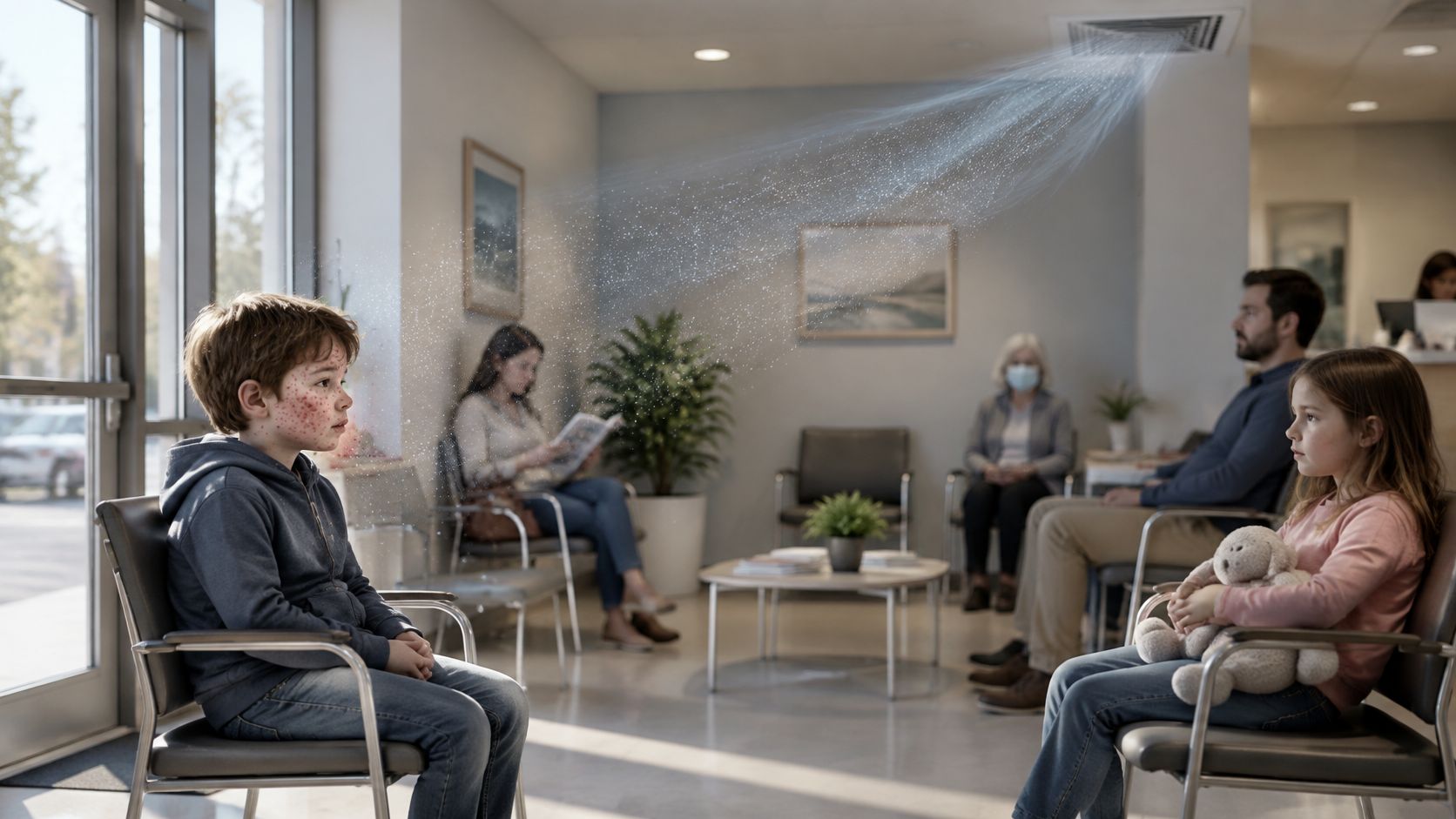
Measles does something few infections can match. In close-contact settings, more than 90% of susceptible people exposed to an infectious patient may develop infection, according to the CDC Pink Book chapter on measles. That is also why public health programs aim for roughly 95% coverage with two doses of measles-containing vaccine, the level at which herd protection holds.
A number that high only makes sense if the virus is unusually good at finding people. Measles doesn't need a handshake or a shared drink. It travels in fine particles that stay suspended in a room, drift into corridors, and remain capable of infecting someone who arrives after the patient has left.
The practical question for anyone who has shared a waiting room, a classroom or a bus with a case isn't whether they stood close. It's what happened to the air, how much virus was in it, and how quickly that air was replaced. Those three things decide how long measles airborne transmission stays a live risk in a given space.
How Long Measles Stays Infectious in Shared Air
Up to 2 hours. In its 2024 CDC Health Alert, the agency stated that measles can remain infectious in the air for up to 2 hours after an infected person leaves an area. Clinic staff and school nurses call that the two-hour rule. Use it as a reference ceiling: the longest interval public health guidance asks you to plan for when you do not yet know how that room handles air.
Times reported underneath the ceiling do not agree, and that disagreement is useful. A 2025 systematic review of airborne measles virus survival describes reported environmental survival from 29 to 120 minutes. Within that span, two US reports from 1985 documented transmission roughly 60 to 75 minutes after the infectious patient had left an outpatient healthcare facility. Experimental studies in the same review reported survival in airborne environments for 30 to 120 minutes, with longer survival at lower humidity.
Read the range correctly. Experimental survival measures how long virus stays viable while suspended. Outbreak reports measure when someone was probably infected after a room emptied. Neither one produces a cutoff that applies to every room.
Guidance turns the ceiling into a clearance target rather than a fixed wait. The CDC's guidance on infection control for measles sets the vacancy interval so that approximately 99.9% of airborne contaminants are removed, and the exact clearance time depends on the room's air changes per hour. Two hours is the maximum reference period. A room whose air is replaced quickly does not have to sit empty for the full two hours.
| Source | Reported persistence | Evidence type |
|---|---|---|
| CDC Health Alert, 2024 | Up to 2 hours after the patient leaves | Public health guidance |
| CDC infection-control guidance | Up to 2 hours; vacancy time targets 99.9% removal | Healthcare guidance |
| Systematic review, 2025 | 29 to 120 minutes overall; experiments 30 to 120 minutes, longer at lower humidity | Experimental and outbreak reports |
| Two US reports, 1985 | About 60 to 75 minutes after the patient left an outpatient facility | Outbreak evidence |
Shared air works like smoke from a burnt pot. A strong fan clears a small kitchen while you can still smell last night's dinner in a closed room with a weak vent. Lower humidity, the condition tied to longer experimental survival, leaves viable virus in that cloud for more of the wait. Room size changes the starting amount: the same cough fills a small exam room faster than a large hall, and a big volume with few air changes can take longer to flush. Fast exchange can bring a space under the ceiling well before two hours. A closed room with little mechanical ventilation can still hold suspended particles at the far end of the reported range. The clock stands in for that physical process. The process, not the round number, decides whether the air you walked into was still a risk.
How Measles Particles Travel Through a Room
Picture two kinds of spreading. A drop of ink in a glass of water colours the whole glass within seconds, even though nobody stirred it. Cigarette smoke in a hallway drifts past doorways and hangs near the ceiling long after the smoker has gone back inside. Measles does both, and the smoke half is the part people underestimate.

Droplets fall quickly, droplet nuclei don't
When an infected person coughs or sneezes, the largest droplets carry a heavy load and travel a short distance before landing on a surface or a sleeve. Those are the droplets that spacing and hand hygiene address, and they matter. The smaller particles behave differently. Once the moisture around them evaporates, they become light enough to ride air currents across a room, out into a corridor, and through a shared ventilation system.
Breathing and talking release them, not only coughing. A person who feels faintly unwell, with a cough they'd call ordinary, sheds virus while doing nothing more dramatic than sitting in a chair.
What shared air means for you
- Breathing the same air: the highest-risk route, and it doesn't require a conversation. Sitting at the far end of a waiting room for twenty minutes can be enough.
- Entering afterwards: particles outlast the visit. Whoever walks into that space next inherits some of what the patient exhaled.
- Touching contaminated surfaces: droplets land on hands, phones, armrests and door handles. This route is real but secondary for a virus that spreads so efficiently through air.
- Close face-to-face contact: the biggest dose, which is why household members and clinicians who lean in to examine a patient are consistently over-represented among secondary cases.
This is why public health investigators ask what amounts to room occupancy history rather than only who shook hands with the patient. Someone who never spoke to the case can still be part of the same exposure event.
Making that picture clear is what VirusFAQ's education articles are for. They explain what a virus is and how it infects people in plain terms, without flattening the parts that matter.
Two questions decide how much any shared air mattered: how long the virus stays viable once suspended, and what in the room speeds up or slows down its removal. Seating charts and visit length just feed into those two.
What Ventilation, Humidity and Room Size Change
Two rooms can hold a similar amount of virus and pose very different risks. Four conditions decide how quickly a space stops being dangerous: humidity, air exchange, airflow between spaces, and how large and crowded the room is.
Humidity widens the range
Experimental work shows measles survives longer at low relative humidity, which is one reason the survival figures spread across nearly two hours. WHO's summary of measles airborne persistence sets out the two-hour figure while noting the limits of the evidence, and the review behind it puts survival at 29 to 120 minutes across experimental and real-world studies.
There's no validated humidity threshold you can act on. Treat humidity as the explanation for why the numbers disagree, not as a dial with a known safe setting.
Air changes per hour set the real clearance time
An air change means one room volume of air being replaced. The more of them per hour, the faster suspended particles are diluted and carried out. WHO's own summary of the modeling shows how wide that effect is:
- Nine air changes per hour: aerosols returned to background levels in about 30 minutes.
- Four air changes per hour: roughly 1.2 hours.
- One air change per hour: about four hours.
- Stagnant air: around nine hours.
Airflow and room size move risk in both directions
Air that moves between rooms, or recirculates through a shared system, can carry virus well beyond the person who produced it. Greater distance from the source reduces the inhaled dose but doesn't eliminate it, because a large room still mixes its air. Size and occupancy work together: a small, closed room with a dozen people reaches a higher concentration faster than a large, sparsely used hall. If you're the one responsible for a room, the practical work of improving exchange and filtration belongs in a wider indoor air quality improvement plan.
Good ventilation is not a safety switch
A modeling study of airborne measles transmission estimated a 17.3% airborne transmission rate at 600 ppm indoor carbon dioxide, against 87.4% at 2,400 ppm under otherwise comparable conditions. In the same work, surgical masks reduced modeled risk by up to about 45%, depending on ventilation.
Those are modeled estimates, not universal probabilities. They rest on assumptions about infectious dose, exposure duration, occupancy, mask fit and how much virus the source patient was shedding. What they do challenge is the reassuring message that opening a window or seeing a low CO2 reading makes a room safe. A low reading means the air is better mixed and better exchanged. It doesn't mean the virus is gone.
Room test for a clinic, classroom or bus: was the space mechanically ventilated, could windows open, how many people shared it, how long ago did the infectious person leave, and how close were you for how long? Four answers in the wrong direction are worth a phone call.
WHO states that the evidence on risk at different intervals after a patient leaves is limited. Two hours is a practical reference point, not a guarantee.
The Eight-Day Window Before and After the Rash

Measles is infectious from four days before the rash appears through four days after, according to the WHO measles fact sheet. That makes an eight-day window. For much of it, a person may have no visible rash to alert others.
Fever, cough, a runny nose and red, watery eyes often appear first. These symptoms can resemble common illnesses. A few days later, the rash usually begins at the hairline and face, then spreads downward. The four days after the rash starts remain within the infectious window; after that, routine precautions no longer treat the person as a transmission risk.
The days that matter most have no rash
The early symptoms can look like a cold, flu or allergy. A person may keep attending appointments or spending time in shared spaces before anyone suspects measles. Precautions that begin only after the rash appears can miss earlier days when transmission is possible.
Public-health investigators therefore consider contacts from four days before the rash began. Anyone who shared air with the person during that period may need to be assessed.
A child with a mild fever visits a clinic three times before the rash appears. The first visit involves a waiting room shared with parents and toddlers. The second includes a corridor and shared bathroom. At the third, the child spends time in a consultation room with a clinician. Each visit creates a separate exposure event, with its own people and timing to assess.
At check-in, asking about fever, cough or red eyes and separating a potentially infectious patient before they sit down can help limit shared-air exposure.
If you think you or your child may have been near a measles case, tell the clinic when the contact happened and describe the setting.
Real Exposure Settings From Clinics to Classrooms
The physics doesn't change between buildings. What changes is how much influence you have over the air and how easily you can know a case was there.
A clinic waiting room. A child with a low fever and a cough sits for an hour beside a fish tank before anyone recognises measles. Everyone who used that room while the child was in it, and everyone who walked in afterwards, needs to be assessed against the timing. The exposure question is simple: who shared the room, and how long after the child left did they arrive?
A classroom. Thirty people breathe the same air for hours in a space with one door and windows that may or may not open. One unrecognised case can put an entire year group on a monitoring list, plus the bus driver and the after-school club. Here the question isn't proximity but duration: how many hours of shared air, in a room that exchanged how much of it?
An aircraft or bus. Recirculated air, fixed seating and a captive group make exposure hard to bound. Public health teams typically need seat numbers and timing to work out who was close enough and who was in the same cabin. That a passenger three rows away may need checking is not bureaucratic caution. It follows from how the particles move.
A household. Prolonged contact in a small space defeats most of the advantages of good ventilation, because exposure time is long and the dose accumulates. Shared bedrooms and bathrooms matter, and so does the fact that a sick child wants to be held. Household contacts carry the highest attack rates of any setting for exactly this reason.
Each of those settings resolves to the same short set of questions: who shared the air, for how long, in a space that turned over how often, and how recently had the infectious person left. Once you can answer those, you know whether you're dealing with a passing exposure or an extended one, and you can tell a clinician something useful instead of "I might have been near someone".
Vaccination and Controls That Cut Airborne Risk
Vaccination is the measure that changes the outcome. Two documented doses of a measles-containing vaccine keep the virus from establishing infection in the first place, and when enough people in a community carry that protection, an introduced case runs out of susceptible people to infect. Everything else in this article manages risk. Vaccination ends it.
| Measure | What it reduces | Main limit |
|---|---|---|
| Two doses of measles-containing vaccine | Susceptibility of contacts and the chain of spread | Needs very high two-dose coverage across the population; people not yet vaccinated stay unprotected |
| Isolation and airborne precautions | Exposure in waiting rooms and wards | Depends on early recognition, which can lag behind the rash |
| Fit-tested N95 or equivalent respirator | Inhaled dose for staff | Requires fit testing and correct use every time |
| Surgical mask | What a patient releases, and some of what the wearer inhales | Less protective than a respirator; fit and occupancy change the result |
| Ventilation and air changes | Aerosol concentration over time | No safe threshold; a low CO2 reading does not prove the air is clear |
How the layers fit together
Vaccination works on the person. Ventilation works on the room. Isolation keeps a case out of shared spaces in the first place, and respirators work on whatever gets past the other three. No single layer is complete, and the ones that depend on a person behaving correctly are the ones that fail first.
The CDC's guidance for clinicians on measles cases is direct about the sequence for a suspected case: mask the patient immediately, separate them from the waiting area, and place them under airborne precautions, with staff in fit-tested N95 respirators or comparably effective protection. After the room empties, the guidance says to estimate clearance from the room's measured ventilation rate rather than assuming a fixed two-hour wait solves it.
That last point is worth repeating to anyone who manages a building. Clearance is a calculation about air, not a ritual about clocks.
Facility rule: mask first, move second, then calculate the room's vacancy time from its air-change rate. The order matters because every minute a suspected case spends in a shared waiting area adds people to the contact list.
Surgical masks cut how much a patient releases, which is why masking a suspected case on arrival is the cheapest effective step available. On the wearer, a surgical mask seals loosely and protects less than a respirator. The difference between the two is measured in fit, not in fabric.
Surface cleaning is not the main answer for an airborne virus. It's still worth doing around a sick person, since droplets land on phones, taps and handles, but wiping every surface in a clinic won't stop a virus that is still suspended in the room. The distinction between routes drives everything else, and it's covered in more depth in our guide to airborne versus droplet precautions.
Confirm Your Immunity Before Any Exposure
Three checks, in order, and the order matters because each one takes less time than the next would.
- Find your record. Look for documentation of two doses of a measles-containing vaccine, or ask a clinician whether you have evidence of immunity. Without a record, assume you need a conversation rather than assuming you're covered.
- Reconstruct the window. If you were in the same room during the period after an infectious person left, or spent time with them across the eight-day infectious period, count yourself as potentially exposed. Write down the date, the time and the room.
- Call before you go anywhere. Phone your doctor or the local health department before visiting a clinic, and say you may have been exposed to measles. Staff can arrange to see you without sending you through a shared waiting room, which is the single most useful thing you can do for everyone else in the building.
Post-exposure vaccination can still help if it's given early enough after exposure and before symptoms start, and health authorities can advise on other options for people who can't be vaccinated. Watch for fever, cough, runny nose and red eyes over the weeks that follow, since symptoms can appear late, and call ahead again if they do.
Adults who aren't sure of their status can check the adult immunization schedule for how the two doses are spaced.
Measles airborne transmission rewards preparation over reaction, and the preparation starts with a piece of paper. Pull out your vaccination record tonight, photograph it, and put it somewhere you'll find it in a hurry. If it shows two doses, you've done the one thing that reliably changes your risk. If it doesn't, book the appointment before the next outbreak notice arrives.
Then do the small things that protect the rooms you share. Keep a tub of disinfecting wipes by the front door and use them on the phone, the remote and the bathroom tap after a sick day, since droplets land on surfaces even when the air is doing most of the work. Read more of VirusFAQ's education articles and scientific articles on measles, ventilation and airborne precautions, and subscribe for updates so the next alert arrives with context instead of panic.
Leave a Reply