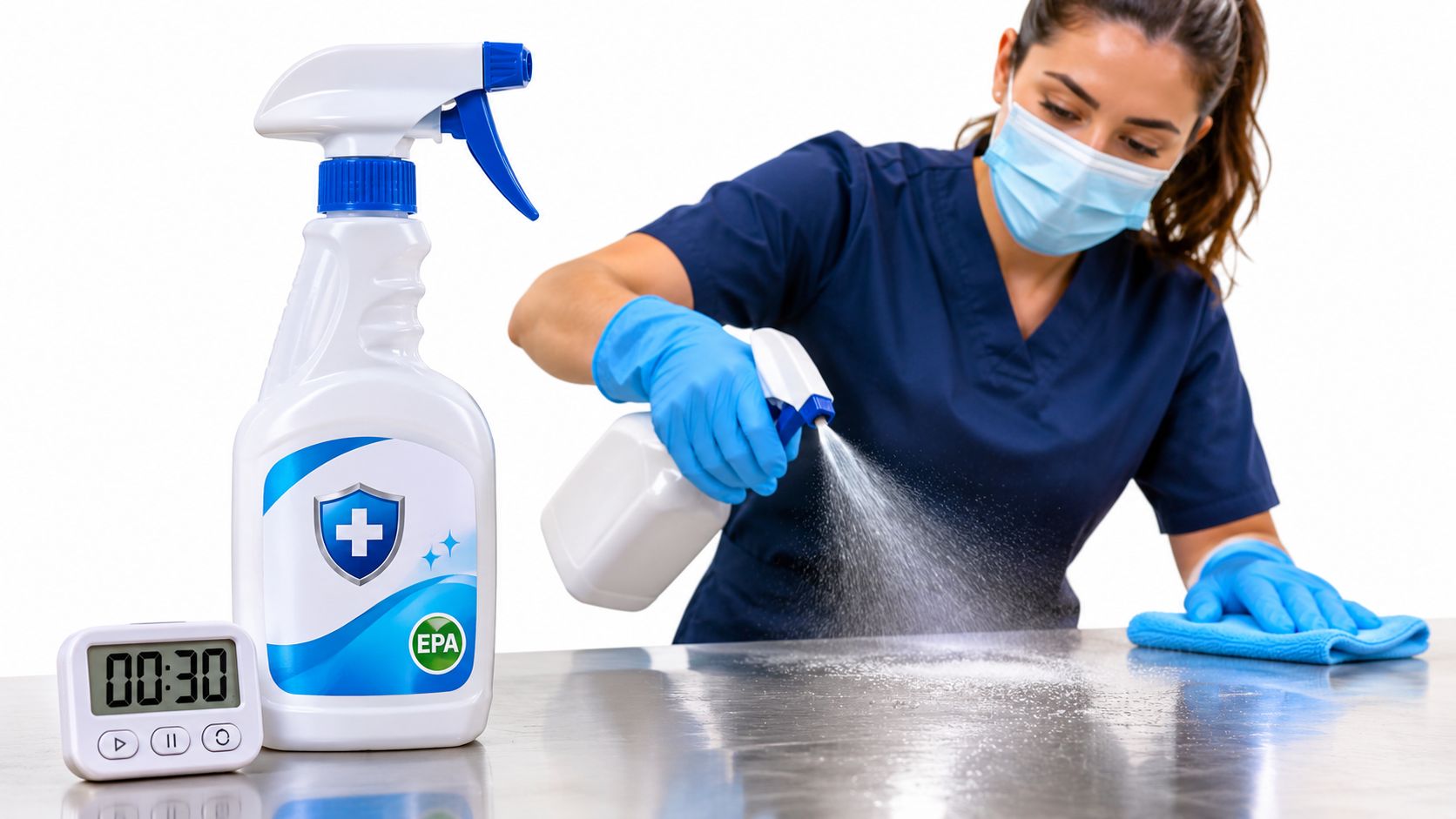
A facilities manager is standing in a supply room with a concentrated cleaner in one hand and a trigger bottle in the other. The commercial shows a quick spray, a wipe, and a reassuring claim about viruses. But the detail that determines whether the product works as shown is usually on the label, not in the ad.
A disinfectant can only support the claims listed for its specific formulation, target organism, surface, and application method. Once you know how to read those instructions, it's easier to compare products and choose a routine staff can follow.
What Makes a Spray Commercial and Who Uses It
The facilities manager's 5-litre concentrate and 500 ml trigger bottle may both be disinfectants, but their packaging and directions are designed for different routines. A commercial disinfectant spray is generally labelled and registered for institutional or professional use, and it may come ready to use or as a concentrate for dilution. Its directions are written with places such as schools, clinics, offices, and hotels in mind.
Facilities managers, cleaning contractors, clinic staff, and hotel housekeeping teams are typical buyers. They need a product that fits the space, the surfaces, the staff's training, and the cleaning schedule. “Commercial” describes the intended audience and packaging, though. It doesn't, by itself, prove a product is more effective than a household spray.

The label is the tested recipe
A household spray may offer convenient, small-scale directions and claims aimed at home use. A commercial product may offer bulk packaging, dilution instructions, or directions for professional equipment. In either case, the product's label is the practical guide: think of it as a tested recipe card. The ingredients are the product, the surface and dilution are part of the recipe, and the contact time is the timer. Changing one of those conditions can mean the result no longer matches the tested directions.
Cleaning, sanitizing, and disinfecting also mean different things in everyday use. This guide to surface hygiene for homes and offices offers a useful primer on those distinctions.
VirusFAQ.com's Education articles highlight practical tips for staying safe, cleaning effectively, and recognizing common risks. Its Science articles cover subjects such as mutation mechanisms, virus-host interactions, disinfection strategies, environmental factors, and real-world applications of virus control. Those perspectives meet at a simple buying principle: judge the product by its registration and directions, not by the commercial's pace or imagery.
Active Ingredients and How Each One Works
The active ingredient helps determine which viruses a spray may inactivate, but the ingredient name alone doesn't establish that a particular product works against a particular virus. The label's organism list and directions are still essential.
A useful first distinction is whether a virus has an outer lipid envelope. Enveloped viruses, including influenza A, HIV-1, hepatitis B virus, and SARS-CoV-2, have a fatty membrane around them. Some disinfectant ingredients can disrupt that membrane. Non-enveloped viruses, such as norovirus, rotavirus, rhinovirus, and feline calicivirus, lack the membrane and can be harder for some formulations to inactivate.
Think of the difference as a soap bubble and a steel ball. A chemical that disrupts a lipid envelope may pop the bubble, while the tougher ball needs a different tool. The analogy helps explain why one spray's claim against an enveloped virus doesn't automatically cover a non-enveloped one.
Compare the active ingredients
| Active ingredient | How it works | Typical label contact time | Main limitation |
|---|---|---|---|
| Quaternary ammonium | Disrupts lipid envelopes and cell membranes | Label-specific; often several minutes | Weak against non-enveloped viruses such as norovirus |
| Ethanol (60–80%) | Denatures viral proteins and dissolves lipid envelopes | Often a short interval, such as 30 seconds to 1 minute | Limited against non-enveloped viruses; evaporates quickly |
| Hydrogen peroxide | Oxidizes viral proteins and genetic material | Label-specific; several minutes may be required | Can bleach some fabrics and discolour some finishes |
| Peracetic acid | Strong oxidizer that damages viral structures | Label-specific; may range from short to longer intervals | Irritating vapour; needs ventilation and PPE |
| Sodium hypochlorite | Oxidizes proteins and genetic material | Label-specific; follow the organism-specific direction | Corrodes metals; weakens with light, heat, and organic soil |
Use the table as a starting point, not a substitute for the product label. Find the row for the organism you're concerned about first, then confirm that the product names that organism and gives directions for the surface you'll treat.
Ethanol-based sprays evaporate quickly, so the surface may dry before the required exposure is complete. Quaternary ammonium products can require several minutes of wet contact. Hypochlorite and peracetic acid are strong oxidizers, so follow the product's ventilation, protective-equipment, and storage directions.
Many commercial sprays combine ingredients or use a formulation whose performance depends on more than the active ingredient. Read the full label rather than choosing by brand name or fragrance. If norovirus is your target, a product that claims activity only against enveloped viruses is the wrong choice, whatever its price.
Reading an EPA Label for Registration and List N
A buyer who wants to verify a disinfectant's claims should start with the EPA registration number on the product label. The number has two sets of digits joined by a hyphen. It identifies an EPA-registered product and can be searched in the EPA pesticide product label database. Registration is a more useful checkpoint than an advertisement's general promise, but you still need to check the directions for the exact use you have in mind.
List N is EPA's list of disinfectants with claims against emerging viral pathogens, including SARS-CoV-2. A product's appearance on the list applies to its specified claims and defined surfaces. It does not mean the product works against every virus or on every material.
One registered disinfectant spray claims activity against SARS-CoV-2 after 30 seconds, and against norovirus after 1 minute on hard, nonporous surfaces. Its label also names feline calicivirus, rhinovirus, and rotavirus as examples of tough, non-enveloped viruses, and lists influenza A, including H5N1. These are claims for that specific product and label, not universal features of disinfectant sprays, as shown by the registered product label.
Scan the label in order
| Label element | Where to find it | What it tells you |
|---|---|---|
| EPA registration number | Front panel and directions | Confirms EPA registration; the number has two sets of digits joined by a hyphen |
| List N status | Product name and EPA list | Covers specified claims against emerging viral pathogens such as SARS-CoV-2, not every virus |
| Named organisms | Directions for use | Lists the exact viruses the product is claimed against, such as norovirus or influenza A |
| Contact time | Directions for use | States how long the surface must stay visibly wet for each named organism |
| Surface type | Directions and surface list | Identifies approved materials, such as hard, nonporous surfaces |
| Dilution and application | Mixing and use instructions | Gives the required concentration and method, such as trigger spray or electrostatic sprayer |
| Signal word and hazards | Front panel | Shows the hazard category, such as Caution, Warning, or Danger, and points to safety requirements |
Keep the specific use in view as you check. A product may list one virus for a surface but not another, or give different directions for different application methods. For a broader look at products that combine cleaning and disinfecting, see this guide to one-step disinfectant cleaners.
Purchase rule: Copy the exact organism names from the label into your buying note. If a commercial says only “germs” or “viruses” without identifying the relevant organisms and use conditions, it hasn't given you enough information to make a careful comparison.
Contact Time Decides Whether Disinfection Works
A spray-and-wipe routine can leave a surface looking clean while ending disinfection too soon. EPA defines contact time as the period a treated surface must remain visibly wet. If the product dries before that time has passed, reapply it as the label directs. Appearance alone cannot show whether the surface stayed wet long enough.
The label works like a recipe card, and the timer is part of the method. A product requiring 10 minutes needs to keep the surface wet for the full period. Another formulation may specify 30 seconds or 1 minute, as explained in CDC guidance on cleaning and disinfecting facilities. Removing the product early can mean the surface did not receive the labelled treatment.

Keep the surface wet for the full time
Use the product label as the step-by-step instruction for the target organism and surface:
- Remove visible soil. Clean dirt or residue first. Soil can interfere with disinfection, so disinfecting does not replace cleaning.
- Apply enough product. Cover the approved surface evenly until it is visibly wet. A fine mist may leave edges, crevices, or irregular areas uncovered.
- Start the timer. Use the contact time listed for that product and organism, not a time remembered from another bottle.
- Reapply if needed. If an area dries before the time is complete, add more product as the label directs.
- Wait before wiping or drying. Leave the surface undisturbed until the labelled time has passed, then wipe or air dry according to the directions.
If the routine cannot keep the surface wet for the required time, choose a product with a shorter labelled time for that organism or adjust the application method. Do not shorten the wait because the surface looks clean.
Test the headline claim
A “kills 99.9%” claim does not, by itself, identify which virus was tested, the surface, dilution, application method, or contact time. The EPA-registered label provides the conditions tied to a product's specific efficacy claims. One registered formulation may list different contact times for different named organisms, so check the label's time for each organism you intend to target. EPA's selected registered disinfectants guidance provides information on registered products.
| Target organism or case | Example label contact time | Surface and application note |
|---|---|---|
| SARS-CoV-2 | 30 seconds on one registered product | Hard, nonporous surfaces |
| Norovirus | 1 minute on one label; 10 minutes on another formulation | Hard, nonporous surfaces |
| Influenza A H1N1 | 30 seconds | Hard, nonporous surfaces |
| HIV-1, hepatitis B, and hepatitis C | 1 minute on one disinfecting product | Hard, nonporous surfaces |
| Electrostatic spraying where 10 minutes would otherwise apply | 3 minutes | Electrostatic sprayer direction only |
| Emerging viral pathogens, ready-to-use formulations | 30 seconds to 10 minutes | Defined hard, nonporous surfaces only |
These examples show why a headline claim cannot replace the directions for use. A quick wipe can end contact early, while a light spray may leave parts of a textured or irregular surface uncovered. Cleaning removes soil; disinfection requires the specified product, adequate coverage, and uninterrupted wet time.
Before choosing a spray, ask: Which virus? Which surface? What contact time? The guide to disinfectant contact time explains why the timer matters as much as the spray itself.
Surface Compatibility and Application Methods
A team arrives to treat a fabric sofa, a laptop keyboard, and a stainless steel counter. One spray may not be appropriate for all three. Many disinfectant claims apply only to hard, nonporous surfaces; carpet, upholstery, unsealed wood, and ceiling tile generally fall outside those claims unless the label specifically names them.
Material compatibility matters, too. Hypochlorite can corrode stainless steel or dull some finishes, and hydrogen peroxide can bleach coloured fabrics. For electronics, check the manufacturer's cleaning instructions before applying liquid. Many manufacturers advise against spraying directly onto screens or keyboards, so apply only in the way both the disinfectant label and device guidance allow.
Match the method to the surface
A hand trigger spray is practical for small areas and spot treatment. A pump or pressurised sprayer can suit larger zones, but staff still need to apply enough product to meet the label's coverage and wet-time directions. An electrostatic sprayer can change how product is distributed around objects, but it doesn't make cleaning unnecessary or remove the need to follow its specific label directions.
The method can affect contact time. One EPA product label gives a 30-second contact time for Influenza A H1N1 and specifies a 3-minute direction for electrostatic spraying where a 10-minute contact time would otherwise apply. The same label examples show that instructions are product- and method-specific, not interchangeable across sprays, as recorded in the EPA label for Influenza A H1N1 and electrostatic use.
Make application manageable
Pre-saturated disinfecting wipes can be useful on items that shouldn't be drenched, provided the wipe's label names the required organism and surface and staff can keep the area wet for the stated time. They can also make it easier to control where the product goes. For any spray or wipe, test an inconspicuous spot first if you're unsure how a finish will react.
For concentrates, measure and mix exactly as the label directs. A weak solution may not meet the product's claim; an overly strong mixture can waste product and leave unwanted residue. Check the label's use-life for mixed solution, discard it when that period ends, and don't top up an old batch with fresh concentrate.
Safety and PPE for Staff Using Commercial Sprays
A staff member sprays a classroom during lunch while a child is still nearby. Someone asks whether the label required gloves, but nobody is sure. In that moment, the signal word and precautionary statements are the first safety checks: they set the minimum protections and handling directions for that product.
Use a short briefing before each shift:
- Read the label first. Check the signal word and precautionary statements before opening or spraying the product.
- Wear nitrile gloves when handling concentrates and wiping surfaces. Follow any additional glove requirements on the label.
- Use eye protection when spraying above head height or in a closed room. Follow the label's stated PPE requirements.
- Use a respirator only when the label requires one and staff have been fit-tested.
- Ventilate the room and keep people out during application. Follow the label's directions on when the area is safe to re-enter.
- Keep products separate. Never combine hypochlorite with acidic cleaners or ammonia-based products, because the reaction can release toxic gas.

Store concentrates in their original containers, away from food and out of children's reach. Keep the Safety Data Sheet somewhere staff can find it, and review its first-aid instructions before a shift. New staff can practise the application sequence with water first, so they learn the motion and coverage without handling a disinfectant.
For further guidance on matching protective equipment to a task, consult VirusFAQ.com's resource on how to use personal protective equipment. Facilities can also review practical ways to reduce risks during workplace cleaning.
Wall checklist: PPE on. Room ventilated. Product matched to the target. Safety Data Sheet available. Application log ready.
Residual Claims and Your Buying Decision
The buying question is which commercial spray to stock and how staff will use it. Choose a product that fits the facility's actual surfaces, routines, and safety requirements, rather than one that merely sounds convenient.
- Match claims to locations. Confirm the named organisms and surface list cover the places staff will treat.
- Choose a workable wet time. If staff can't keep an area wet for the labelled interval, look for a suitable alternative product or format.
- Check the building fit. Confirm the PPE and ventilation requirements are practical for the space.
- Keep the documentation. Make sure the Safety Data Sheet is on file and accessible.
A residual claim is not a promise that a surface stays virus-free all day. EPA's separate residual-efficacy guidance gives examples of a 3-log reduction within 1–2 hours, while an unqualified residual claim may require a 5-log reduction within 10 minutes. Qualifying products must first meet ordinary disinfectant standards, and residual performance still depends on the product, tested organism, surface, abrasion, and recontamination. See EPA guidance on adding residual efficacy claims.
EPA also limits claims for products listed against emerging viral pathogens. Broad commercial language doesn't establish protection against every current or future virus. Hand hygiene, ventilation, and reducing high-touch contamination remain useful parts of a broader prevention routine.
Keep an application log with the product, named organism, contact time, staff initials, and date. When staff struggle to keep an item wet, a pre-saturated disinfecting wipe matched to the same label may make the routine easier to follow. Choose the format your team can use correctly, then record each application consistently.

Before your next supply order, ask staff to bring the current product label and the list of surfaces they treat. Compare those against the organisms, application directions, wet time, and safety requirements, then stock the spray or pre-saturated wipes your team can use exactly as labelled.
Leave a Reply