A biodegradable wet wipe sounds reassuring, but the label doesn't tell you what happens after the wipe leaves your hand. In the real world, breakdown depends on fiber type, binder chemistry, water conditions, and where the wipe ends up. That matters for anyone trying to balance infection control with environmental responsibility, because a wipe that removes viral material from a surface still has to be handled correctly afterward.
For consumers, the confusion is simple. For healthcare workers, it's more serious. A wipe used during a norovirus cleanup, a flu season outbreak, or a SARS-CoV-2 response may need to perform two jobs at once, physical removal and chemical action, while still being disposed of in a way that doesn't create a downstream problem. The science shows those goals don't always line up neatly with front-of-pack marketing.

The Biodegradable Label Does Not Mean What You Think
The biggest mistake people make is assuming “biodegradable” means fast disappearance. It doesn't. In the wet wipes market, that assumption has been reinforced by growth, packaging language, and the general appeal of a product that sounds cleaner for the planet. But a 2023 peer-reviewed study concluded that most flushed biodegradable wet wipes do not really degrade under real-world conditions, even though the category had already tripled over the prior decade to more than USD 3 billion in 2022 (PubMed study).
That gap matters because the label can change behavior. A consumer who sees biodegradable or flushable may think the wipe belongs in the toilet, then the wipe enters a system that isn't designed to make all sheet-like products vanish quickly. The result is a public health issue, not just an environmental one.

Why the label matters for infection control
In healthcare, the word choice on the package can change how a worker uses the wipe. Someone cleaning a room after a norovirus event may think a biodegradable wipe is automatically safer or more appropriate, when the bigger question is whether the wipe removes or inactivates the virus on contact. For SARS-CoV-2, HIV-1, and influenza, wipe performance depends on the full product system, not just the fiber source.
Practical rule: a wipe's environmental promise and its infection-control function are separate questions. A product can be designed to reduce plastic residue and still be a weak choice for a viral cleanup if its chemistry, texture, or durability are wrong.
The market has also become concentrated. The top five players, P&G, Albaad, Nice-Pak, Honest Company, and Kimberly-Clark, account for about 45% of 2025 revenues (Global Market Insights). That concentration tells you something important about the category. Scale, certification, and distribution matter, which is one reason labels alone can't tell the whole story.
What Biodegradable Wet Wipes Are Actually Made Of
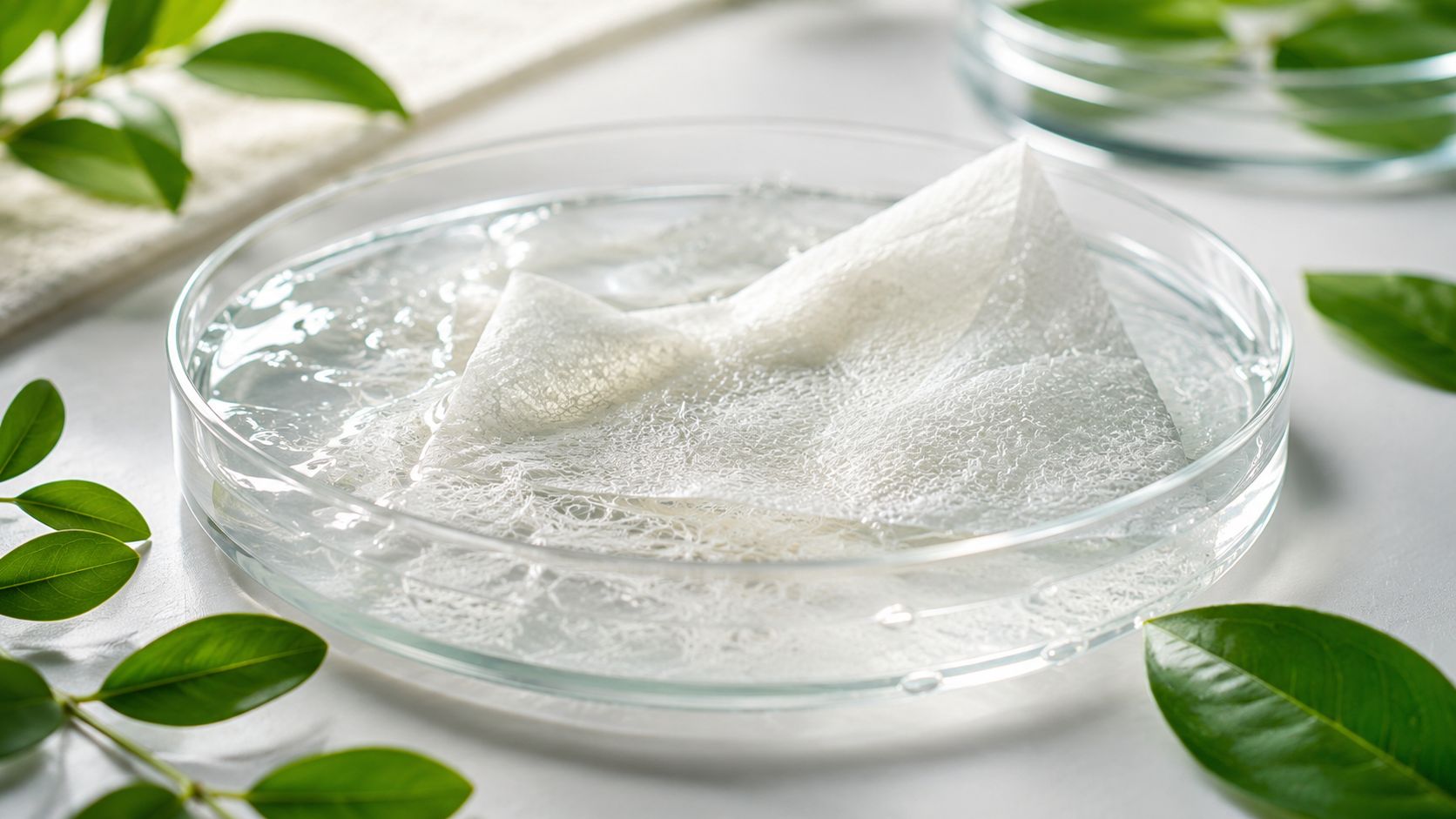
A biodegradable wet wipe is usually a system, not a single material. The sheet needs a fiber substrate that can hold together during use, a binder or bonding strategy that gives it wet strength, and a lotion that supports skin feel, cleaning, or disinfection. The balance among those parts determines whether the wipe feels sturdy in the hand, tears too easily, or breaks down in the environment.
Fiber substrate and wet strength
The best clue is the fiber. A technical standard for disposable wet wipes in East Africa requires at least 20% cellulose fibers by ISO 1833-11, and the declared size must match within ±2% under ISO 22198 (EAS 1075-2021 PDF.pdf)). That emphasis on cellulose is not cosmetic. Cellulosic material gives the wipe a biodegradable base while preserving the structure needed for real use.
One tested biodegradable wipe made from banana fiber had a mass per unit area of 50.67 g/m^2 and wet tensile strengths of 166.712 N in the machine direction and 133.043 N in the cross direction, far above the EAS wet tensile thresholds of 5 N and 4 N (EAS 1075-2021 PDF). That matters because a wipe that keeps its shape while wet is less likely to tear, shed lint, or leave residue behind during cleaning.
Binder chemistry and lotion design
The chemistry matters just as much as the fiber. One biodegradable intimate wipe product uses 100% viscose with a pH of 4 to 5, plus a lotion system containing aqua, glycerin, sodium benzoate, sodium laureth-11 carboxylate, laureth-10, lactic acid, and potassium sorbate (product technical sheet). A related flushable design uses polyvinyl alcohol-based binder technology and a lotion with about 0.1 to 0.9% boric acid and about 5 to 8% alkali metal bicarbonate, producing a wipe pH between 7 and 9 and wet strength of about 8 to 20 oz/in (product technical sheet).
That mix shows the engineering tradeoff. The wipe has to stay intact while you use it, but it also has to be built so it can disperse or biodegrade later under the right conditions. A “natural” label alone doesn't tell you that story.

The best shortcut is to look for the combination of cellulose-rich fiber, documented wet tensile strength, and a lotion or binder system that states how the wipe behaves in use. If a package only says eco-friendly and leaves the material details vague, you don't know much about performance or disposal.
How Wipe Materials Affect Viral Inactivation
A wipe only helps with infection control if it does more than move liquid around. The sheet has to pick up material, hold onto it, and, in some products, support a disinfecting lotion that helps inactivate the target virus. That's why the structure of the wipe matters as much as the liquid on it.
Enveloped and non-enveloped viruses are not equal
Viruses with a lipid envelope, including SARS-CoV-2, HIV-1, and influenza viruses, are generally more vulnerable to surface treatment than hardier non-enveloped viruses such as norovirus and rotavirus. The difference is structural. An envelope is easier for a wipe's chemistry to disrupt, while a non-enveloped virus has a tougher outer shell and can be harder to remove or inactivate.
That doesn't mean every envelope-virus cleanup is easy. It means the wipe's formulation, contact time, and friction all matter. If the wipe is thin, pills, tears, or sheds lint, the user can end up redistributing contaminants instead of removing them. In practice, the physical act of wiping is often as important as the chemical claim printed on the package.
Why linting and sheet integrity matter
A low-quality wipe can create a new problem during cleaning. Fibers left behind on a counter, bed rail, or exam surface can trap soil and potentially carry viral particles with them. For public health educators, that's the point worth repeating. Infection control is not just about “killing germs,” it's also about not leaving behind a messy surface that invites hand contact later.
A wipe that feels soft isn't automatically safer. If it breaks apart during use, it may be worse than a sturdier sheet with a more transparent material spec.
For readers comparing product types, one useful reference is the practical discussion of contact time and surface use in VirusFAQ's guide to alcohol wipes and germ control. The key lesson is simple, match the wipe to the organism and the task. A wipe that works well for routine household cleaning may not be the right tool for norovirus-heavy settings.
Matching the wipe to the viral threat
If the job is a household spill during a respiratory illness, the wipe may need to help with surface removal and support a disinfecting step. If the job is a norovirus cleanup in a shared setting, the wipe has to be chosen much more carefully because non-enveloped viruses are harder to deal with. In both cases, the material needs enough strength to clean effectively without falling apart in your hand.
The safest approach is to read the material and efficacy claims together. A good biodegradable wipe should tell you how it behaves as a sheet, not just how green it sounds.
What Happens After You Throw a Biodegradable Wipe Away
The test starts after use. In a 2023 peer-reviewed study, cellulose-based biodegradable wipes were still shown to persist under real-world conditions, and the category's growth had already reached over USD 3 billion in 2022 (PubMed study). More recent river testing found that two cellulose-based brands remained after five weeks in water, with one degrading at about 6.7% per day and the other at about 3.1% per day (phys.org report on the 2025 breakdown test).
Environment changes the result
That spread tells you something important. Hydrodynamic exposure, water temperature, and surface fouling all shape breakdown. A wipe that survives long enough in a river can behave very differently from the same wipe in a controlled disposal system. The material isn't acting in a vacuum.
A PhD thesis on cellulose-based wipes reached the same broad conclusion. Even with biodegradable labels, many wipes did not degrade rapidly in freshwater, and field observations plus scanning electron microscopy still found structural remnants after five weeks (PhD thesis). The thesis also noted that degradation is strongly affected by material type, hydrodynamic exposure, and surface fouling.
Disposal behavior adds another layer
The UK context shows why this matters in public health messaging. About 11 billion wet wipes are discarded annually there, and roughly 17% of adults flush them (PubMed study). That's not a niche behavior. It's a routine disposal pattern that can affect sewer systems, rivers, and shorelines.
Bottom line: a biodegradable wipe that breaks down in one setting may linger in another. The disposal environment is part of the product.
If you're trying to evaluate claims, ask where the wipe is meant to degrade. Freshwater, wastewater, compost, and landfill all produce different outcomes. “Biodegradable” isn't a universal promise.
Certifications and Testing Standards to Look For
A good wipe label should tell you more than the front-of-pack slogan. Start with the test standard, then look for the product's intended disposal route, then check whether the wipe's performance was measured in a way that matches how you'll use it. That order matters because the word biodegradable can describe very different outcomes.
What to check first
Look for evidence that the wipe was tested for:
- Fiber composition, especially the cellulose content and how it was measured.
- Wet tensile strength, because a wipe has to stay intact when used.
- Declared size accuracy, since the sheet has to match what the package promises.
- Disposal behavior, including whether the product is meant for flushing, composting, or landfill disposal.
The East African standard is useful because it ties composition and physical performance together. It requires at least 20% cellulose fibers by ISO 1833-11 and size conformity within ±2% by ISO 22198 (EAS 1075-2021 PDF). That kind of detail is more informative than a vague eco-label.
What to be skeptical about
Be careful with terms like flushable, dispersible, and biodegradable when they appear without test details. A product can be marketed to sound environmentally friendly while still persisting in water. The research on flushed wipes shows why that distinction matters, especially for freshwater and sewer systems (PubMed study).
If a package claims viral cleaning, look for pathogen-specific efficacy data rather than a general promise. A wipe that has been tested against one class of organism may not be enough for another, especially when non-enveloped viruses are involved. That's where label reading becomes a practical skill, not a marketing exercise.
For households and clinics that want a broader cleaning protocol, the educational articles on VirusFAQ.com also compare product categories and surface-use considerations. Used carefully, those references can help readers separate material claims from infection-control claims.
Safe Disposal Practices for Infection Control
Disposal is part of the cleaning process, not an afterthought. A wipe that lifts soil or viral material from a surface still has to leave the room safely, especially in settings where norovirus, influenza, or SARS-CoV-2 may be involved. The right disposal method depends on what the wipe touched and where it's going next.
What not to do
Don't treat biodegradable as a permission slip to flush. The research on real-world degradation shows that wipes can persist in freshwater for weeks, which is exactly the wrong behavior for a product entering sewer systems or aquatic environments (PubMed study). Flushing may also create infrastructure problems long before any biodegradation happens.
For household illness cleanup, keep the used wipe with the waste stream that matches the risk. If the wipe handled vomit, fecal contamination, or body fluids during a viral illness, it should be treated as contaminated waste rather than routine trash. In medical or caregiving environments, follow the site's waste policy and local biohazard rules.
Practical handling by setting
- Households: place used wipes in a lined trash bin and seal the bag before disposal if the wipe was used during a sickness episode.
- Healthcare or caregiving spaces: follow facility biohazard procedures when the wipe was used on potentially infectious material.
- Composting: only consider this if the product is specifically certified for that end use and the composting system can support it. General home compost piles aren't the same as controlled composting.
- Landfill disposal: often the safer fallback when the product's breakdown conditions are unclear.
If you're dealing with bodily fluids or a contamination event, a professional cleanup resource can help you think through containment and disposal. For a practical example of how careful cleanup guidance is framed, see Phoenix biohazard cleanup advice from Restore Heroes.
What matters most is simple. A wipe that did its job on the surface can still become a problem if it's sent to the wrong place afterward.
Practical Guidance for Healthcare Workers and the Public
A nurse cleaning a shared bathroom after a stomach virus should not choose a wipe the same way a parent wiping a kitchen counter after lunch does. The first job may involve a hard-to-control virus and strict disposal rules. The second may call for a sturdy biodegradable wipe that supports routine cleaning without creating unnecessary waste.
For healthcare workers, the first question is always the pathogen. If the target is a non-enveloped virus such as norovirus, choose a wipe and cleaning protocol that have been validated for that kind of organism, not just for general dirt removal. If the target is a respiratory virus like influenza or SARS-CoV-2, make sure the wipe's chemistry, wet strength, and surface compatibility all line up with the task.
For households, read the package in layers. Start with the material, then the cleaning claim, then the disposal instructions. If a product says biodegradable but doesn't clearly explain where and how it breaks down, treat that as a warning sign, not a reassurance.
The most useful habit is to match the wipe to the job. A better wipe is not just the softest or the greenest one. It's the one that removes contamination, holds together during use, and enters the waste stream in the least harmful way.
Choose your next wipe the same way you'd choose any infection-control tool, by reading the material, checking the testing claim, and disposing of it correctly. If you're reviewing products for a home, clinic, or care setting, compare the wipe's fiber content, wet-strength details, and pathogen-specific cleaning evidence before you buy.
Leave a Reply