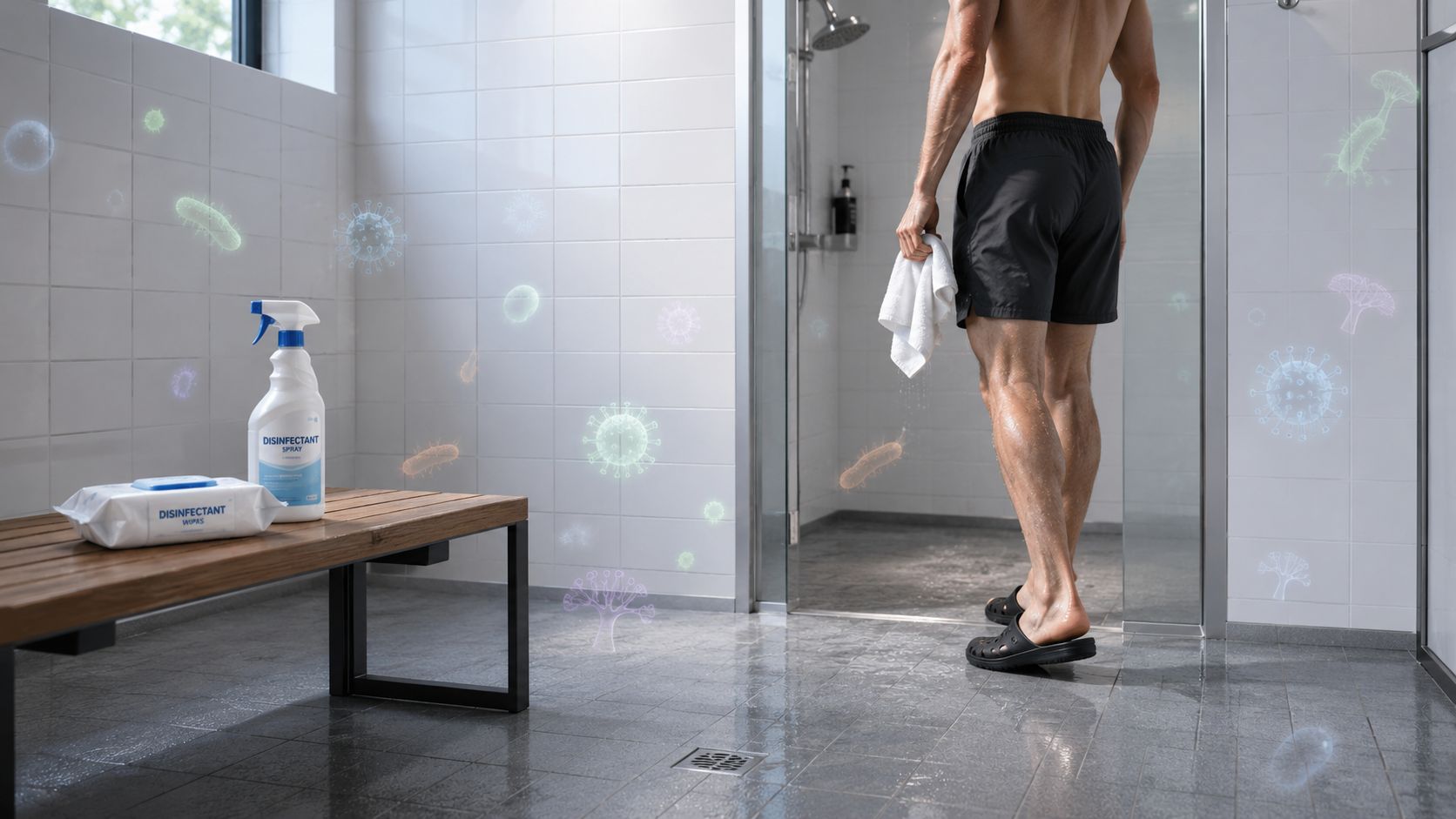
You step into the locker room after a swim, a workout, or a long day on the road. You've got sandals in one hand, a towel over your shoulder, and a quick decision to make. Do you use the men's public shower without thinking twice, or do you pause and wonder what might be living on the floor, bench, or faucet handle?
That hesitation is normal. Public showers combine bare skin, shared surfaces, moisture, and heat. Those conditions can support fungi, bacteria, and viruses, but that doesn't mean every shower is dangerous or that every damp floor is a threat. It means risk depends on what's present, how it spreads, and what you do next.
A calm, useful approach works better than fear. If you understand where actual risks are, what myths to ignore, and how small habits interrupt transmission, you can use a men's public shower much more confidently. Facility managers can do the same on a larger scale by making the environment easier to clean and safer to use.
The Unseen World of a Men's Public Shower
A men's public shower often feels clean and questionable at the same time. You see tile, drains, steam, and running water. What you don't see is the microbial traffic that can move through a shared space over the course of a day.
That hidden world isn't one thing. It includes fungi that like damp skin, bacteria that can survive on shared surfaces, and viruses that may spread through touch and contaminated objects. The important point is that these organisms don't behave the same way. A fungal infection on the foot has a different pattern of spread than a stomach virus carried from a contaminated hand to the mouth.
Many readers get stuck on one vague idea: “germs.” That word is too broad to be useful. A better question is, “What kind of organism am I trying to avoid, and where is it most likely to be?”
What people usually worry about
Most men aren't just thinking about infection. They're also thinking about exposure, privacy, and whether the place looks cared for. A shower with puddled water, a musty smell, and residue on handles signals poor maintenance. A shower with dry floors between uses, stocked soap, and visibly cleaned surfaces signals control.
Practical rule: If a public shower looks neglected, treat that as a cue to increase your precautions or skip it if you can.
What matters most
In practice, the biggest everyday concerns are simple:
- Bare feet on wet floors where skin organisms can linger.
- Hand contact with shared fixtures like knobs, latches, and benches.
- Incomplete drying after the shower, especially between the toes or around irritated skin.
- Small skin breaks that give microbes an easier entry point.
Public health advice works best when it's concrete. Wear shower shoes. Keep your own towel and soap. Dry off well. Clean high-touch surfaces when needed. Those habits sound basic because they are. They also work.
Fungi Bacteria and Viruses in Wet Environments
The shower floor is usually the first place to think about. In shared facilities, fungal, bacterial, and viral infections are commonly acquired from floor surfaces at pools, gyms, and dorms, which is why thorough disinfection and shower shoes or flip-flops matter so much, according to University of Utah Health guidance on shower floor risks.

Fungi on skin and floors
Fungi tend to get the most attention in public showers because they fit the environment so well. They like moisture, warmth, and skin that stays damp for too long. That's why feet are a common target.
Athlete's foot is the classic example. The fungus doesn't need dramatic conditions. It benefits from wet tile, damp sandals, and toes that stay moist after showering. Ringworm behaves similarly, even though the name sounds unrelated. Both are fungal skin infections, and both spread more easily when skin stays warm and wet.
A simple way to think about fungi is this:
| Type | Common setting | Why showers help |
|---|---|---|
| Athlete's foot | Floors, changing areas | Damp skin and shared wet surfaces |
| Ringworm | Shared contact surfaces | Moisture and skin contact |
Bacteria on handles benches and standing water
Bacteria in public showers don't all act the same way either. Some are mostly harmless in the environment but become a problem if they reach broken skin. Others can cause rashes or localized skin infections when conditions line up.
Two names often come up in discussions of wet facilities: Staphylococcus aureus and Pseudomonas aeruginosa. You don't need to memorize them. What matters is what they represent. Shared benches, faucet handles, drains, and wet surfaces can hold bacteria long enough for the next user to pick them up. If someone has a cut, a shaving nick, or irritated skin, the barrier that normally protects the body isn't as strong.
This is one reason surface care matters so much. It's also why many people carry disinfecting wipes for quick cleanup of touch points before use. That extra step can be useful when a facility is busy or when a bench or control handle looks recently used.
If you want a broader primer on persistence outside the body, this overview of how long viruses live on surfaces helps put environmental risk in context.
Viruses in a shower setting
Viruses in public showers are usually less about “the steam in the air” and more about contact. Some can spread from contaminated hands or surfaces. Others spread through direct contact with infected skin or lesions.
Examples people ask about include human papillomavirus, which can be associated with warts, and gastrointestinal viruses such as norovirus and rotavirus, which are tied more closely to hand contamination than to the shower water itself. Herpes Simplex Virus 1 (HSV-1) and Herpes Simplex Virus 2 (HSV-2) also come up often, though the realistic transmission pattern in a shower is narrower than many people fear.
For readers interested in virology more broadly, the same basic principles of transmission and environmental survival matter across many virus topics, from SARS-CoV-2 and Human Coronavirus to Influenza A Virus (H1N1), Hepatitis B Virus (HBV), Hepatitis C Virus (HCV), Human Immunodeficiency Virus Type 1 (HIV-1), Herpes Simplex Virus 1 (HSV-1), Herpes Simplex Virus 2 (HSV-2), Norovirus, Human Rotavirus, Feline Calicivirus, Rhinovirus Type 14, and Rhinovirus Type 39. The names differ, but the practical question stays the same: where does the organism survive, and what interrupts its path to the next person?
Wet doesn't automatically mean dangerous. Shared contact plus poor hygiene is the combination that raises concern.
Understanding Pathogen Transmission in Showers
Most infections linked to a men's public shower don't start with the water spraying from above. They start with a chain. One person leaves microbes on a surface. Another person touches or steps on that surface. The organism reaches skin, a cut, or the mouth through the hands. That's the pathway worth interrupting.
The contact route most people overlook
Think about a common sequence. A user with a skin infection walks barefoot across tile. Another user enters moments later, also barefoot, with a small crack in the skin near the heel. That's enough for transfer to become possible. The same logic applies to benches, hooks, locker handles, and shower controls.
This kind of spread is called fomite transmission, which means transfer through contaminated objects or surfaces. In public showers, fomites include floors, faucet handles, stall latches, soap dispensers, and benches. The shower itself doesn't need to look dirty for this to happen.
A quick operational lesson from cleanup work outside gyms applies here too. If you want a practical explanation of why contaminated surfaces need methodical handling, Restore Heroes offers a useful homeowner's guide to biohazard safety that makes the logic of contact-based risk easy to understand.
Humidity isn't the villain many people assume
A lot of people assume steam-filled rooms make airborne virus spread worse. The evidence is more nuanced. In shower-like conditions, high humidity above 80% relative humidity and temperatures above 30°C do not increase COVID-19 transmission risk. The available evidence reviewed by the National Collaborating Centre for Environmental Health on high-humidity environments and COVID-19 transmission suggests that higher humidity can decrease virus viability in airborne particles and on surfaces while also increasing airborne mass deposition.
That doesn't mean ventilation is irrelevant. It means the common fear that “steam itself makes COVID spread more” isn't supported by that evidence.
Entry points are what make exposure matter
Contact alone isn't always enough. Microbes still need a route in. In shower settings, the main entry points are:
- Broken skin such as shaving cuts, cracked heels, or abrasions
- Mucous membranes if contaminated hands touch the nose, mouth, or eyes
- Softened skin after prolonged soaking, which can be easier to irritate
The key question isn't whether microbes exist in a public shower. It's whether they can move from a shared surface into a person in a way that leads to infection.
Your Personal Hygiene Playbook
Good habits in a men's public shower don't need to be elaborate. They need to be repeatable. The goal is to lower contact with shared contamination, protect skin, and avoid carrying organisms from the shower area to your face, clothes, or home.

Six habits that do most of the work
Wear shower sandals every time
This is the simplest barrier you can use. Flip-flops or shower shoes reduce direct contact with wet flooring, which is a common pickup point for infections in gyms, pools, and dorms.Bring your own towel and toiletries
Shared bars of soap, communal cloth items, and borrowed razors increase cross-contact. Personal items keep your hygiene routine inside your own lane.Dry your feet and skin folds well
The shower is only part of the story. What happens after matters just as much. Fungi do better when moisture lingers between the toes, in the groin, or under tight clothing.Cover cuts before you enter
A small nick from shaving can become an entry point. If you have open skin, cover it with a clean waterproof dressing or avoid the shower until it closes.
Smart extras that many people skip
If a bench, handle, or shelf looks heavily used, a quick wipe-down is a reasonable extra layer of protection. In such situations, disinfecting wipes can be practical. They're portable, fast, and useful for high-touch points you can't avoid. They don't replace facility cleaning, but they can help you reduce contact with residue left by the previous user.
Avoid placing your towel or clean clothes on a wet bench. Hang them up or use a bag hook. Once a towel touches a contaminated surface, it can carry that contamination right back to your skin.
For readers who use fitness facilities often, this article on whether to shower at the gym adds useful context about balancing convenience and hygiene.
Finish strong with hand hygiene
The last step often gets rushed. You leave the shower area, touch your locker, bag zipper, phone, and water bottle, then head out. That's a lot of hand contact in a short span.
A useful finding here is that post-restroom automatic hand sanitizer use reduces the probability of infection for viruses like norovirus by up to 99.75%, and in that analysis it performed better than hand washing inside the restroom across multiple virus types, according to this study on hand sanitizer placement and infection probability. That doesn't make soap useless. It means the timing and placement of hand hygiene matter.
A simple exit routine works well:
- Dry first: Wet hands dilute products and spread moisture.
- Sanitize after high-touch exits: Use sanitizer after touching locker handles, door pulls, or shared dispensers.
- Keep your phone clean: Don't undo all your effort by handling a contaminated phone with freshly cleaned hands.
One good habit beats five half-done ones. If you only remember a few things, wear sandals, keep your gear personal, dry off fully, and clean your hands on the way out.
Facility Management and Disinfection Protocols
A safe men's public shower depends on more than user behavior. Managers control the conditions that either limit or enable transmission. If the schedule is inconsistent, if surfaces stay damp for hours, or if staff clean visibly but don't disinfect high-touch points correctly, users inherit avoidable risk.

Baseline standards managers should treat as nonnegotiable
Public hygiene guidance for personal hygiene facilities serving vulnerable populations gives a practical standard that many shared shower operators can learn from. Hot water should be maintained between 100°F and 120°F (37.8°C to 48.9°C), and routine cleaning should occur at least once daily with disinfectant application on high-touch surfaces, with weekly deep cleaning to address biofilms, according to the King County interim guidelines for personal hygiene facilities.
That daily work needs to include more than a fast mop. Showerheads, controls, door handles, benches, and surrounding touch points need actual disinfectant contact, not just visual tidying.
What an effective cleaning program looks like
A strong protocol usually includes these elements:
Clear surface priorities
Staff should know which surfaces get touched most often and in what order they should be cleaned.Product selection that matches the risk
Use EPA-registered disinfectants that are appropriate for the organisms likely to matter in wet public settings, including harder-to-kill non-enveloped viruses such as norovirus.Deep cleaning that targets buildup
Grout, caulking, corners, and drain-adjacent surfaces can collect residue and biofilms. Weekly deep cleaning matters because routine wiping won't always reach those areas well.Documentation and verification
A log sheet on the wall isn't enough by itself, but it does create accountability when paired with supervision and spot checks.
Managers also need to pay attention to plumbing performance. Slow drainage leaves standing water on floors and keeps surfaces wet longer than necessary. If drainage problems keep recurring, this guide to fixing bathroom drain issues is a practical maintenance reference for understanding what may be going wrong.
Staff training matters more than fancy branding
A facility can buy expensive products and still underperform if staff aren't trained in sequence, contact time, dilution, and safe use. Cleaning and disinfection aren't interchangeable. Staff need to know when they're removing soil, when they're applying a disinfectant, and how long the surface must remain wet for the product to work as intended.
Managers looking for a broader operational framework can use this resource on cleaning public bathrooms to align shower-area protocols with nearby restroom and locker-room practices.
Clean-looking tile can still be poorly managed tile. Good protocols focus on touch points, moisture control, and consistency.
Beyond Cleaning Policy and Design Improvements
Cleaning helps, but design can prevent problems before cleaning starts. A men's public shower that dries quickly, separates users appropriately, and reduces unnecessary touch points is easier to maintain and more comfortable to use.
Design choices that lower exposure
Open communal showers create broad surface sharing. Individual stalls or partial partitions reduce that exposure by limiting where water spreads, where people place personal items, and how much skin contacts shared surroundings. Non-porous materials also matter because they're easier to disinfect and less likely to hold moisture.
Small design changes can have outsized effects:
- Partitions reduce direct exposure and improve privacy.
- Hooks and shelves in each stall keep towels and clean clothes off benches.
- Better drainage and airflow help floors dry faster.
- Touch-reduced fixtures cut down on repeated hand contact.
Privacy is a public health issue too
One neglected part of the conversation is emotional discomfort. The privacy side of the men's public shower experience remains under-discussed, even though online discussions show many men report anxiety and stress related to exposure in communal showers with no partitions, as seen in this AskMen discussion about locker room and communal shower discomfort.
That matters for hygiene because discomfort changes behavior. Men who feel exposed may rush, skip proper drying, avoid washing thoroughly, keep underwear on in the shower, or avoid the facility altogether and delay cleaning up after sports or work. The result isn't just psychological strain. It can also undermine the hygiene practices the facility is supposed to support.
Policy can support dignity
A better facility pairs design with policy. That can include posted cleaning schedules, easy access to soap and sanitizer, clear rules against sharing personal items, and layouts that let users move through the space without feeling watched.
The history of men's public sanitation also helps explain why these spaces feel socially charged. In 1421, Dick Whittington introduced London's first sex-segregated public toilet facilities, Whittington's Longhouse, with 64 seats for men and 64 for women, according to the Wikipedia history of public toilets. Long before modern gyms, public hygiene spaces were already shaped by rules about separation, privacy, and who belonged where.
A useful shower space doesn't just remove dirt. It supports dignity, routine, and safe use.
Public Shower Hygiene Myths and FAQs
Can you catch a sexually transmitted infection from a shower bench
In ordinary public shower use, that's not the main concern. The more realistic risks involve skin organisms, contaminated surfaces, and hand-to-face transfer. People often overfocus on dramatic possibilities and underfocus on basic contact hygiene.
Does peeing in the shower prevent athlete's foot
No. Urine isn't a treatment for fungal infection. Athlete's foot prevention is much simpler: wear shower shoes, dry your feet well, and avoid walking barefoot on shared wet floors.
Is a humid shower room automatically worse for virus spread
Not necessarily. As discussed earlier, high humidity in shower-like conditions doesn't automatically raise COVID-19 transmission risk, and the effect can go in the other direction for viral viability.
Are antibacterial or antimicrobial soaps always better
Not always. The key issue in public showers is usually how you wash and what you touch afterward. Regular soap, proper rinsing, clean towels, and hand hygiene on exit often matter more than premium labeling.
If the floor looks clean, is it safe barefoot
Appearance helps, but it doesn't prove the floor is free of organisms. Wet shared flooring is one of the most sensible places to keep a barrier between your skin and the environment.
What's the single best habit for most users
If you want one answer, it's this: wear shower sandals consistently. If you want the best combination, pair sandals with your own towel, thorough drying, and hand hygiene before you leave.
A men's public shower doesn't have to be a place of guesswork. Good design, good maintenance, and a few repeatable habits turn it into a manageable environment instead of an anxious one.
If you want more evidence-based explainers on virus transmission, environmental survival, and practical disinfection, explore the educational and scientific resources at VirusFAQ.com.
Leave a Reply