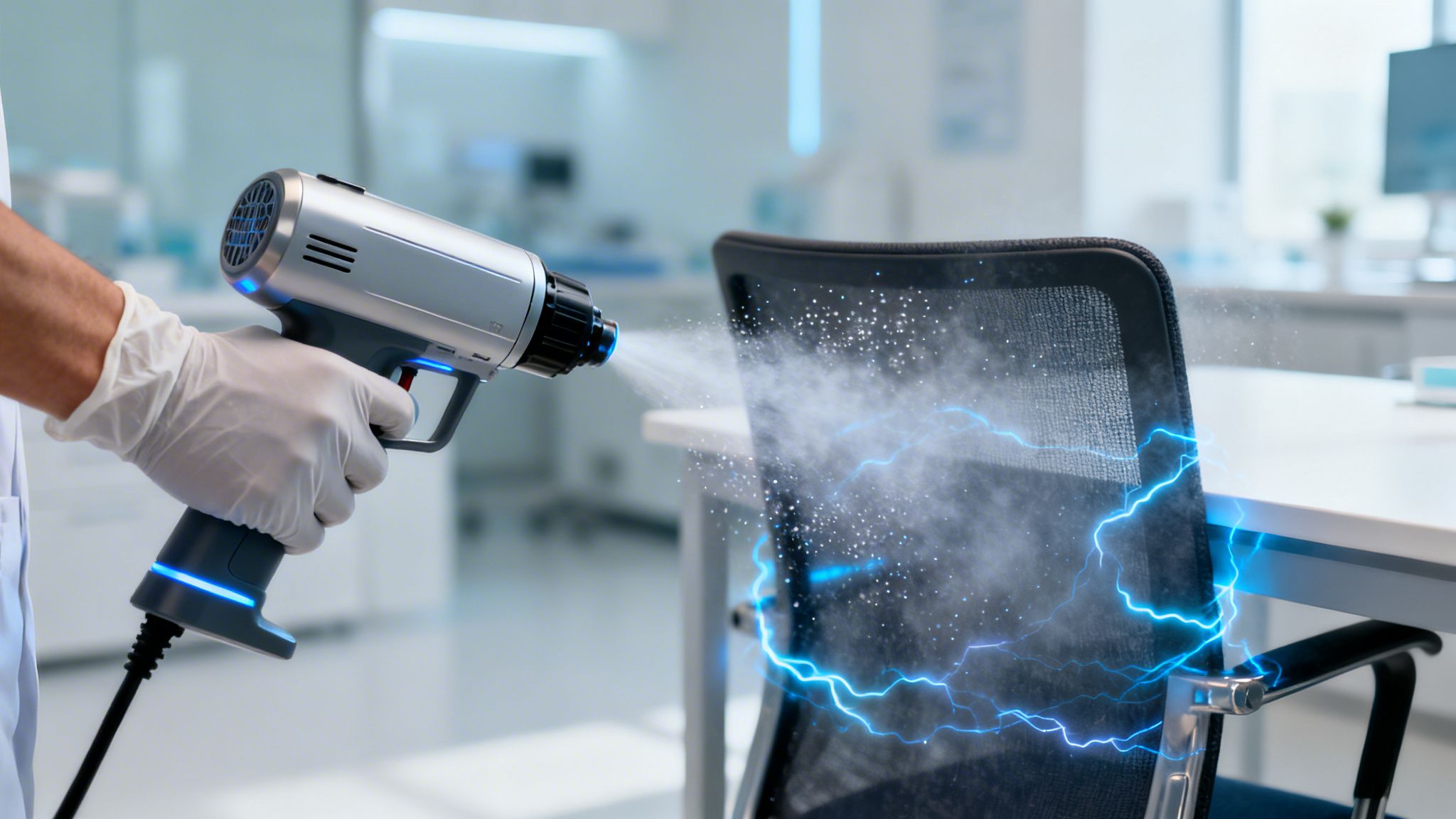
An electrostatic sprayer is a disinfection tool that gives a positive electrical charge to the liquid disinfectant it sprays. This charge makes the tiny droplets cling to surfaces like a magnet, wrapping all the way around them for 360-degree coverage that traditional methods just can't match.
How Electrostatic Sprayers Work
Think about trying to paint every nook and cranny of a metal gate with a standard spray can. You’d get the front, but you’d almost certainly miss the back, the sides, and the tight spots between the bars. Conventional spray-and-wipe disinfection has the same problem—it's incredibly easy to miss the undersides of desks or the back of a doorknob, leaving a perfect hiding place for pathogens.
Electrostatic sprayers solve this by turning disinfectant droplets into tiny, targeted magnets. It's a massive leap forward from standard spray bottles and rags, which can leave behind untouched areas where viruses like Influenza A Virus (H1N1), SARS-Related Coronavirus 2 (SARS-CoV-2), or Norovirus can linger and spread.
The Science of "Wraparound" Coverage
So, how does it actually work? Inside the sprayer, a special nozzle adds a positive electrical charge to the disinfectant solution as it mists out. Since most surfaces in a room—like desks, chairs, and equipment—have a neutral or slightly negative charge, the laws of physics take over. Just like opposite ends of a magnet snap together, those positively charged droplets are actively pulled toward the surfaces.
This attraction is so powerful that the droplets can defy gravity, moving sideways and even upwards to find and coat an object. They don't just land on the surface you're aiming at; they actively "wrap around" to cover the sides and back. This is what we in the industry call the wraparound effect.
The process is surprisingly simple:
- Charge: An electrode in the sprayer gives a positive charge to the disinfectant droplets.
- Attract: The charged droplets are magnetically drawn to neutral or negatively charged surfaces.
- Wrap: The droplets spread out and envelop the object, ensuring even, complete coverage.
This diagram shows exactly how that process works, from the moment the charged droplet leaves the nozzle to when it fully wraps the surface.

As you can see, the technology ensures the disinfectant actively seeks out and sticks to surfaces instead of just settling wherever gravity and airflow take it.
To really understand the difference this technology makes, let's compare it side-by-side with the old-school approach.
Comparing Electrostatic Spraying to Traditional Disinfection
| Attribute | Electrostatic Sprayer | Traditional Sprayer and Wipe |
|---|---|---|
| Coverage | 360-degree wraparound; covers sides, back, and crevices. | Manual and inconsistent; often misses hard-to-reach areas. |
| Efficiency | Uses 30-50% less chemical due to targeted application. | High potential for overuse and chemical waste (puddling). |
| Speed | Covers large areas quickly with minimal manual effort. | Slow and labor-intensive, requiring manual wiping of every surface. |
| Consistency | Provides a uniform, even layer of disinfectant. | Prone to human error, resulting in uneven application. |
| Dwell Time | Even coating helps maintain the required wet contact time. | Wiping can remove disinfectant before it works; uneven drying. |
It's clear that while spray-and-wipe has its place, electrostatic technology offers a far more reliable and efficient way to ensure surfaces are truly disinfected. For many day-to-day tasks, however, the convenience of a disinfecting wipe remains unmatched.
Superior Efficiency and Viral Inactivation
This targeted application isn't just more complete—it's far more efficient. Because the disinfectant is pulled directly to surfaces, less of the solution is wasted floating in the air or pooling on the floor. This advantage is why so many industries are making the switch.
This isn't just about saving time and money, either. In high-stakes environments like hospitals, that complete coverage is essential for stopping the spread of dangerous pathogens. Some data has shown a 25% reduction in hospital-acquired infections in facilities that have integrated electrostatic sprayers into their cleaning protocols.
By making sure every surface gets a consistent coating of disinfectant, electrostatic sprayers create the perfect conditions for killing pathogens. This total coverage is the key to achieving proper contact time—the amount of time a surface must stay wet to kill a virus—which we'll dig into next.
How Electrostatic Sprayers Actually Kill Viruses Like SARS-CoV-2 and Norovirus
Getting a disinfectant to cover every square inch of a surface is just the first step. The real magic happens during what’s known as dwell time—the amount of time a disinfectant needs to stay wet on a surface to actually kill germs.
If a disinfectant dries too quickly, viruses like Influenza A Virus (H1N1) or SARS-Related Coronavirus 2 (SARS-CoV-2) can easily survive. This is where traditional spray-and-wipe methods often fall short. Wiping can physically remove the disinfectant before its job is done, or it can leave an uneven layer that dries in patches, giving pathogens a place to hide.
This is where electrostatic sprayers shine. They create such a fine, even mist that it coats every part of a surface—front, back, and sides. This consistent coverage ensures the disinfectant stays wet for its full, required dwell time, giving it the window it needs to break down and neutralize viruses. For immediate spot cleaning, however, the direct application from a disinfecting wipe also ensures proper dwell time right where it's needed most.
Enveloped vs. Non-Enveloped Viruses
To understand why complete coverage is so important, you have to know your enemy. Viruses aren't all the same; they fall into two main categories based on their structure, which determines how hard they are to kill.
Enveloped Viruses: Think of viruses like Human Immunodeficiency Virus Type 1 (HIV-1), Avian Influenza Virus (H5N1), and Herpes Simplex Virus 1 (HSV-1). They're wrapped in a soft, fatty outer layer called an envelope. This lipid shell is their weak point—it's easily dissolved by most disinfectants, making these viruses relatively simple to inactivate.
Non-Enveloped Viruses: These are the tough guys of the viral world. Viruses like Norovirus (Norwalk Virus), Human Rotavirus, and Rhinovirus Type 14 don't have that fragile envelope. Instead, they are protected by a hard protein shell called a capsid, making them notoriously difficult to kill.
This difference is everything when it comes to disinfection. Getting rid of a small non-enveloped virus like Norovirus—famous for causing massive outbreaks—demands a powerful disinfectant and a foolproof application method that guarantees full coverage and dwell time.
The 360-degree wrap from an electrostatic sprayer is especially powerful against these hardier non-enveloped viruses. By making sure no part of a surface is missed, it eliminates the safe havens where these pathogens could otherwise survive. Of course, surface disinfection is just one piece of the puzzle. Other technologies like UV light in HVAC systems can add another layer of protection by targeting airborne pathogens.
The Inactivation Process, Step-by-Step
So what does it actually look like when an electrostatic sprayer neutralizes a virus? The process is a simple but effective combination of physics and chemistry.
Droplets Find Their Target: As the charged disinfectant droplets are sprayed, they are actively pulled toward nearby surfaces like tiny magnets.
A Uniform Coat Forms: The droplets don't just land; they spread out and create a seamless, thin film of liquid that envelops the entire object. This "wraparound" coverage eliminates the missed spots you get with manual methods.
Dwell Time Is Achieved: Because the layer of disinfectant is so uniform, it stays wet for the full time required by the product's label. This is the critical period when the chemical action happens.
The Virus Is Destroyed: During this dwell time, the disinfectant’s active ingredients go to work. For an enveloped virus like Hepatitis B Virus (HBV), they dissolve the outer membrane. For a tough, non-enveloped virus like Human Rotavirus, they break down the protective protein capsid, rendering the virus harmless. This systematic process ensures even the most stubborn germs are inactivated.
Selecting the Right Disinfectant for Your Sprayer
Choosing the right sprayer is only half the battle. An electrostatic sprayer is only as good as the disinfectant you put inside it, and pouring just any chemical into the reservoir is a recipe for disappointment—and potential danger.
The device is calibrated for specific liquid properties. Using the wrong one can lead to clogs, damage the internal components, or simply fail to disinfect properly.
Even worse, aerosolizing a chemical that hasn't been tested and approved for it can create serious health hazards for your team and anyone else in the building. This is why it’s absolutely critical to stick with disinfectants that are not only registered with the Environmental Protection Agency (EPA) but also specifically approved by the manufacturer for electrostatic use.
Matching the Chemical to the Pathogen
Your first question should always be: does this disinfectant actually kill the viruses I’m worried about? A product that works wonders on an enveloped virus like Influenza A2/305/57 Virus (H2N2) might not be strong enough to handle a tough, non-enveloped bug like Norovirus.
When you’re looking at a disinfectant, check the product label for specific kill claims. These claims are backed by rigorous lab testing and confirm the product’s power against certain pathogens, such as:
- SARS-Related Coronavirus 2 (SARS-CoV-2)
- Hepatitis B Virus (HBV) and Hepatitis C Virus (HCV)
- Herpes Simplex Virus 1 (HSV-1) and Herpes Simplex Virus 2 (HSV-2)
- Human Rotavirus
- Rhinovirus Type 39
If a product doesn’t explicitly list the virus you’re targeting, you have to assume it hasn’t been proven to kill it. Always look for the EPA registration number to verify its claims. The same scrutiny applies when selecting disinfecting wipes, which also carry specific kill claims on their packaging.
Considering Surface Compatibility and Safety
Beyond its germ-killing power, you also have to think about where you'll be spraying. Some powerful chemicals can be corrosive or cause discoloration on sensitive materials and electronics. It’s essential to read the label to make sure the product is safe for your environment. You can learn more about how different chemicals work in our detailed guide on what kills viruses on surfaces.
Remember, professional disinfection requires professional precautions. The act of aerosolizing a disinfectant fundamentally changes how you interact with it, making Personal Protective Equipment (PPE) a non-negotiable part of the process.
The product label is your guide to safety. It will specify the minimum PPE required for anyone applying the product, which often includes N95 respirators, eye protection, and gloves. Ignoring these guidelines can lead to respiratory irritation or other serious health issues.
The training and safety protocols required for electrostatic spraying really underscore its role as a tool for large-scale, professional jobs—not quick, daily wipe-downs of a few doorknobs. This is why having a supply of ready-to-use disinfecting wipes is essential for everyday hygiene.
A Quick Checklist for Choosing Your Disinfectant
Navigating chemical labels can feel overwhelming, but it gets a lot simpler when you know what to look for. Before you purchase a disinfectant for your electrostatic sprayer, run through this checklist:
- EPA Approved for Electrostatic Use: Is the product explicitly tested and approved by its manufacturer for application with an electrostatic sprayer? This is non-negotiable.
- Kills Your Target Pathogens: Does the label list kill claims for the specific viruses you need to eliminate (e.g., Norovirus, SARS-CoV-2)?
- Correct Dwell Time: Is the required contact time—the time a surface must stay visibly wet—realistic for your facility? A 10-minute dwell time is tough to maintain in a dry or high-airflow area.
- Surface Safe: Is the chemical compatible with your surfaces, including electronics, fabrics, and metals? Check the label for any warnings.
- PPE Requirements: Do you have the necessary Personal Protective Equipment (PPE) specified on the safety data sheet for your team?
Using this checklist helps ensure you select a product that is not only effective but also safe for your equipment, your surfaces, and your people.
Where Electrostatic Disinfection Delivers the Biggest Impact
The real power of an electrostatic sprayer shines in places where a simple wipe-down just won't cut it. Think complex, high-traffic environments filled with nooks, crannies, and hard-to-reach surfaces. In these settings, getting complete disinfectant coverage isn't a luxury—it's essential for keeping people safe.
That’s where the "wraparound" effect comes in. The charged droplets actively seek out and cling to surfaces, coating them from every angle. This means you can disinfect an entire room of desks, chairs, and equipment in a fraction of the time it takes to do it by hand, without missing the undersides or backs of objects.

High-Stakes Environments
Some places are just built for germs to spread. The risk of transmission is higher, the surfaces are more complicated, and the consequences of a missed spot can be serious. Electrostatic technology was practically made for these challenges.
Hospitals and Healthcare Facilities: Operating theaters, patient rooms, and waiting areas are packed with intricate medical equipment. The wraparound coverage is perfect for disinfecting IV poles, bed rails, and monitors, helping to control dangerous pathogens like Bovine Viral Diarrhea Virus (BVDV), a common lab surrogate for Hepatitis C Virus (HCV), and Duck Hepatitis B Virus (DHBV), a model for Hepatitis B Virus (HBV).
Public Transit: A city bus or subway car is a masterclass in complex surfaces. Handrails, vinyl straps, seat backs, and windows are touched by thousands of people every single day. Electrostatic sprayers let operators disinfect an entire vehicle between runs—a job that’s nearly impossible to do thoroughly with manual wiping.
Schools and Universities: Classrooms, cafeterias, and gyms are breeding grounds for viruses like Rhinovirus and Norovirus. This technology offers a fast, effective way to treat large areas and tricky objects like desks and playground equipment, minimizing school-day disruptions while keeping students and staff healthy. For smaller-scale disinfection at home, check out our guide on choosing a disinfection sprayer for home use.
Beyond Public Health and Sanitation
The same science that makes electrostatic spraying so good for disinfection has found a home in other industries where total coverage is a must. One of the biggest is agriculture, where the technology is now a critical tool for protecting our food supply.
In fact, electrostatic sprayers now command a 32% market share in the agricultural sector. Why? The charged droplets reduce chemical drift by up to 50% and stick to plant leaves much more effectively. Research shows this approach gives 70-90% better coverage than old-school sprayers, which is vital for fighting plant viruses and keeping crops healthy. You can dig into the numbers yourself by reading the full forecast analysis on IndexBox.io.
This real-world use in farming is powerful proof of the core principle: electrostatic charging dramatically improves how well a liquid sticks to and covers a surface.
Key Takeaway: The same science that helps protect a patient in a hospital is also used to protect a field of crops from disease. It's a testament to how robust and adaptable this technology really is.
Whether you’re trying to stop the flu in a classroom, disinfect a commuter train, or safeguard the nation's food supply, electrostatic spraying offers an unmatched advantage. For the immediate, day-to-day disinfection of high-touch surfaces in these same environments, disinfecting wipes provide a simple, effective, and crucial layer of protection.
Essential Safety Protocols for Using Electrostatic Sprayers
Electrostatic sprayers are incredible tools for disinfecting large areas, but let's be clear: they’re not simple spray bottles. This is professional-grade equipment that turns chemical disinfectants into a fine, aerosolized mist.
Without the right precautions, that mist can easily be inhaled, putting the operator and anyone else in the building at risk. Following a strict safety protocol isn't just a good idea—it's non-negotiable.

Your first line of defense is always Personal Protective Equipment (PPE). What kind of PPE you need depends entirely on the disinfectant’s Safety Data Sheet (SDS), not the sprayer itself. Cutting corners here is a serious mistake.
Required Personal Protective Equipment
Before an operator even thinks about mixing a disinfectant solution, they need to be fully kitted out. Breathing in aerosolized chemicals can lead to respiratory irritation or worse, long-term health issues.
Standard PPE for electrostatic spraying almost always includes:
- Respirator: An N95 respirator or better is usually the minimum to filter out fine chemical particles.
- Eye Protection: Safety goggles or a full-face shield are a must to protect eyes from mist and splashes.
- Gloves: Chemical-resistant gloves are essential to prevent the disinfectant from touching the skin.
- Protective Clothing: Long sleeves or a disposable gown will protect the skin from any accidental contact.
The level of gear required makes one thing obvious: electrostatic spraying is a job for trained professionals. For a quick wipe-down of a doorknob or countertop, this much prep is completely impractical, making a simple disinfecting wipe the superior choice.
Room Preparation Before Spraying
Getting the room ready is just as critical as wearing the right PPE. The whole point is to make sure the disinfectant only touches what it's supposed to, without damaging property or contaminating sensitive items.
A pre-spraying checklist should always include these steps:
- Remove People and Pets: Nobody without full PPE should be in the room during or right after application. No exceptions.
- Clear Food and Drinks: Any food, beverages, or things that touch food (like plates and utensils) need to be removed or sealed in airtight containers.
- Cover Sensitive Electronics: That fine mist can still cause problems. Cover computers, keyboards, and other delicate electronics with plastic sheeting.
- Protect Porous Surfaces: If your disinfectant isn't rated for fabrics, cover or remove things like important papers, textiles, and untreated wood.
And don't forget—these are electrical devices. Following proper electrical safety guidance is crucial to prevent shocks or short circuits.
Post-Application Procedures
The job isn’t done when the spraying stops. What you do afterward is key to making sure the disinfectant actually works and the room is safe to re-enter. The disinfectant's label is your guide here for dwell time and ventilation.
After spraying, the operator must:
- Allow for Dwell Time: The room must stay empty for the entire dwell time specified on the product label. This is what ensures pathogens like Herpes Simplex Virus 2 (HSV-2) or Rhinovirus Type 39 are killed.
- Ventilate the Area: Once the dwell time is up, air out the room based on the manufacturer’s directions. This might mean opening windows or turning on the HVAC system.
- Adhere to Re-Entry Times: The label will also state a safe re-entry time for people without PPE. This is a critical safety instruction that must be followed to the letter.
This intensive, multi-step process shows that electrostatic disinfection is a powerful but complex tool. The extensive training and safety measures involved confirm its place as a solution for large-scale, professional jobs, making simpler options like disinfecting wipes the perfect, safe choice for daily use by anyone.
Knowing the Limits and Choosing the Right Tool for the Job
Electrostatic sprayers are incredible tools for disinfecting large areas, but they aren't a silver bullet for every hygiene problem. To build a truly effective cleaning strategy, you need to know not just what these devices can do, but what they can't.
Frankly, one of the biggest misunderstandings we see is the idea that these sprayers clean and disinfect in one shot. They don't. An electrostatic sprayer is a disinfection tool only. Its job is to apply an even coat of disinfectant to kill pathogens, not to scrub away dirt, dust, or grime.
Pre-Cleaning Is Not Optional
Think of it this way: you wouldn't try to paint a dirty, rusty car without sanding and washing it first. The paint would just sit on top of the grime and flake right off. It’s the same with disinfectants. If a surface is covered in a layer of soil, the disinfectant can't reach the viruses and bacteria hiding underneath.
Every surface you plan to treat with an electrostatic sprayer must be cleaned first. This means manually wiping it down with soap or detergent and water to remove all visible soil. It's a non-negotiable step in any professional disinfection protocol.
Skipping pre-cleaning wastes time, money, and disinfectant. Even worse, it creates a false sense of security. That perfect 360-degree coverage is useless if the chemical never actually touches the germs you’re trying to kill, like tough-to-kill pathogens such as Feline Calicivirus (a common surrogate for Norovirus) or Rhinovirus.
For more on the cleaning side of the equation, you can check out our guide on different types of surface cleaning machines.
When a Sprayer Is Impractical
Beyond the need for pre-cleaning, there are plenty of everyday situations where firing up an electrostatic sprayer is just overkill. These machines are built for broad, room-scale application, not for small, targeted cleanups.
Think about these common scenarios:
- Wiping up a small spill in a breakroom.
- Disinfecting a doorknob someone just coughed on.
- Cleaning a shared remote control or light switch.
- Sanitizing your phone or keyboard.
Using an electrostatic sprayer for these jobs is like trying to water a single houseplant with a firehose. It's inefficient, messy, and totally unnecessary given the setup time, PPE, and need to clear the room.
The Right Tool for Targeted Disinfection
This is where you need to reach for a different tool. For all those immediate, spot-disinfection jobs, nothing beats the simplicity and effectiveness of a good disinfecting wipe.
After prepping raw chicken on a countertop, you need to clean and disinfect that spot right now. Grabbing a wipe is fast, easy, and gets the job done. It lets you physically remove the mess and apply a disinfectant directly where it's needed, all in one go.
Disinfecting wipes are the perfect partner to a broader electrostatic spraying program. They are the go-to choice for:
- High-Touch Points: Quickly hitting doorknobs, faucets, light switches, and elevator buttons throughout the day.
- Personal Items: Safely cleaning phones, keyboards, and mice without risking damage.
- Spot-Cleaning: Responding instantly to messes that need immediate attention.
- Daily Maintenance: Empowering staff or family members to maintain a clean space without needing specialized equipment or training.
By understanding the limits of an electrostatic sprayer for cleaning, you can see where it shines—and more importantly, where a simple disinfecting wipe is the smarter, more practical choice. Wipes aren't a lesser option; they're an essential part of any complete and effective hygiene plan.
Frequently Asked Questions About Electrostatic Sprayers
Whenever a new piece of tech like an electrostatic sprayer comes along, it’s natural to have a few questions. We’ve put together some straightforward answers to the most common things people ask, helping you see exactly where these tools fit into a complete infection control plan.
Can I Put Any Disinfectant in My Electrostatic Sprayer?
Absolutely not. This is one of the most critical safety rules: only use disinfectants that are EPA-registered and explicitly approved by the manufacturer for electrostatic application. Pouring just any chemical into the tank is a recipe for disaster.
Using an unapproved product can damage the sprayer’s internal components, but more importantly, it can create serious health hazards. Chemicals not tested for aerosolization can be extremely dangerous to inhale. Always, always read the disinfectant's label first.
Does Electrostatic Spraying Replace Manual Cleaning?
No, electrostatic spraying is a final disinfection step, not a replacement for good old-fashioned cleaning. You must thoroughly clean every surface of visible dirt, dust, and grime before you even think about spraying.
Disinfectants can't work through a layer of filth. Grime acts like a shield for germs, protecting viruses like Human Coronavirus or Rhinovirus from the disinfectant. Think of it this way: you wouldn't wax a dirty car. Pre-cleaning is a non-negotiable first step, which is why a combined cleaning and disinfecting wipe can be so useful.
Is Electrostatic Spraying Safe Around Electronics?
While the fine mist is generally less risky for electronics than a drench-and-wipe method, you still need to be careful. The best approach is to always follow the specific guidelines from both the sprayer and the disinfectant manufacturers.
The best practice is to always cover or remove sensitive and high-value electronics before you begin spraying. You should never spray directly onto keyboards, monitors, or open ports. For these items, a targeted disinfecting wipe is a much safer and more appropriate tool.
When Should I Use Wipes Instead of a Sprayer?
Think of wipes and sprayers as two different tools for two different jobs. Wipes are perfect for quick, targeted disinfection of small, high-touch surfaces where a large-scale sprayer would be overkill. A sprayer, on the other hand, is built for broad, room-wide disinfection after a thorough cleaning.
Use wipes for jobs like:
- Wiping down doorknobs, elevator buttons, and light switches.
- Cleaning a shared countertop after a spill.
- Disinfecting your own phone, desk, or keyboard.
For these immediate, spot-treatment tasks, wipes are far more practical and efficient. They let you tackle a specific contamination point instantly, without the setup time, PPE, and room-clearing protocols needed for an electrostatic sprayer for cleaning. Wipes are your go-to for daily maintenance, while sprayers are your heavy-hitters for periodic deep disinfection.
Leave a Reply