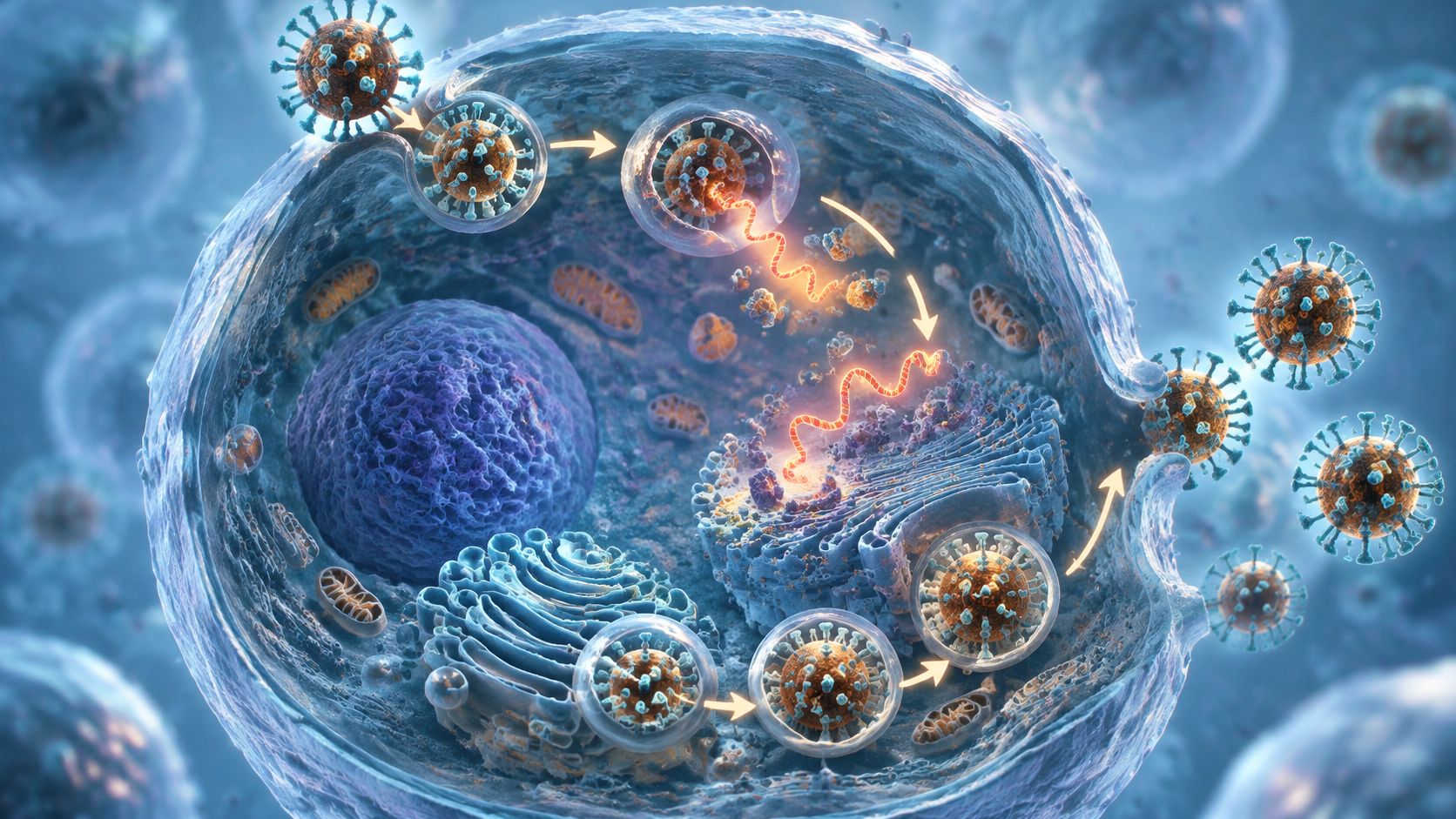
A household member comes home feeling unwell, and soon everyone's thinking about shared surfaces, close contact, and whether cleaning will help. Behind those everyday concerns is a process happening at a scale too small to see: a virus must enter a susceptible cell, use that cell to make viral components, and get those components into new infectious particles. Understanding the viral life cycle makes it easier to see where infection can be interrupted, why viruses behave differently, and why a test result doesn't always tell the whole story.
What Is the Viral Life Cycle
A useful starting point is to think of a virus as a visitor carrying instructions but lacking the machinery to run a factory. It can't reproduce independently. Instead, it must reach a suitable host cell and use resources inside that cell to make more virus.
Virologists describe this process as a sequence of functional stages: attachment, entry, uncoating, genome replication and viral-protein production, assembly, and release. In plain language, the virus first binds to a compatible cell, gets inside, makes its genetic instructions available, directs production of viral components, assembles new particles, and leaves the cell. The stages form a helpful map, though the molecular details vary with the virus's genome, envelope, and host cell.

The framework has a history rooted in bacteriophage research. In 1952, Alfred Hershey and Martha Chase used radioactive labels to show that viral nucleic acid, rather than the bacteriophage's protein coat, entered bacteria and supplied the information needed for virus reproduction. The Nobel Prize's historical summary describes the larger pattern that followed: viral nucleic acid and protein separate, the nucleic acid multiplies, virus-specific proteins are made, and new particles are reconstituted. The Nobel Prize's account of the Hershey–Chase experiments explains why this model remains foundational.
The factory analogy has limits, but it captures the essential point: a virus depends on a host cell. Some infections end with particles leaving the cell; others can leave viral genetic material in a quiet or persistent state. So the life cycle isn't one universal script. It's a set of biological tasks, carried out in different ways by different viruses.
The Six Stages of Viral Replication
Each stage is a possible bottleneck. If the virus can't complete one, infection may fail to produce new infectious particles, even if earlier steps succeeded.
-
Attachment is the key meeting the lock. Viral surface proteins bind to receptors on a susceptible cell. Because cells in different tissues carry different receptors, receptor availability helps determine tissue tropism, or which tissues a virus can infect.
-
Entry gets the virus across the cell boundary. Depending on the virus, it may fuse with the cell membrane or enter within a membrane-bound compartment. Entry gets the virus inside, but it doesn't guarantee that the infection will succeed.
-
Uncoating opens the package. The viral genome must become accessible in the right cellular location. If the genome remains trapped or is released in the wrong place, the infection can stop before productive replication begins.
-
Genome expression and replication put the cell to work. The virus uses its own enzymes, host-cell machinery, or both to produce viral genetic material and proteins. The details depend on the virus's genome and the resources available in that cell.
-
Assembly and maturation turn components into particles. Viral genomes and structural proteins come together, then some viruses need additional changes before the new particles can infect another cell.
-
Release lets progeny leave. Non-enveloped viruses commonly exit when the host cell breaks open, a process called lysis. Enveloped viruses often bud through a cell membrane and acquire a lipid envelope as they leave.
Researchers describe these steps as distinct mechanistic bottlenecks. For example, receptor binding and entry aren't enough if uncoating fails and the genome never becomes available. A review of viral replication stages and their dependencies discusses why the exact stage matters when studying infection or considering an antiviral target.
Why the steps matter: A virus can attach to a cell without completing a productive infection. Finding out where the process stalls is more informative than simply asking whether the virus reached the cell.
For younger learners, life-cycle activities can make the idea of ordered stages easier to grasp. A butterfly stages worksheet offers a familiar example of how one stage leads to another, while the viral process adds the important complication that a virus depends on a host cell.
How the Cycle Varies Across Virus Families
The same broad tasks don't mean every virus follows the same route. A virus's genome type, envelope, and host cell influence how it enters, where it copies its genome, and how it exits.
Some positive-sense RNA viruses can use their incoming genome as a template for protein production soon after reaching the cytoplasm. They may also reorganize host-cell membranes into replication sites that concentrate viral enzymes and help shield nucleic-acid intermediates from host defenses. By contrast, viruses that replicate in the nucleus may need to transport their capsids or genomes through nuclear pores. That adds another logistical hurdle: reaching the right compartment.

Exit also differs. Enveloped viruses often bud through a cellular membrane or leave through vesicular transport, acquiring a host-derived lipid membrane along the way. Non-enveloped viruses commonly leave through cell lysis instead. These are common strategies, not rules that make every member of a broad virus category identical.
Rotavirus shows how specialized genome copying can become. Its genome is double-stranded RNA, and the virus copies it inside assembling particles rather than leaving the genome freely exposed in the cytoplasm. Viral RNA is gathered in structures called viroplasms, then packaged into nascent cores, where RNA synthesis takes place. Keeping this process inside a particle helps limit exposure of the double-stranded genome. A detailed review of rotavirus replication describes this assembly-linked process.
Think of the life cycle as a map, not a script. The stages help organize what happens, but they don't tell you every molecular detail about a particular virus.
That distinction matters when comparing viruses or interpreting experiments. The overview of RNA viruses and their replication strategies can help readers connect genome type to the different routes viruses take through the broader life-cycle framework.
Why the Life Cycle Matters for Treatment and Testing
Antiviral treatment makes more sense when you can see the step it's designed to disrupt. HIV provides a clear example: after binding to a susceptible cell, it fuses with the cell membrane, converts its RNA genome into DNA, integrates that DNA into a host chromosome, and later produces particles that mature as they bud. Different viral enzymes act at different points in this sequence.
That gives drug classes distinct targets. Entry inhibitors interfere with the virus getting into a cell. Reverse-transcriptase inhibitors block the conversion of viral RNA into DNA, while integrase inhibitors interfere with insertion of viral DNA into the host genome. Protease inhibitors disrupt the processing of viral proteins needed for mature infectious particles. A CDC report from 1998 estimated HIV's generation time, from release of a virion to infection of another cell and release of progeny, at approximately 2.5 days, corresponding to roughly 140 generations per year. The Nobel Prize's advanced information on HIV research describes the replication cycle and cites the report's estimate.

Testing also depends on what you want to measure. A test that detects viral RNA can identify genetic material, but that doesn't automatically show that replication-competent infectious particles are still being produced. Viral RNA may persist after infectious-particle production has stopped. When researchers need to assess replication-competent virus, plaque assays or focus-forming assays are more suitable endpoints than a measurement of total viral RNA alone. A review of virus–host variation and measurement discusses why these endpoints shouldn't be treated as interchangeable.
For clinicians and researchers, the practical question is precise: which stage is the treatment targeting, and which stage is the test measuring? The overview of how antiviral drugs work provides further context on matching medicines to viral dependencies.
The Host Cell as an Active Partner in Infection
A virus brings genetic instructions, but the host cell helps determine what happens next. Receptors and membrane composition can influence entry. Cellular enzymes, metabolites, and organelles can affect genome replication. Host trafficking systems can help move components into position for assembly and release. The outcome is therefore a host–virus partnership, not a self-contained viral program.
This perspective helps explain why similar viruses can behave differently in different tissues, and why the same virus may not produce the same outcome in every person. Cells differ in the receptors and proteins they make, their internal state, and the resources available to an infection. Age, comorbidities, and immune status can also shape an individual's response, though their effects vary by virus and person.

A study published in 2026 tracking Zika and chikungunya RNA inside living cells identified more than 200 host proteins interacting with Zika virus and 132 shared host factors between the two viruses. Reducing one shared factor, SFPQ, sharply decreased production of both viruses in laboratory cells. These findings point to possible host dependencies, but laboratory cell results don't by themselves establish what will happen in human tissues. The report on tracking viral RNA in infected cells describes the work.
Targeting a host factor could make it harder for a virus to escape treatment by changing its own proteins. But host proteins also serve normal cellular functions, so interfering with them may create toxicity risks. Researchers must ask whether a host factor is needed by the virus and whether it can be targeted without unacceptable harm. For readers interested in how researchers introduce genetic material into cells, CRISPR transfection advice offers related laboratory context.
When the Cycle Goes Quiet Latency and Reservoirs
The life cycle doesn't always end with a cell bursting or releasing a steady stream of new particles. Some viruses can persist in a cell, with their genetic material present while active production is low or absent. Latency describes a quiet state that may later reactivate; a reservoir is a population of cells that retains virus capable of restarting infection.
HIV shows why this matters. Antiretroviral therapy blocks actively replicating virus, but it doesn't eliminate long-lived, replication-competent proviruses integrated mainly into resting memory CD4+ T cells. If treatment is interrupted, reactivation from even a small reservoir can restart systemic infection. This is why suppression and eradication aren't interchangeable terms.
Research published in 2025 reported that HIV infection can drive a quiescence program involving p53 and KLF2. The program suppresses cellular proliferation and viral transcription while promoting latent-reservoir formation. The research on HIV-driven quiescence and latent reservoirs examines this mechanism.
Undetectable doesn't always mean eradicated. A test can show that active virus is suppressed without proving that every replication-competent provirus has disappeared.
Productive infection, latency, persistence, and chronic low-level replication describe different patterns, and they don't apply identically across virus families. A quiet state can help a virus persist without obvious signs of active production, but not every persistent virus behaves like HIV. Strategies intended to reactivate latent virus are still experimental, not established cures. For a related public-health question, asymptomatic viral shedding is a useful topic to distinguish from latency: quiet persistence and transmission without noticeable symptoms aren't the same concept.
Practical Takeaways for Prevention and Disinfection
Knowing the life cycle helps put prevention in context. A virus must reach a susceptible host and complete the steps needed for infection. Measures that reduce opportunities for exposure, including hand hygiene and cleaning shared surfaces, can help interrupt that path. They don't replace medical advice or virus-specific public-health guidance.
Choose cleaning and disinfecting products according to their labels. Products aren't interchangeable, and instructions matter. Check which surfaces the product is intended for, how it should be applied, and how long the surface needs to remain wet. Don't mix cleaning products, and follow any label precautions for ventilation and contact with skin.
High-touch surfaces in shared spaces, such as households, schools, and workplaces, deserve attention as part of a broader hygiene routine. Disinfecting wipes can be convenient for suitable surfaces when their label supports that use; they aren't a substitute for handwashing or for following instructions on the specific product. A property manager disinfection resource can help building managers consider professional cleaning and disinfection for shared environments.
VirusFAQ.com publishes educational articles about viral biology, transmission, and prevention, alongside more technical material for readers seeking deeper scientific detail. Whatever resource you consult, match prevention choices to the setting and the product's directions. Understanding where transmission can be interrupted makes it easier to choose sensible routines instead of assuming one cleaning method works for every virus.
Frequently Asked Questions About the Viral Life Cycle
How long does the viral life cycle take?
There's no single timetable. It depends on the virus, the host cell, and the stage being measured. HIV's estimated generation time is approximately 2.5 days, as described in the treatment section, but that estimate shouldn't be applied to other viruses.
Why can some viruses infect many cell types while others are tissue-specific?
A virus needs a compatible cell. The distribution of suitable receptors helps determine which cells it can enter, while the host cell's internal proteins and resources influence whether infection can proceed. Receptor binding alone doesn't guarantee successful replication.
Is the viral life cycle the same for every virus?
No. Attachment, entry, genome production, assembly, and release provide a useful shared framework, but viruses differ in genome type, replication location, envelope, and dependence on host-cell machinery. A stage may serve the same broad purpose in two viruses while relying on different molecular steps.
Understanding those differences helps readers make better sense of prevention, testing, and treatment. For everyday use, check the label on disinfecting wipes before applying them to a surface, and follow the stated contact time and safety directions.
Leave a Reply