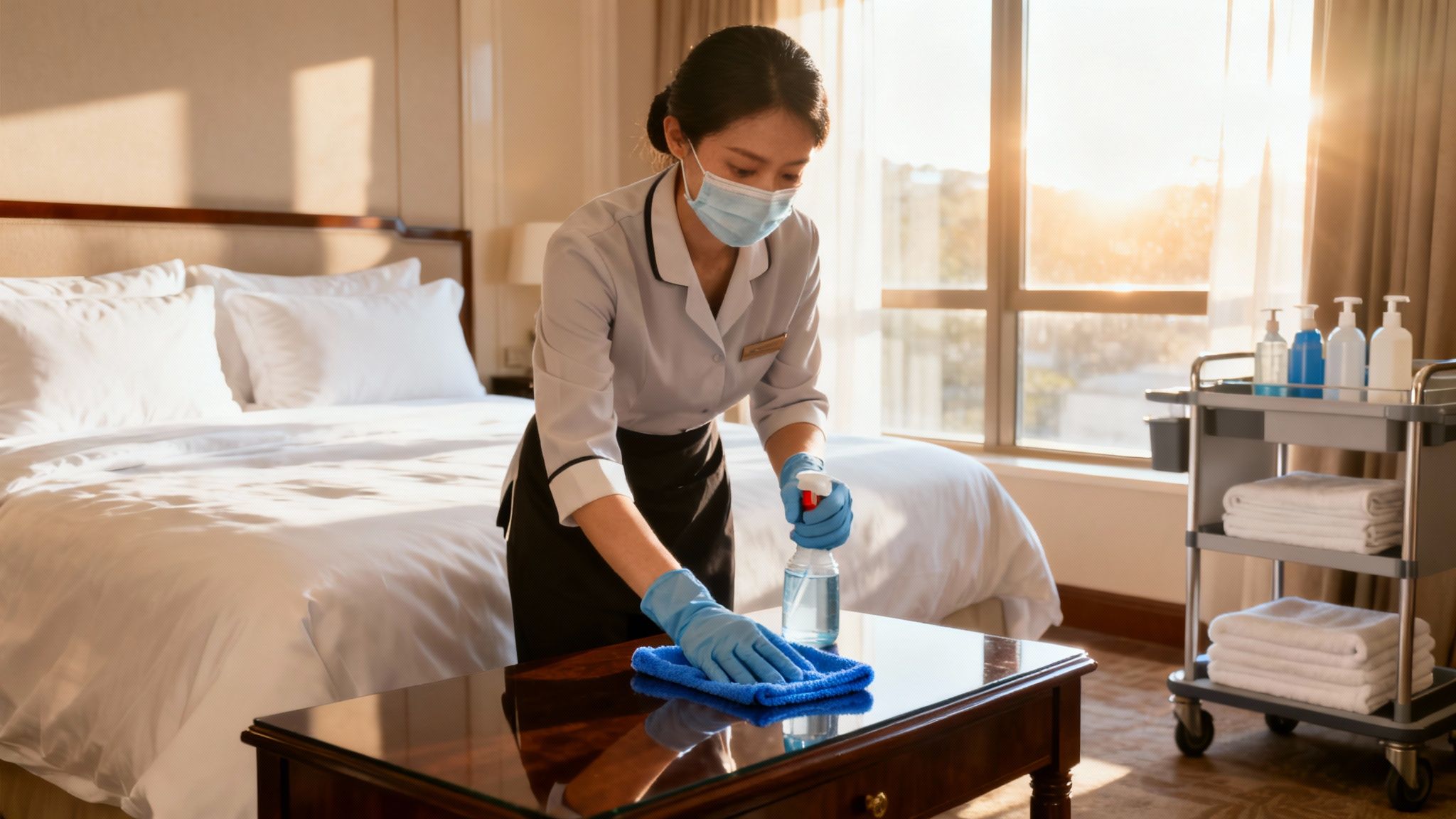
Proper hotel rooms cleaning goes far beyond just making things look neat. At its core, it's a public health strategy designed to break the chain of viral transmission from one guest to the next.
The goal is simple: systematically disinfect every high-touch surface to kill any pathogens left behind. This isn't just about good housekeeping; it's about building trust and ensuring the next guest walks into a genuinely safe environment where viruses like Norovirus, Human Coronavirus, and Influenza A are neutralized.
Why Modern Hotel Hygiene Is More Than Just Tidiness
Guest expectations have changed. A decade ago, a clean room meant a vacuumed carpet and a freshly made bed. Today, travelers are far more aware of how viruses like Norovirus, Influenza, and Human Coronavirus can linger on surfaces, and they expect proof of deep cleaning and disinfection.
This shift has pushed the industry from aesthetics to science. A room that looks clean is no longer enough. It has to be microbiologically safe. Effective cleaning protocols today are built on a solid understanding of virology—knowing which germs, from Rhinovirus to SARS-CoV-2, are common in shared spaces and exactly how to eliminate them.
The Business Case for Advanced Cleaning
Let's be clear: rigorous disinfection isn't just a cost center. It's a powerful business strategy. A single negative review mentioning cleanliness can torpedo your reputation and scare away countless bookings. On the flip side, a proven commitment to hygiene builds the kind of guest trust and loyalty that marketing campaigns can only dream of.
The market reflects this new reality. The global hotel cleaning services market was valued at a huge USD 15 billion in 2023 and is on track to hit USD 25 billion by 2032. This explosive growth is driven by guest demand and the need for specialized providers who can keep up with modern health standards.
A truly comprehensive approach to modern hotel hygiene is about creating a holistic safe space. This means thinking beyond the main room and remembering the importance of often-overlooked elements like maintaining washroom exhaust fans to control moisture and prevent mold growth.
At the end of the day, a science-backed cleaning program is an investment. It protects your guests, strengthens your reputation, and ensures your business can thrive in an era where health and safety are non-negotiable.
Identifying Viral Hotspots In Every Guest Room
To really get a room disinfected, you have to think like a virus. A truly effective cleaning strategy isn't about scrubbing harder—it's about cleaning smarter. It all starts with a risk assessment, figuring out exactly where viruses are most likely to be hiding. This is what turns a simple room turnover into a precise, science-backed protocol.
First, you have to know your enemy. Viruses aren't all the same, and their structure dictates how tough they are to kill. For instance, small non-enveloped viruses like Norovirus (the culprit behind most stomach flu outbreaks) and Human Rotavirus are notoriously difficult to get rid of. They don't have a fragile outer fatty layer, which makes them resistant to many common cleaners and allows them to survive on a doorknob or TV remote for days, sometimes even weeks.
On the other hand, you have enveloped viruses like Influenza A, Human Coronavirus, and Herpes Simplex Virus 1 (HSV-1). They're surrounded by a fatty (lipid) membrane, which is actually a major weakness. This outer layer is easily broken down by disinfectants, especially soap and alcohol-based products, which effectively neutralizes the virus. Understanding this difference is key to prioritizing the right disinfectants for the job.
Mapping The Guest Touchpoint Journey
Every guest moves through a room in a fairly predictable way, leaving a trail of high-touch surfaces behind them. If you map out this "touchpoint journey," you can pinpoint the room's biggest viral hotspots. The goal is simple: disinfect every single thing a guest is likely to touch from the moment they walk in until they check out.
Think about how it plays out from the guest's perspective:
- The Entryway: It begins before they even get inside. The exterior and interior door handles, the deadbolt, the security latch, and the light switches right by the door are the very first points of contact.
- The Main Room: Next, they'll probably adjust the thermostat, open the windows, or pull the curtains. The desk is another critical zone—the surface itself, the chair arms, the phone, and the lamp switch are all guaranteed to be touched.
- Entertainment and Amenities: The TV remote is legendary for being one of the grimiest items in any hotel room. Don't forget the alarm clock, the minibar handle, the ice bucket, and the coffeemaker, either.
- The Bedside Area: Nightstands, lamps, and any outlets or charging ports are also frequent-contact surfaces.
These surfaces are ground zero for fomite transmission, where an everyday object acts as a middleman, transferring germs from one person to another. We cover this in-depth in our guide on what fomite transmission is and how to prevent it.
Prioritizing Surfaces Based On Material And Use
Not all surfaces are created equal when it comes to spreading germs. The type of material and how often it's touched makes a huge difference.
Hard, non-porous surfaces—think plastic, metal, and glass—are the most efficient transmitters. Viruses survive much longer on these materials, which is why things like light switches, faucets, and remotes should be at the very top of your disinfection list. Keeping single-use disinfecting wipes on every housekeeping cart is a great way to ensure these critical points are never missed.
One study found that the TV remote and the main light switch were two of the most heavily contaminated surfaces in hotel rooms, often harboring bacteria levels far higher than what’s considered acceptable.
What about soft or porous surfaces like carpets, couches, and curtains? While they are less likely to transmit viruses efficiently, they still need regular, thorough cleaning. Pathogens don't survive as well on these materials, but they can definitely still be a source of contamination.
By identifying these hotspots and understanding a little of the science, you can transform your cleaning checklist. Instead of just cleaning a room, your team can work methodically through it, neutralizing threats at every critical point before the next guest ever touches the door. This systematic approach is what builds a truly safe and trustworthy guest experience.
Your Blueprint For A Flawless Room Turnover
Turning over a guest room is so much more than just tidying up. It's a systematic health and safety procedure, a repeatable workflow designed to transform a used space into a pristine, safe environment. Done right, it neutralizes pathogens and builds guest confidence. The process kicks off the moment a guest checks out and isn't truly finished until that room is certified ready for the next arrival.
Let’s walk through a blueprint that breaks down the key phases of an effective turnover. Following a structured approach like this helps your team work efficiently without ever cutting corners on the details that matter most for eliminating tough viruses like Norovirus and Human Coronavirus.
Phase One: Air Out and Clear Out
Before a single cloth touches a surface, get some fresh air moving. Prop the door open and, if possible, open the windows. This simple first step is crucial—it helps disperse any lingering airborne particles and aerosols, making the room safer for your housekeeping staff from the get-go.
Next, do a quick visual sweep for any items left behind by the guest and start clearing the room. This means carefully gathering all used towels, bathmats, and linens. It's important to handle soiled linens gently; avoid shaking them, as that can launch viral particles into the air. Place them directly into designated laundry bags for safe transport.
Finally, empty all trash bins in the main room and the bathroom. This initial clearing stage gets the clutter and most obvious contaminants out of the way, setting the stage for the real deep cleaning and disinfection to follow.
Phase Two: The Top-To-Bottom Cleaning Workflow
Now that the room is cleared, it’s time to clean. The golden rule here? Always work from top to bottom. This methodical approach ensures that any dust, debris, and microbes you dislodge from higher surfaces fall downwards, where they'll be cleaned away as you progress. Starting high prevents the frustrating mistake of re-contaminating a surface you just cleaned.
Start by dusting high-up spots like the tops of wardrobes, curtain rods, and light fixtures. Then, work your way down to the walls, headboards, and furniture. This is the cleaning part of the process—physically removing dirt, grime, and organic matter. This step is non-negotiable because disinfectants can't do their job properly if they have to fight through a layer of grime.
With the cleaning done, the disinfection phase begins. This is where you actively kill the pathogens left behind. This isn't just about wiping things down; it’s about using the right product and, most importantly, giving it enough time to work.
Key Takeaway: The single most important factor in effective disinfection is contact time, also known as dwell time. This is how long a disinfectant must remain visibly wet on a surface to kill the germs listed on its label. A quick "spray-and-wipe" is almost always useless because the chemical is removed long before it has a chance to work.
Your team absolutely must be trained to read product labels. A disinfectant might claim to kill Norovirus, but the fine print will say it needs to dwell for five minutes or longer. Wiping it off after 30 seconds might make the surface look clean, but it hasn't been disinfected. For a deeper dive, our guide on how to disinfect surfaces covers how to choose the right products and use them correctly.
Phase Three: Mastering Surface-Specific Protocols
A hotel room is full of different materials, and a one-size-fits-all cleaning strategy just won’t cut it. You have to adapt your approach to the surface you're treating.
-
Hard, Non-Porous Surfaces: These are your highest-risk areas. Think doorknobs, light switches, faucets, TV remotes, and thermostats. Always clean them first with a general-purpose cleaner to remove soil, then apply your disinfectant, making sure you honor that critical contact time. Disinfecting wipes are great for these small, high-touch items because they're formulated to stay wet long enough to be effective.
-
Soft and Porous Surfaces: Things like upholstered chairs, curtains, and carpets are less likely to be major transmission points, but they still need attention. Vacuum them thoroughly—ideally with a vacuum that has a HEPA filter. Spot-treat any visible stains with an appropriate cleaner. While some fabric sanitizing sprays can be used, nothing beats regular deep cleaning or steam cleaning for long-term care.
-
Porous Surfaces: Wooden furniture, for example, requires a bit more care. Use cleaners and disinfectants specifically designed for wood finishes. When trying a new product, always test it on a small, hidden spot first to make sure it won't cause damage.
The biggest hotspots for viruses are often the first things a guest touches. You have to get these right every single time.

This diagram perfectly illustrates the guest’s initial path into the room, making it crystal clear why the door handle, light switches, and TV remote are non-negotiable targets for disinfection during every turnover.
A Practical Checklist For Consistent Results
To make sure no high-touch point is ever missed, a checklist is your best friend. It removes the guesswork and creates a consistent standard of excellence that your team can follow every single time. A good checklist breaks things down by room area.
Here’s a look at what that should cover.
High-Touch Point Disinfection Checklist
| Room Area | High-Touch Points to Disinfect | Recommended Disinfectant Type |
|---|---|---|
| Entryway | Door handles (inside & out), deadbolt, security latch, light switches, closet handles | EPA-registered disinfecting wipe |
| Main Room | TV remote, thermostat, telephone, desk surface, chair arms, lamp switches, window latches, drawer pulls | Liquid spray disinfectant/wipes |
| Bedside | Nightstands, alarm clock, light switches, charging ports | Disinfecting wipe or spray |
| Bathroom | Faucet handles, toilet flush lever, countertop, shower controls, towel racks, hairdryer | Hospital-grade liquid disinfectant |
This structured approach ensures the most critical zones for viral transmission are systematically addressed. By combining proper ventilation, a top-to-bottom workflow, surface-specific techniques, and a rigorous checklist, you can execute a flawless room turnover that protects guest health and builds unwavering trust in your brand.
Boosting Housekeeping Efficiency Without Cutting Corners
Anyone in hotel operations knows the daily scramble: getting rooms perfectly clean and disinfected under a tight turnover clock. The secret isn't cleaning faster; it's cleaning smarter. You absolutely can bridge the gap between rigorous disinfection and the practical realities of a busy hotel, but it takes the right strategy.

This means building a solid protocol that’s tough on viruses like Influenza A and Norovirus but isn't a nightmare for your staff to follow. It all starts with empowering your team—giving them the right tools, sharp training, and a workflow that just makes sense.
Optimizing Your Housekeeping Cart
Think of the housekeeping cart as a mobile command center. If it’s a disorganized mess, your staff will waste precious minutes on every single room just trekking back to the supply closet. That time adds up fast.
A well-organized cart should be standardized across the entire team, period. Every single item, from disinfectant bottles and microfiber cloths to fresh linens and coffee pods, needs a designated home. This "a place for everything" approach cuts out the guesswork and keeps the process moving smoothly.
- Pre-Shift Audits: Kick off every shift with a quick cart check. Are all spray bottles full? Are clean cloths kept separate from used ones? Is every required amenity accounted for?
- Logical Grouping: Arrange supplies in the order they're actually used. For example, things for stripping the room (like trash and linen bags) should be front and center. Restocking items (toiletries, coffee) can be grouped together for that final sweep.
- Ergonomic Considerations: Make sure the cart is easy to push and not a safety hazard. Heavier items should always go on the bottom to keep it stable and prevent tipping.
Streamlining The Cleaning Workflow
Once the cart is dialed in, it's time to focus on the in-room process. Time-motion studies in hospitality have proven this over and over: a systematic, repeatable workflow is always faster than making it up as you go. Adopting an ultimate vacation rental cleaning checklist is a great way to bake consistency and efficiency right into your operations.
The whole point is to eliminate backtracking and wasted motion. Staff should move in one continuous direction around the room, either clockwise or counter-clockwise, and end up back at the door.
A classic time-waster is starting the bathroom, jumping to the bedroom, and then having to go back to finish the bathroom. Knock out one entire section at a time. It’s a simple change that saves a surprising amount of time.
This methodical approach isn't just faster—it dramatically lowers the risk of cross-contamination and ensures no high-touch surfaces get missed. For properties looking to cover large areas quickly, advanced tools can be a game-changer. Our article on electrostatic disinfectant sprayers dives deeper into that technology.
Staffing and Resource Allocation
Guest preferences are changing, especially with the rise of on-request-only cleaning. This calls for a more nimble approach to staffing. Instead of sticking to rigid daily schedules, a demand-aligned model lets you put your team where they’re needed most, boosting productivity without burning them out.
This isn't just theory; the industry is already seeing the results. Recent data shows a 7.1% decline in housekeeping labor hours per occupied room (HPOR) between January and September 2025. This shows how operators are getting more done with less by adopting smarter staffing and more efficient processes to combat rising costs.
By combining an organized cart, a streamlined workflow, and smarter staffing, you'll see real gains in efficiency. This frees up your team to maintain the highest standards of cleanliness, even when the hotel is completely booked.
Adapting To New Guest Cleaning Preferences
The days of assuming every guest wants daily housekeeping are over. It's just not the universal expectation anymore. Today's travelers are often more concerned with privacy, have a genuine desire to reduce their environmental footprint, or simply don't need their room tidied up every single day.
This shift isn't a problem to be solved; it's an opportunity. It's a chance to show your property is flexible, modern, and respects guest autonomy. The trick is to move from a rigid, one-size-fits-all schedule to a more responsive, on-demand model. You have to balance guest choice with the non-negotiable need for impeccable hygiene. While a guest might skip daily tidying, the deep cleaning and full disinfection between stays must remain the bedrock of your operation.
Communicating Cleaning Options Clearly
The key to making this work is crystal-clear communication. Ambiguity is the enemy here—it just leads to confused guests and frustrated staff. Guests need to know exactly what their options are, preferably from the moment they book.
You can get the message across through a few simple touchpoints:
- Booking Confirmation: A quick note in the confirmation email can set the stage. Outline your standard housekeeping schedule and briefly explain how they can request—or decline—service.
- Pre-Arrival Email: A friendly reminder a day or two before check-in is the perfect spot to reiterate their cleaning options.
- In-Room Signage: This is the most direct method. A simple, well-designed card or a classic door hanger lets guests signal their daily preference without any fuss.
The way you word it matters. Frame it as a benefit, not a reduction in service. Something like, "To respect your privacy and help us conserve resources, we service rooms upon request," empowers the guest and aligns your hotel with values they care about.
Balancing Guest Choice With Hygiene Standards
Giving guests a choice is great, but your hygiene standards are not up for debate. A guest can absolutely opt out of daily service for their entire stay. That's their call. But the moment they check out, your team's rigorous turnover process has to kick in, same as always.
The core principle is this: guest preference dictates the frequency of service during their stay, but hotel policy dictates the standard of disinfection between every single guest. There can be no compromise on the latter.
This approach isn't just a good idea—it's a direct response to a clear trend in hospitality. A 2025 trends report found that a huge chunk of guests, with survey responses clustering between 16% and 39%, actually prefer less frequent or on-request room cleaning. Hotels are smart to adjust. It reduces wasted resources and gives guests exactly what they want. You can dive deeper into these trends in the full hospitality report.
By communicating these options clearly, you turn a potential operational headache into a win. You meet modern expectations for control and privacy while ensuring your hotel rooms cleaning protocol remains rock-solid where it counts most—protecting the health of the next person to walk through that door.
Your Top Questions About Hotel Disinfection, Answered
Even with the best protocols, questions are always going to pop up—from managers, from staff, and especially from guests who are more health-aware than ever before. Let's cut through the noise and get straight to the facts on some of the most common topics.
Cleaning vs. Sanitizing vs. Disinfecting: What's the Real Difference?
You hear these words thrown around all the time, but they aren't interchangeable. In our world, where we're fighting off invisible threats like viruses, knowing the difference is the bedrock of a solid hygiene program.
- Cleaning: This is square one. It’s the physical act of wiping away dirt, dust, and grime with soap and water. You’re not trying to kill germs here, just get rid of the gunk they hide in. Think of it as clearing the battlefield—disinfectants can't do their job properly on a dirty surface.
- Sanitizing: This is a step up. Sanitizing reduces bacteria to a level public health authorities consider safe, which is why you hear the term used so much in kitchens and restaurants. But here's the catch: it's not designed to take out tough viruses.
- Disinfecting: This is our gold standard. Disinfection uses specific chemicals to kill a broad spectrum of pathogens, including both bacteria and stubborn viruses. When you're worried about Norovirus or enveloped viruses like Human Coronavirus and Influenza A, simply cleaning or sanitizing won't cut it. You have to disinfect.
When a product says it's a disinfectant, that means a regulatory body like the EPA has tested it and confirmed it actually works against the germs listed on the label. Always, always check that label for what it kills and how long it needs to sit wet on a surface—that's the contact time.
What Are the Most Commonly Missed Spots?
When you’re turning over a dozen rooms before check-in, it’s shockingly easy to miss the little things. Unfortunately, the "little things" are exactly what guests touch the most, making them hotspots for germs. A good checklist is your best friend here.
The usual suspects we see missed again and again are:
- The TV remote (the king of all missed items)
- Light switches and those tiny lamp switches
- Thermostat controls
- The room phone and alarm clock
- Hair dryers, especially the handle
- Handles on every single drawer, wardrobe, and minibar
These are the critical points where you break the chain of transmission. The easiest way to tackle them? Make sure every housekeeping cart is stocked with single-use disinfecting wipes. It empowers your team to hit these spots quickly and correctly during every single turnover, no excuses.
How Often Should a Room Really Be Deep Cleaned?
People often mix up the daily turnover with a true deep clean. They're both critical for hygiene, but they have very different jobs and happen on different schedules.
Your daily disinfection of all high-touch surfaces between every single guest is non-negotiable. That's your front line of defense against immediate viral spread.
A deep clean is a whole different beast. This is something you should have scheduled regularly, maybe quarterly or twice a year. It's where you do all the heavy lifting that isn't part of a normal turnover:
- Steam cleaning carpets and all upholstered furniture
- Washing curtains and laundering heavy items like duvets
- Wiping out the inside of every drawer and cabinet
- Scrubbing tile grout and descaling bathroom fixtures
- Cleaning out the AC filters and vents
While deep cleaning is essential for long-term maintenance and getting rid of built-up grime, remember this: the daily, thorough disinfection of every surface a guest can touch is what stops an outbreak in its tracks.
Are "Eco-Friendly" Cleaners Actually Strong Enough to Kill Viruses?
The push for greener products in hospitality is fantastic, but we can't let marketing get in the way of safety. When it comes to protecting guests, a product's power comes from its active ingredients, not the "eco-friendly" label on the bottle.
Let's be blunt: many "green" cleaners are great for wiping up spills but do absolutely nothing to kill a virus. To be sure your products are up for the job, you have to do your homework.
Only use disinfectants registered with a government agency like the EPA. You need to look at the product's official kill claims to see which viruses it's proven to be effective against—whether that's SARS-CoV-2, Influenza A, or the notoriously tough Norovirus. The great news is that chemistry has come a long way. There are now powerful disinfectants on the market that are both highly effective and far less harsh than the old-school formulas, striking a much better balance for your staff, your guests, and the planet.
Leave a Reply