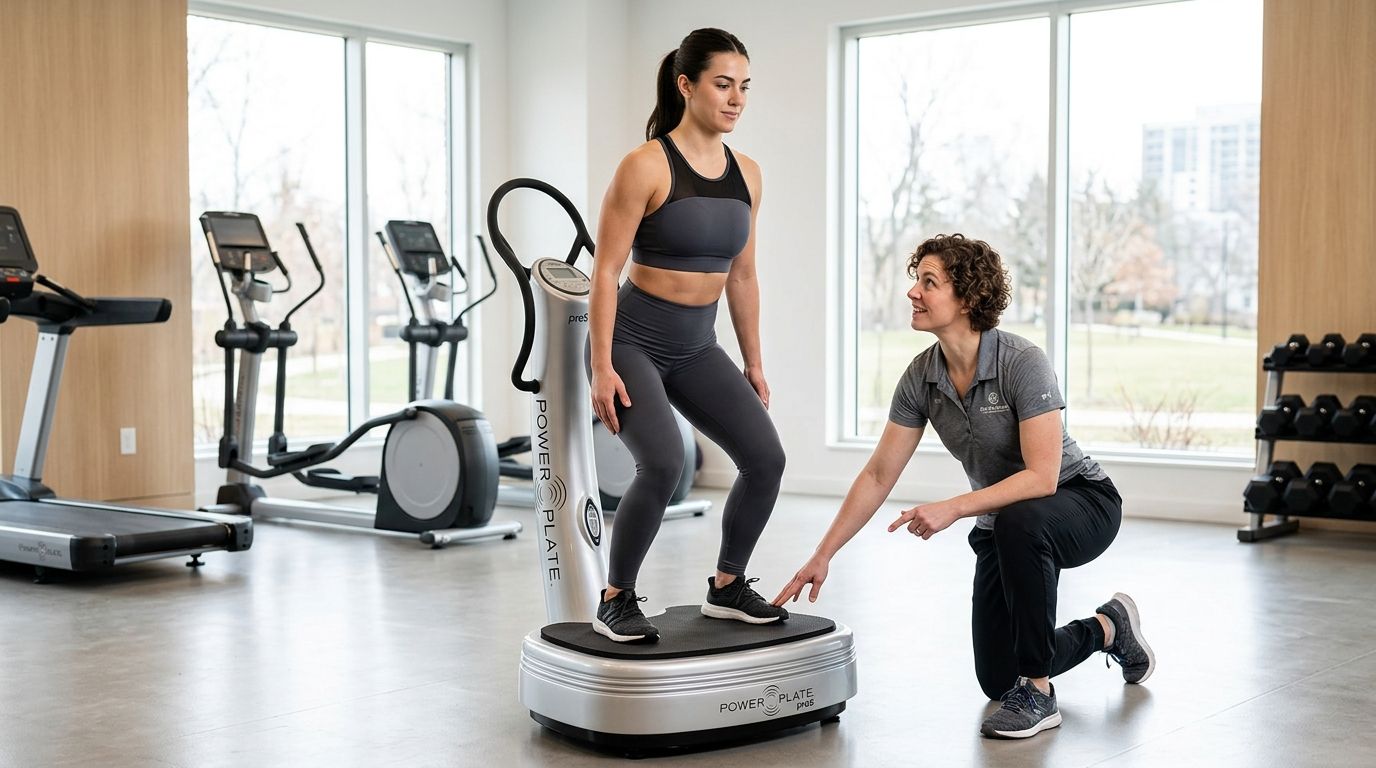
You've probably seen a Power Plate sitting off to the side at a gym or rehab clinic and wondered whether it's useful or just another machine people stand on for a few minutes. That hesitation is normal. The platform moves fast, the settings look unfamiliar, and users often lack a real explanation of what to do once they step on it.
Used well, a Power Plate can add challenge to simple movements, increase muscle activation, and give beginners a low-impact way to build tolerance for exercise. Used poorly, it becomes an awkward balance test that irritates joints and leaves people thinking vibration training doesn't work. The difference usually comes down to setup, position, and how you fit it into the rest of your training.
Your Introduction to Whole Body Vibration
A Power Plate uses whole body vibration, often shortened to WBV. The platform sends rapid, small vibrations through the body while you stand, hold a position, or perform a controlled exercise. Those vibrations create repeated muscle contractions and make easy-looking positions feel much more active than they do on the floor.
Clinical guidance around WBV became more standardized in the late 1990s and early 2000s, and common therapeutic and performance protocols typically use frequencies between 20 and 45 Hz, with around 30 Hz often reported as especially effective for improving skeletal muscle endurance and strength in adults, according to a clinical review on whole-body vibration. In practice, that means the machine isn't just “shaking.” It's delivering a dose of mechanical input that your muscles and nervous system have to manage.

What it can do well
Power Plate training works best when you stop thinking of it as a replacement for exercise and start treating it like a tool that changes the feel of familiar patterns.
A few practical benefits stand out:
- More muscle activity during simple movements: The vibration adds challenge to positions like squats, planks, and lunges.
- Low-impact loading: Many people who aren't ready for jumping or heavy lifting can still tolerate basic WBV work.
- Useful support for mobility and balance training: Controlled holds and stance work can make you more aware of posture and joint position.
If your goal is to improve your functional movement at home, that same mindset applies here. The best results usually come from training basic patterns well, not from chasing novelty.
Practical rule: Start with positions you already know how to control on the floor. The plate should add stimulus, not confusion.
What beginners usually get wrong
Most first-time users make one of two mistakes. They either stand stiff and lock everything down, or they go straight to advanced exercises because the machine seems easy at first glance. Both are problems.
The platform rewards soft knees, active feet, and a braced trunk. If you stiffen your legs and let the vibration travel straight through your skeleton, the session feels harsher and less productive. If you treat the plate like a shortcut, you miss the point of how to use power plates safely.
In a shared gym, there's another piece people skip. The platform surface gets touched by hands, shoes, and sometimes forearms during planks or push-up variations. Before and after use, it makes sense to treat it like any other high-contact fitness surface and follow a solid fitness center cleaning supplies checklist.
Safety First Setting Up and Pre-Workout Checks
The fastest way to waste a Power Plate session is to ignore safety and hope your body sorts it out. A better approach is simple. Check whether the machine is appropriate for you, make sure the setup is stable, and choose settings your body can tolerate.

Who should pause before using it
Some people shouldn't jump into WBV without medical clearance. That isn't fear-based advice. It's basic risk management.
Emerging research suggests that acute WBV can transiently raise systolic blood pressure and heart rate. Low-frequency WBV at 15 to 30 Hz for 10 to 15 minutes can benefit elderly populations, but studies also note that cardiovascular tolerance varies from person to person, which is why users with unstable angina, recent stroke, or pacemaker concerns should seek medical advice before use, as noted in this WBV safety overview.
That same caution applies if you're dealing with severe unsteadiness, recent surgery, acute pain, or a joint that already feels irritated during normal standing exercise. In those cases, the machine may still have a role later, but not as your first choice today.
Your pre-session checklist
Before the machine turns on, run through this short list:
- Check the surface: The platform should sit on a firm, level floor with enough space around it.
- Look over the machine: If the plate rocks, rattles unusually, or the console behaves erratically, skip the session.
- Know the controls: Identify the frequency setting first. Don't stand on the machine and then start guessing.
- Choose proper footwear: Wear stable athletic shoes unless the manufacturer or your clinician has you using another setup.
- Keep support nearby: If your balance is questionable, stand where you can use the handle or an external support.
A short dynamic warm-up before stepping on matters too. If you want ideas that transfer well to lower-body training, these warm-ups for better lifts are useful because they prepare hips, ankles, and trunk control rather than just raising body temperature.
Don't judge the machine by the first ten seconds. Judge it by whether you can hold good posture once the vibration starts.
The ready stance that makes the machine safer
The safest default position is boring on purpose. Stand with your feet about hip-width apart, bend your knees slightly, keep your ribs stacked over your pelvis, and brace your midsection as if you're about to do a controlled squat. That posture absorbs the vibration through muscle rather than letting it slam through locked joints.
If you're using a shared facility, one more habit belongs in the setup phase. Wipe down the contact surfaces before you train and again when you finish. A practical fitness center cleaning routine protects the next person and reduces your own exposure to whatever was left on the machine before you walked over.
Your First Power Plate Session A Step-by-Step Routine
Your first session should feel controlled, not heroic. If you finish thinking you could have done a little more, that's usually a good sign. The body needs time to get used to vibration, and technique matters more than intensity on day one.

Start with the warm-up
A common expert protocol begins with 1 to 3 minutes at 8 to 12 Hz, then moves into 2 to 4 sets of 20 to 30 second work intervals separated by 30 seconds of rest, with a total session of 15 to 20 minutes. That structure can increase energy expenditure by 20 to 40% compared with static standing. Those protocol details are summarized in the verified guidance above.
Think of that opening phase as a nervous-system introduction. You're not trying to get tired yet. You're teaching your body what the platform feels like while maintaining posture.
A beginner routine that works
Use this sequence for your first session:
Warm-up stand
Stand tall with soft knees for your low-frequency warm-up. Keep your hands lightly on the handle if needed.Static squat hold
Lower into a small squat that you can hold without your knees caving in or your back rounding. Work for a short interval, then step off or stand tall for rest.Incline plank with hands on the plate
If a floor plank is already easy for you, place your hands on the platform and hold a straight line from head to heel. If that's too much, place your hands higher on a stable support and skip the plate for this movement.Alternating split stance hold
Put one foot slightly forward and hold a balanced stance. This teaches hip control and foot pressure without asking for too much motion.Calf stretch or easy recovery stance
Finish with easy standing or gentle stretching once the machine is off.
What to focus on during every rep
The most important cue is simple. Stay active. Don't hang on your joints.
Use these reminders during the whole session:
- Keep knees soft: Never lock them out.
- Breathe normally: Bracing doesn't mean breath-holding.
- Choose range carefully: A small, steady squat is better than a deep, collapsing one.
- Step off if symptoms feel wrong: Dizziness, sharp pain, or unusual discomfort means stop and reassess.
If the vibration makes you rush, your setting is too aggressive or your exercise choice is too advanced.
A good first session leaves you more confident about how to use power plates, not intimidated by them. Save progression for later.
Fundamental Exercises and Progression Paths
The easiest way to think about exercise selection on a Power Plate is this. Static first, dynamic second, asymmetrical last. That order lets you build control before you ask the body to manage motion or single-leg stress.
What proper form feels like
A good squat on the plate feels springy and stable. Your feet stay planted, your knees remain slightly bent, and your trunk stays firm enough that the motion doesn't throw you around. You should feel your legs and glutes doing work, not your teeth rattling.
That matters because form changes the training effect. According to Power Plate guidance, EMG studies show that squatting on a 25 to 30 Hz platform can increase gluteus maximus activation by 15 to 25% compared with the same squat without vibration, but locking the knees or losing core bracing undermines that benefit. The same guidance recommends keeping the knees slightly bent and weight shifted a bit toward the forefoot to improve results and reduce risk in their explanation of how the platform works.
The foundational exercise menu
Here are the movements I'd teach first in a clinic or training floor setting:
Static squat hold
Best first lower-body drill. Easy to coach, easy to regress, and it teaches the ready stance.Supported split squat hold
Useful when someone needs hip stability work but isn't ready for dynamic lunges.Forearm or incline plank
Good for trunk stiffness if the shoulders tolerate weight-bearing.Calf raise or calf stretch
Helpful for ankle stiffness and lower-leg awareness, especially when done slowly.Push-up with hands on the platform
Better saved for people who already own a clean push-up pattern.
If you want a broader framework for increasing challenge without jumping too quickly, this guide on how to apply progressive overload fits well with vibration training. The same principle applies here. First improve control, then time, then exercise complexity.
Power Plate Exercise Progression
| Exercise | Beginner (Weeks 1-4) | Intermediate (Weeks 5-12) | Advanced (Weeks 12+) |
|---|---|---|---|
| Squat | Static partial squat hold | Slow controlled squat reps | Single-leg supported squat variation |
| Split stance | Supported split stance hold | Split squat reps | Rear-foot emphasis or balance challenge |
| Plank | Incline plank hold | Forearm plank on plate | Plank with alternating limb movement |
| Calves | Double-leg calf raise hold | Slow calf raise reps | Single-leg calf raise with support |
| Upper body | Hands-elevated hold | Push-up reps with short range | Full push-up variations if form stays clean |
Progress without chasing settings
Beginners often think progression means turning the machine higher right away. Usually it doesn't. Better progress looks like this:
- Increase work quality first: Cleaner reps and less wobbling.
- Then add time: Hold positions longer before changing anything else.
- Then add sets: More total work if recovery stays good.
- Only after that adjust frequency: And only if technique stays stable.
That order keeps the machine working for you instead of turning every session into a fight for balance.
Integrating Vibration Training Into Your Fitness Plan
The Power Plate works best as a supplement to a broader plan. It's useful for activation, controlled strength work, balance practice, and low-impact conditioning. It's not a complete replacement for walking, resistance training, or the basic recovery habits that keep people consistent.
Where it fits in a normal week
Many beginners do well placing Power Plate sessions on days when they want focused movement without heavy loading. That might mean pairing a vibration session with mobility work, basic strength exercises, or a brisk walk later in the day. It can also fit nicely before a traditional session as a primer for squats, lunges, or trunk work.
What matters most is volume management. Guidance for sedentary adults emphasizes that WBV should complement, not replace, traditional training, and that better outcomes come from pairing low-impact vibration work with gradual resistance progression and dedicated rest days to reduce tendon irritation and support adaptation, as discussed in this overview of vibration plate use within a broader routine.
A practical way to structure the week
You don't need a rigid template, but you do need separation between demanding sessions. A simple rhythm works well:
- Day 1: Power Plate session plus light accessory strength work
- Day 2: Walk, bike, or another easy cardio option
- Day 3: Traditional strength training
- Day 4: Rest or mobility-focused recovery
- Day 5: Power Plate session with a different exercise emphasis
- Day 6: General activity
- Day 7: Rest
The plate can help you train around limitations. It shouldn't become a reason to skip the rest of your program.
Signs your weekly volume is too high
Overuse rarely shows up as one dramatic event. It usually starts as a pattern. Your calves stay irritated, the front of the knee feels annoyed during stairs, or your balance gets worse instead of better because you're fatigued every time you step on the machine.
When that happens, don't ask whether WBV “works.” Ask whether you've given your tissue enough recovery and whether the plate is competing with your other training instead of supporting it.
Machine Care Hygiene and Common Troubleshooting
A Power Plate is exercise equipment, but it's also a high-contact surface. People stand on it with shoes, place hands on it during planks and push-ups, and often touch the console before and after a workout. In a home gym, cleaning is straightforward. In a shared gym, it's part of using the machine responsibly.

Why hygiene matters more than most people think
Norovirus is responsible for an estimated 685 million cases of acute gastroenteritis worldwide each year, and its combination of high environmental stability and a low infectious dose of fewer than 20 viral particles makes thorough surface disinfection important on shared gym equipment, according to this summary on Power Plate use and gym hygiene context.
That matters because a quick dry wipe isn't the same as disinfection. If you use the platform in a public setting, use a product intended for gym equipment and viral control, especially after hand-contact exercises. A practical place to start is this guide to disinfectant wipes for gym equipment.
What to clean every time
Don't just clean the obvious center of the platform. Clean the full touch path.
- Platform surface: Especially where shoes, hands, forearms, or knees made contact.
- Handles or rails: Frequently touched, often skipped.
- Console buttons: High-touch points that collect residue quickly.
- Nearby support surfaces: Benches or bars used for balance deserve the same attention.
Simple troubleshooting before you blame the machine
If the session feels off, check the basics before assuming the unit is broken.
| Issue | First check | Likely cause |
|---|---|---|
| Excessive discomfort | Your stance and knee bend | Locked joints or too much tension |
| Poor exercise control | Exercise choice | Movement is too advanced for your current balance |
| Console seems unresponsive | Power and startup sequence | User error or interrupted power |
| Unusual noise | Floor contact and stability | Machine isn't sitting evenly |
| Hands or feet slipping | Surface cleanliness and footwear | Dust, sweat, or poor shoe grip |
Clean equipment protects more than appearances. It lowers the chance that one person's workout becomes someone else's illness.
Use the machine like a piece of professional equipment. Respect the settings, maintain the surface, and stop treating cleaning as optional.
Power Plate training works when you keep the goal narrow and practical. Stand well. Choose simple exercises. Progress slowly. Fit the sessions into a real training week. Clean the machine like the shared surface it is.
For readers who want more evidence-based prevention content on viruses, transmission, and safer shared environments, VirusFAQ.com offers detailed educational and scientific articles that connect everyday habits, including surface disinfection, with real-world infection control.
Leave a Reply