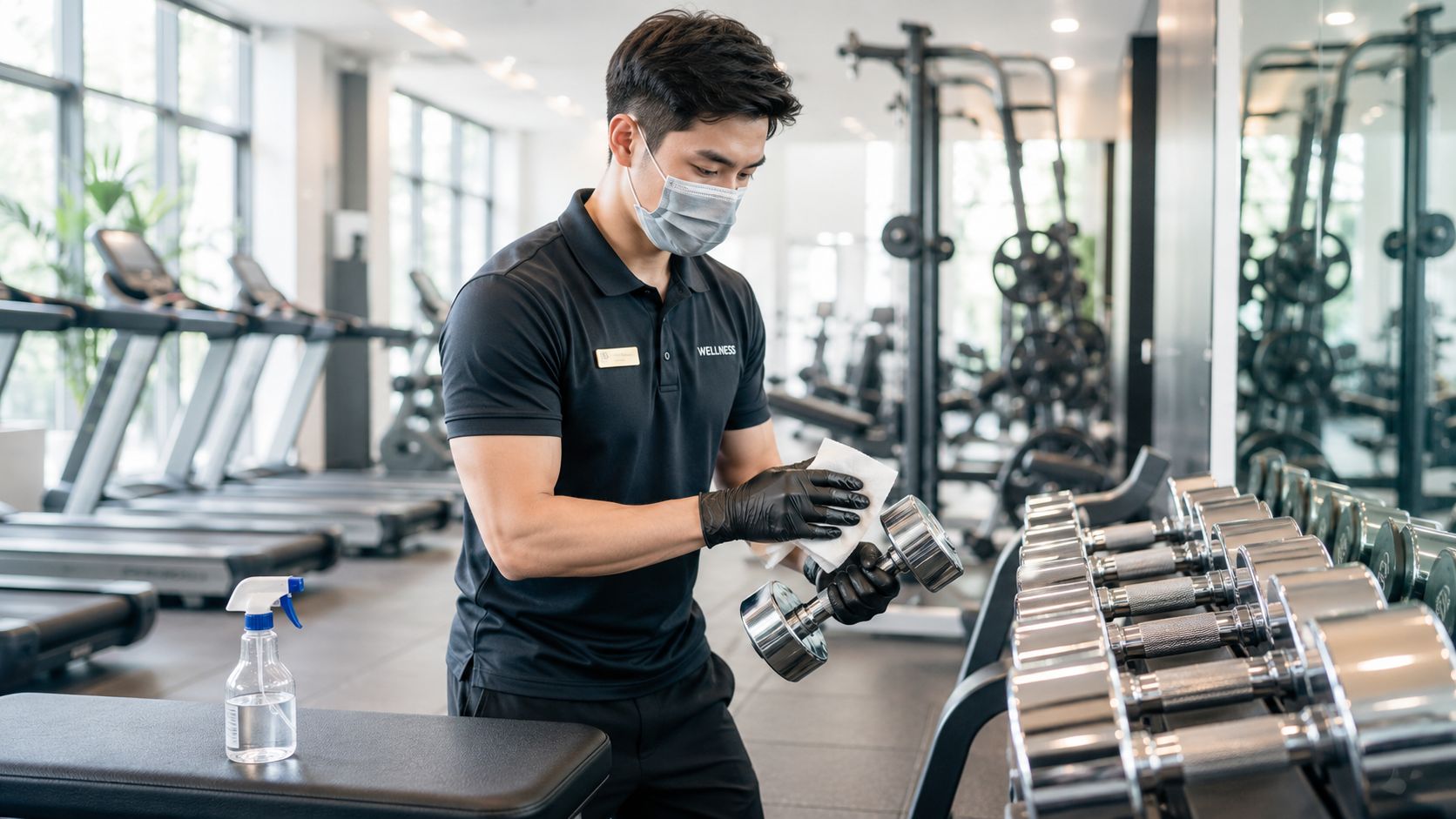
The gym opens at 5 a.m. The first members hit the treadmills half awake, the strength crowd follows, classes turn over fast, and by noon every shared touchpoint has been handled again and again. If you own or manage that space, fitness center cleaning isn't a side task. It's part infection control, part operations, and part brand management.
Most new gym owners underestimate the difference between a room that looks clean and a facility that is cleaned with purpose. Sweat films, skin oils, damp locker room surfaces, and shared grips create exactly the kind of environment where viruses and other microbes move easily from person to person. Members rarely describe that risk in technical terms. They decide whether your gym feels safe, cared for, and worth returning to.
Why a Clean Gym Is Your Best Business Asset
A busy fitness center tells members two things immediately. First, people trust the place enough to train there. Second, management either has control of the environment or it doesn't. Members notice that long before they evaluate your programming, retention offers, or equipment mix.

Industry reporting cited by EZFacility says facilities with better cleanliness and hygiene see a 15% higher member retention rate, and 60% of gym users notice cleanliness strongly enough to factor it into their experience, according to EZFacility's gym cleaning checklist. That makes cleaning a business system, not just a janitorial line item.
Members judge what they can see and what they can sense
A polished front desk helps. So does a fresh-smelling locker room. But members also read subtler signals:
- Stocked wipe stations tell them staff expect equipment to be cleaned often.
- Dry, orderly locker rooms signal control over moisture, clutter, and contamination.
- Clean grips and benches show attention to the places where skin contact is constant.
- Fast spill response tells members the team is present, not reactive.
A gym with premium machines and weak cleaning discipline feels careless. A simpler gym with tight cleaning habits often feels more professional.
Practical rule: Members don't renew because a checklist exists. They renew because the facility feels consistently managed.
Cleanliness protects trust before it protects reputation
Most owners think about cleaning after a complaint. That's too late. By then, members have already made the connection between your brand and avoidable risk.
In real operations, the damage usually starts small. Smudged cardio screens. Dirty dumbbell handles. Overflowing wipe bins. Wet locker room corners that stay wet too long. None of those failures looks dramatic in isolation. Together, they create doubt.
That doubt spreads faster than any ad campaign fixes it.
Treat cleaning like a front-of-house function
The strongest operators stop separating “member experience” from “sanitation.” In a fitness setting, they are the same thing. Every visible cleaning action reassures members that the unseen work is happening too.
That's why good fitness center cleaning programs prioritize touchpoint disinfection, schedule discipline, and visible access to the right supplies. If you want members to trust your facility with their routines, their health, and their recurring payments, cleaning has to work as reliably as your access control and billing system.
Mapping Your Gyms Viral Hotspots
Most gyms don't have a cleaning problem everywhere. They have a concentration problem. Staff spend time on low-risk visible areas while missing the surfaces that transfer contamination all day.
The right way to assess a facility is by zone. Reception, workout floor, studios, locker rooms, and shared amenities all create different patterns of contact. Viruses such as Influenza, SARS-CoV-2, Rhinovirus, and Norovirus don't need a visibly dirty environment to move through a building. They need repeated contact, poor hand hygiene, and inconsistent surface control.

One industry summary reports that free weights can harbor 362 times more bacteria than a toilet seat, and other equipment surfaces can have more than 1 million germs per square inch, as discussed in the peer-reviewed article hosted by PMC. Even if you focus mainly on viral prevention, those numbers make one point clearly. High-touch equipment accumulates heavy contamination pressure.
Entrance and reception
Reception is your first transmission hub, not just your first impression point. People arrive from work, public transit, school, and errands. They touch shared surfaces before washing their hands, if they wash them at all.
Watch these surfaces closely:
- Check-in tablets and card readers because nearly every member touches them.
- Door handles and push plates because traffic is constant from open to close.
- Counters, clipboards, and pens because they become casual shared items fast.
This area gets missed because it doesn't look sweaty. That's exactly why it's often under-cleaned.
Cardio and free weights
This is the core of your contact burden. Members grip, adjust, lean, tap screens, and move quickly to the next station. Sweat isn't the only issue. Repeated hand transfer is.
The high-priority surfaces are straightforward:
| Zone | Highest-risk touchpoints | Why they matter |
|---|---|---|
| Cardio deck | Handles, speed controls, touchscreens, heart-rate grips | High turnover, heavy hand contact |
| Selectorized machines | Pins, seat levers, grips, pads | Shared adjustments during short intervals |
| Free weights | Dumbbell handles, barbell knurling, plate edges | Direct hand contact with rapid reuse |
| Benches | Top pads, adjustment points | Skin contact plus repeated handling |
Studios, mats, and accessories
Group exercise creates bursts of dense use. Members rotate through equipment quickly and often stack mats or accessories before they're fully cleaned or dried. That matters for viruses spread through hands and shared surfaces, and it matters for general hygiene perception.
Pay attention to mats, resistance bands, yoga blocks, storage rack handles, and studio door hardware. If classes turn over in minutes, your cleaning method has to match that tempo.
If a class schedule leaves no time to clean shared accessories correctly, the schedule is the problem, not the staff.
Locker rooms and the forgotten shared points
Locker rooms combine moisture, bare skin exposure, and dense touch patterns. Members often touch faucets, locker handles, benches, and stall hardware before or after handwashing. That makes sequence matter.
Focus on:
- Faucets and sink counters
- Toilet handles, stall locks, and door pulls
- Locker handles and seating benches
- Shower controls and related fixtures
- Water fountains and vending machine buttons in adjacent areas
A strong hotspot map changes how you deploy labor. Instead of “clean the gym,” staff can work the exact surfaces most likely to affect member safety and confidence.
Mastering the Clean-Then-Disinfect Protocol
A lot of gym cleaning fails for one simple reason. Staff treat cleaning and disinfecting as if they're the same action. They aren't.
If sweat film, dust, or body oils stay on a surface, they can interfere with the disinfectant's job. The correct workflow is to remove the soil first, then apply the disinfectant to the now visibly clean surface, and keep it wet for the required dwell time. That process is outlined in the Zogics fitness center cleaning guide.

What staff often get wrong
The common mistakes are operational, not theoretical.
- They wipe too fast. A quick pass may spread residue without allowing proper dwell time.
- They disinfect over visible grime. That lowers effectiveness.
- They use too much liquid on electronics. That risks damage and encourages shortcuts next time.
- They skip documentation. Then missed zones become impossible to trace.
For viruses like SARS-CoV-2 and Influenza, consistent surface disinfection still depends on using the product as directed. For harder-control environments where Norovirus is part of your risk planning, label review matters even more.
The sequence that works on busy gym floors
Use a simple staff-facing workflow:
- Remove visible soil first with a microfiber cloth or mop, depending on the surface.
- Check the surface condition so you're not trapping grime under the disinfectant.
- Apply the disinfectant fully so the entire contact area is covered.
- Hold the surface wet for the product's required dwell time.
- Let it air dry or wipe excess only if the product instructions allow for that step.
Professional-grade disinfecting wipes excel. For benches, grips, consoles, handles, and locker room touchpoints, wipes reduce dosing errors, travel easily, and increase the likelihood of both staff and members performing the step correctly. On a crowded floor, convenience isn't a luxury. It's compliance.
For equipment-specific guidance, this detailed resource on disinfectant wipes for gym equipment is worth keeping in your SOP library.
A disinfectant can't do its job if the surface never stays wet long enough.
Build the protocol into member-facing operations
The best cleaning protocol isn't hidden in a binder. It shows up in how the gym runs. That means wipe stations near high-touch clusters, clear staff assignments during rush periods, and enough supplies that nobody has to hunt for them.
Owners who want a broader service perspective on reassurance and sanitation can also achieve peace of mind with safe cleaning by reviewing how cleaning providers frame risk reduction around visible, repeatable processes.
Your Arsenal Against Germs Disinfectants and Tools
Once your workflow is right, product selection becomes easier. Don't shop by scent, price alone, or whatever the distributor pushes first. Shop by surface type, turnover speed, ease of use, and the viruses you care most about controlling.
For gym owners, the practical distinction is this: some viruses, such as Influenza and coronaviruses, are generally easier to inactivate than tougher non-enveloped viruses such as Norovirus. That doesn't mean one category is unimportant. It means your label-reading discipline matters.
What to prioritize when buying
Use these decision criteria:
- Match the disinfectant to your risk profile. If locker rooms, childcare, or dense class turnover are part of your operation, choose products with broad claims appropriate to that setting.
- Match the product to the surface. Benches, rubber grips, touchscreens, mirrors, and painted metal don't all tolerate the same chemistry equally well.
- Match the format to staff behavior. If staff are rushed, ready-to-use products usually outperform concentrates in practical application because they remove mixing guesswork.
- Match dwell time to turnover reality. A product that works on paper but doesn't fit your class schedule will be ignored.
Disinfectant comparison for fitness centers
| Active Ingredient | Effective Against | Avg. Contact Time | Best For |
|---|---|---|---|
| Quaternary ammonium compounds | Many common hard-surface disinfection needs, often including enveloped viruses depending on label claims | Varies by product label | Benches, machine frames, locker room fixtures, routine hard-surface programs |
| Hydrogen peroxide formulations | Broad hard-surface cleaning and disinfection uses depending on label claims | Varies by product label | Multi-surface programs where residue control and ease of use matter |
| Ready-to-use disinfecting wipes | Common high-touch disinfection tasks depending on label claims | Varies by product label | Handles, touchscreens, grips, quick turnover areas |
| Concentrated disinfectants | Broad use where dilution systems are managed well | Varies by product label | Back-of-house programs with trained staff and controlled dispensing |
Because contact time varies by product, the label controls the decision. Don't let staff memorize one time and apply it to everything.
Wipes versus sprays and concentrates
Sprays can work well for larger fixed surfaces. Concentrates can be economical in controlled systems. But both create more room for inconsistency.
Ready-to-use disinfecting wipes are often the better choice for member-facing touchpoints because they are fast, portable, and hard to misuse. They also help with accountability. Staff can see whether a station is stocked, and members can participate without needing a bottle, towel, and separate instructions.
If you're building your supply list from scratch, this guide to fitness center cleaning supplies helps connect product type to actual gym tasks.
Buy for the behavior you need, not the chemistry you wish people would use perfectly.
Implementing Your Gym Cleaning Schedule and SOPs
A cleaning plan only works if it matches traffic. Generic once-a-day routines overlook the actual conditions in gyms, where contamination pressure spikes during rush hours, class transitions, and special events. Industry guidance emphasizes aligning cleaning with those patterns in CSG's overview of fitness center cleaning.

Build your schedule around traffic, not convenience
Most facilities need both zone-based and time-based scheduling.
Zone-based scheduling assigns ownership. One staff member covers reception and entrance touchpoints, another handles cardio and weights, another rotates through locker rooms and restrooms. Time-based scheduling tells them when the work must happen, especially before and after predictable peaks.
A practical schedule usually includes these layers:
- Continuous coverage during peak hours for wipe station checks, spill response, and high-touch equipment resets.
- Daily structured tasks for floors, restrooms, locker rooms, and facility-wide touchpoints.
- Weekly deeper work for mirrors, vents, shower detailing, and behind-accessory storage zones.
- Monthly and periodic tasks for hard-to-reach buildup, equipment pull-outs, and larger floor-care projects.
A sample SOP framework
Your SOP should be short enough to use and strict enough to audit.
- Define each zone clearly so staff know exact boundaries.
- List required tools and products for that zone only.
- State the clean-then-disinfect sequence in plain language.
- Identify dwell time requirements by product used in that zone.
- Set task timing around opening, rush periods, class turnover, and closing.
- Require initials or digital sign-off for accountability.
- Escalate exceptions such as body fluid incidents, supply outages, or damaged surfaces.
For floor-care planning, it helps to keep a dedicated reference on gym floor cleaner standards and surface compatibility, especially if your facility mixes rubber, vinyl, tile, and studio flooring.
Train for repeatability
Staff don't need a lecture in virology. They need clear reasons for each step. Explain that some viruses persist on shared surfaces long enough to make rushed or partial cleaning a problem. Then teach the behavior that prevents the shortcut.
Focus training on:
- PPE use when chemicals or contamination risks require it
- Product selection by zone and surface
- Dwell time discipline
- Microfiber handling and replacement
- Escalation for spills and body fluid incidents
A new owner should also think beyond the interior. Entryways, exterior glass, and surrounding walkways influence what gets tracked inside, and they shape first impressions before a member reaches the desk. This piece on why routine exterior cleaning matters is useful for seeing that connection in operational terms.
Fostering a Long-Term Culture of Health and Safety
The best fitness center cleaning program doesn't feel like a scramble. It feels normal, visible, and built into the way the facility operates. That's the point where cleaning stops being an emergency response and becomes part of the brand.
Members don't need to see every back-of-house task. They do need to see enough to trust the environment. That includes stocked wipe stations, prompt touchpoint cleaning, dry locker rooms, and staff who understand why they're doing each step. When those signals are consistent, members stop wondering whether the gym is clean enough and focus on training.
Culture shows up in small repeated actions
A real culture of health and safety usually includes:
- Accessible supplies so members can clean equipment immediately after use
- Visible signage that tells people what to wipe and when
- Staff reinforcement that is polite, consistent, and not optional
- Routine review of missed areas, supply gaps, and workflow bottlenecks
This shared-responsibility model matters because no staff team can shadow every member. The facility has to make the right behavior easy.
Keep communication practical
Avoid dramatic messaging. Members don't want to be alarmed. They want confidence.
Use short signs, plain language, and direct expectations. Tell members where wipes are, what surfaces to clean after use, and who to notify about spills or empty stations. If you maintain glass-heavy entrances or large front windows, it's also worth understanding common assumptions around surface cleanliness and public health. This article on Covid 19 and window cleaning misconceptions is a helpful reminder that visible cleanliness supports trust, but surface-specific control still matters.
A clean gym protects more than health. It protects renewals, staff confidence, and reputation. If you want a facility that members recommend without hesitation, build around three habits: identify key hotspots, follow the clean-then-disinfect protocol correctly, and run the schedule with discipline.
Want more evidence-based guidance on viruses, transmission, and practical prevention strategies in shared spaces? Explore the educational and scientific resources at VirusFAQ.com.
Leave a Reply