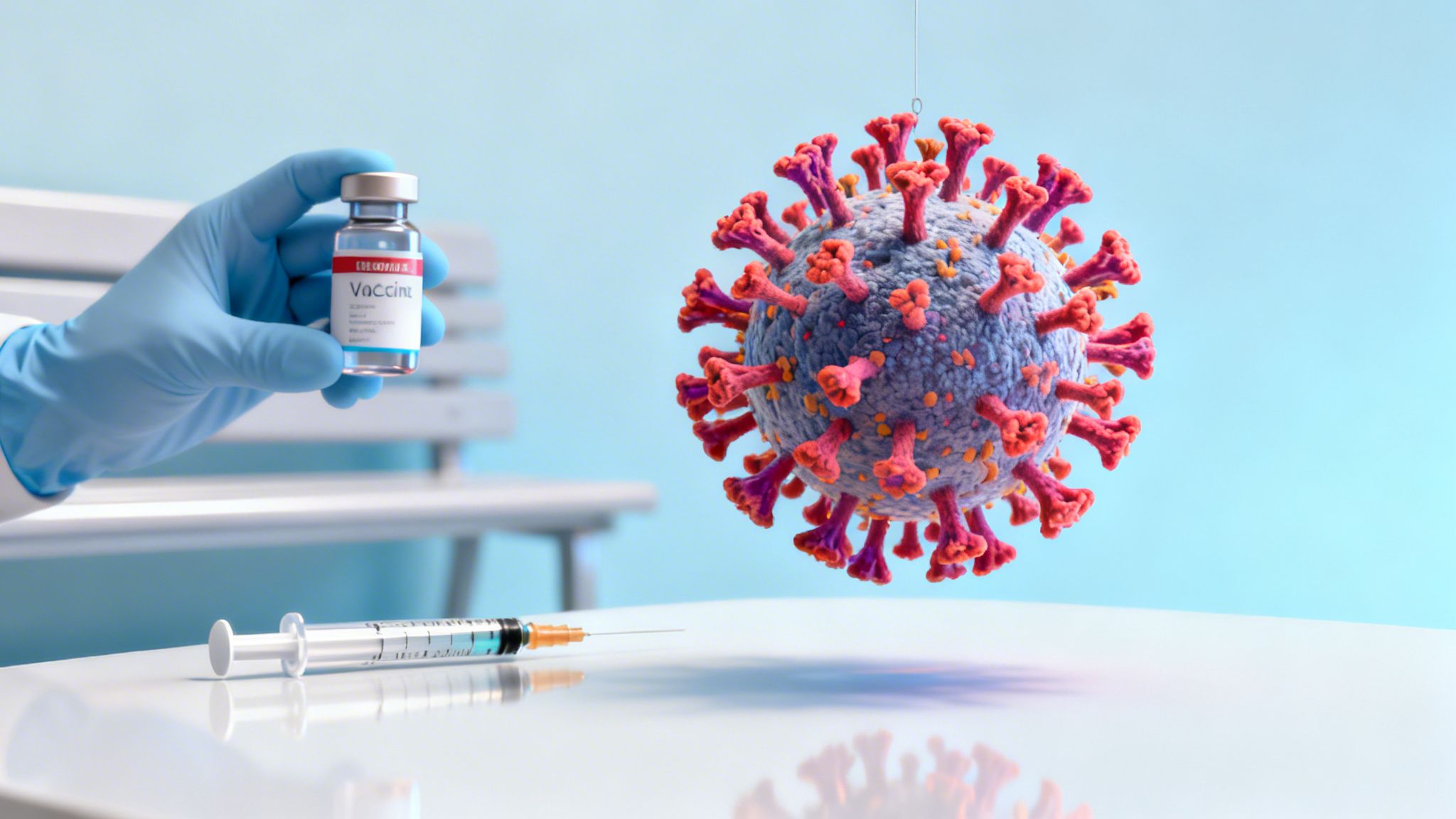
So, what exactly is a viral disease? At its heart, it’s an illness caused by a microscopic invader called a virus.
Viruses are fascinating and frustrating. They're tiny biological agents that can't survive or multiply on their own. To do that, they have to hijack the cellular machinery of a living host—whether that’s a person, an animal, or even a plant. Once inside, a virus forces the host cell to crank out thousands of new copies of itself. These new viruses then burst out to infect more cells, spreading the disease.
The Three Key Players in Viral Disease

Understanding how a virus operates becomes a lot simpler when you think of it as a drama with three main characters. Every single viral infection involves an interaction between the virus itself, the host it infects, and the environment that brings them together.
Thinking about it this way helps demystify how these incredibly small agents can cause such massive health problems. Each one has a specific role to play in this biological showdown.
To get a clearer picture, let's break down who does what in this process.
The Key Players in a Viral Disease
| Component | Role and Analogy | Real-World Example |
|---|---|---|
| The Virus | The Hijacker: Think of it as a rogue line of code. It's inactive until it's inserted into a computer (the host cell), where it takes over and forces the system to make endless copies. | SARS-Related Coronavirus 2 (SARS-CoV-2) is a classic hijacker, using human cells to replicate. |
| The Host | The Factory: The host is the living organism with the right cellular "machinery" for the virus to use. The virus turns it into a dedicated virus-making factory. | Humans are the host for the Human Rotavirus, which takes over cells in the small intestine. |
| The Environment | The Bridge: This includes everything external that helps the virus travel from one host to another, like the air, water, or contaminated surfaces. | Airborne droplets from a cough provide the perfect bridge for Human Coronavirus to find a new host. |
By understanding these three components, you can see exactly where to intervene to stop a virus in its tracks.
The Virus: The Hijacker
A virus is essentially just a package of genetic instructions—either DNA or RNA—wrapped up in a protective protein coat called a capsid.
Some viruses, like Influenza A Virus (H1N1) and SARS-Related Coronavirus 2 (SARS-CoV-2), have an extra outer layer made of lipids, known as an envelope. This lipid envelope is actually a critical weakness. It's easily destroyed by simple things like soap, alcohol, and many common disinfectants. This group is known as enveloped viruses.
Other viruses are "non-enveloped," lacking this fatty layer. These include Human Rotavirus and Norovirus, which are often much tougher and more resistant to disinfection.
The Host: The Factory
The host is any living thing a virus can successfully invade. For a virus to replicate, it has to find a host cell with the right "keyhole"—a specific receptor on the cell's surface that it can bind to and use to get inside. It's a lock-and-key system.
Once it's in, the virus gets to work. It takes over the cell's own internal machinery, essentially turning it into a zombie factory that follows only one set of instructions: make more viruses.
The hijacked host cell is forced to:
- Read the viral genetic code.
- Build new viral proteins and genetic material.
- Assemble thousands of new virus particles.
This hostile takeover almost always damages or kills the host cell, which is what causes the symptoms we feel. For example, the Human Rotavirus infects and destroys cells lining the small intestine, leading to severe diarrhea and dehydration.
The Environment: The Bridge
The environment is the final piece of the puzzle. It covers all the external factors that give the virus a pathway from an infected host to a new, susceptible one. This can be the air we breathe, the water we drink, or the surfaces we touch.
Respiratory viruses like Human Coronavirus spread through tiny airborne droplets when someone coughs or sneezes. On the other hand, tough viruses like Norovirus and Feline Calicivirus can contaminate food, water, or countertops, just waiting for someone to touch them and then touch their mouth.
This is why things like handwashing and surface cleaning are so critical for prevention. By using disinfecting wipes on high-touch surfaces, you’re essentially destroying the bridge the virus needs to travel, breaking the chain of transmission.
How Viruses Hijack Cells and Spread
Ever wonder how a particle so simple it’s not even technically alive can cause so much trouble? The secret is its ruthlessly efficient strategy for invasion and replication. A virus is nothing more than a bit of genetic code—either DNA or RNA—wrapped in a protective protein shell. On its own, it’s completely inert.
But once it finds the right host cell, it springs to life.
Think of it like a rogue piece of software. By itself, the code is harmless. But upload it to a compatible computer, and it executes its program, overwriting the system's normal functions. This is exactly what a virus does, turning a healthy cell into a factory that does nothing but churn out more viruses.
The Five Steps of Viral Invasion
The viral life cycle is a masterclass in biological hijacking. While the specifics differ between viruses like Herpes Simplex Virus 1 (HSV-1) and Rhinovirus Type 14, the fundamental game plan is always the same. It’s a five-step process that explains exactly how a viral disease takes hold in the body.
Here are the five key stages:
- Attachment: The virus first physically latches onto the outer surface of a target cell.
- Entry: The virus, or just its genetic material, punches through the cell’s membrane and gets inside.
- Replication: The virus seizes control of the cell's own machinery, forcing it to start making new viral parts.
- Assembly: All the newly made viral parts are pieced together into complete, functional viruses.
- Release: The new viruses burst out of the host cell—often destroying it in the process—and head off to infect neighboring cells.
This systematic takeover is the engine behind every single viral illness. Fortunately, each stage also offers a potential target for our immune system or antiviral drugs to step in and shut the process down. You can learn more in our detailed guide on how viruses infect cells and replicate.
From Cellular Hijacking to Widespread Transmission
Once thousands of new viruses are released, their next challenge is to spread to a new host. Viruses have evolved an incredible array of strategies to travel from one person to another, turning a localized cellular infection into a community-wide problem. The method a virus uses is almost always tied to the part of the body it infects.
These methods generally fall into a few main categories, and each one requires a different prevention strategy to break the chain of infection.
A virus is a piece of bad news wrapped in protein.
– Sir Peter Medawar, Nobel Laureate
This famous quote perfectly captures the essence of a virus. Its core is disruptive information, and its only mission is to deliver that information where it can do the most damage.
Common Pathways of Viral Spread
Knowing how viruses move through our environment is the key to stopping them. Some of the most common ways they get around include:
- Airborne Transmission: When someone with a respiratory virus like Influenza A Virus (H1N1) or a Human Coronavirus coughs, sneezes, or even talks, they expel tiny droplets and aerosols loaded with viral particles. If someone nearby inhales them, the virus has found a new home.
- Fomite Transmission: Many viruses are tough enough to survive on inanimate objects—known as fomites—for hours or even days. Non-enveloped viruses like Norovirus (Norwalk Virus) and Human Rotavirus are notorious for this, contaminating doorknobs, countertops, and toys. An infection happens when you touch a contaminated surface and then touch your eyes, nose, or mouth.
- Direct Contact: Some viruses, such as Herpes Simplex Virus 2 (HSV-2), require direct skin-to-skin contact or contact with bodily fluids to spread.
- Bloodborne Transmission: Viruses like Hepatitis B Virus (HBV), Hepatitis C Virus (HCV), and Human Immunodeficiency Virus Type 1 (HIV-1) travel primarily through contact with infected blood.
This is where simple hygiene becomes one of our most powerful weapons. Thoroughly washing your hands with soap and water physically removes and destroys viruses. In the same way, using disinfectant wipes on high-touch surfaces breaks the bridge that viruses on fomites need to find a new host, stopping an infection before it can start.
To really wrap your head around viral diseases, it helps to go beyond the textbook definitions and look at how these tiny invaders actually work in the real world. Viruses are an incredibly diverse bunch, causing everything from a quick seasonal bug to a lifelong illness.
By looking at a few common examples, you can start to see the connection between a virus’s biology and the symptoms we experience. Some travel through the air with a simple cough, while others can survive for days on a doorknob. Each one gives us a lesson in how viruses behave and why stopping them is so important.
This diagram breaks down the basic game plan for nearly every virus out there.

It’s a simple three-step cycle: attach to a host cell, replicate by hijacking the cell's machinery, and release new copies to infect more cells. This process is the engine behind every viral disease, and disrupting any of these steps is the key to stopping an infection in its tracks.
Respiratory Viruses
Respiratory viruses are experts at spreading, often needing just a single cough or sneeze to find a new host. They mainly set up shop in the cells lining our airways, causing some of the most common illnesses we all know.
- Influenza Viruses (e.g., H1N1, H2N2): These are the villains behind the seasonal flu. Influenza is a master of disguise—it’s constantly changing its surface proteins, which is why we need a new flu shot every year to keep up. Historical strains like Influenza A2/305/57 Virus (H2N2) caused major pandemics.
- Coronaviruses (e.g., SARS-CoV-2): While some coronaviruses just cause a mild cold, others like SARS-Related Coronavirus 2 (SARS-CoV-2) can lead to severe, life-threatening illness. Their outer envelope makes them surprisingly vulnerable to disinfectants, which is why cleaning surfaces is such a good defense.
- Rhinoviruses (e.g., Type 14, Type 39): Famous for causing the common cold, Rhinovirus Type 14 and Rhinovirus Type 39 are highly contagious but usually result in a mild sickness that goes away on its own. With hundreds of different types out there, creating a single vaccine is practically impossible.
Viruses Causing Chronic Conditions
Some viruses don’t just hit and run. After the initial infection, they stick around for good, becoming a permanent part of the body and causing chronic diseases that can last a lifetime.
A chronic viral infection is like having an uninvited guest who decides to move in permanently. You can't always evict them, but you can learn to manage their presence and limit the trouble they cause.
The Human Immunodeficiency Virus (HIV) is a textbook example. First identified in the early 1980s, the HIV/AIDS crisis grew from a medical mystery into a global health emergency. Caused by Human Immunodeficiency Virus Type 1 (HIV-1), the virus attacks the immune system's CD4 cells, leaving the body defenseless. Untreated, this progresses to Acquired Immunodeficiency Syndrome (AIDS), where even minor infections can become fatal. Since tracking began, HIV has infected over 85 million people worldwide and caused more than 40 million deaths. You can read more on the history and impact of HIV in this detailed overview from the National Center for Biotechnology Information.
Other major viruses that cause chronic illness include:
- Hepatitis B (HBV) and Hepatitis C (HCV): These bloodborne viruses target the liver. Over decades, they can cause chronic inflammation that leads to serious damage like cirrhosis and liver cancer. Antiviral drugs can now manage or even cure them. Duck Hepatitis B Virus (DHBV) is a related virus used in research to understand HBV.
- Herpes Simplex Viruses (HSV-1, HSV-2): Known for causing oral and genital herpes, these viruses go into hiding in nerve cells after the initial infection. They can then reactivate periodically, causing recurring sores.
Disruptive Gastrointestinal Viruses
Gastrointestinal viruses specialize in wrecking the digestive system, triggering symptoms like nausea, vomiting, and diarrhea. They're often incredibly tough and can survive for a long time on surfaces, waiting for their next victim.
- Norovirus (Norwalk Virus): Infamous for causing explosive outbreaks on cruise ships and in hospitals, Norovirus is extremely contagious. It's a small, "non-enveloped" virus, making it notoriously hard to kill and able to linger on surfaces for days.
- Human Rotavirus: This was once a leading cause of severe, dehydrating diarrhea in babies and young children around the world. Thankfully, highly effective vaccines have drastically reduced its threat in many countries. As a large, non-enveloped virus, it can persist on surfaces and requires thorough disinfection.
How We Fight Back Against Viral Invaders

As relentless as viruses are, we aren't helpless bystanders. Far from it. Over millennia, our bodies have developed an incredibly sophisticated defense system, and in the last century, science has given us a powerful toolkit to back it up.
The fight against viral diseases happens on multiple fronts—from the microscopic battles raging inside our cells to the simple, life-saving act of washing our hands.
It all starts with our own internal security force: the immune system. This complex network of cells and proteins is constantly on patrol, ready to identify and neutralize foreign invaders. When a virus like Influenza A Virus (H1N1) gets in, the immune system springs into action, mounting a specific attack to clear the infection. It’s this natural response that helps us recover and build future resistance.
But we don't have to wait for an invasion to prepare our defenses.
Medical Interventions: The One-Two Punch
Modern medicine gives us two game-changing strategies for dealing with viral threats: vaccines and antiviral drugs. Think of them as proactive training and reactive sabotage.
Vaccines are like a training exercise for your immune system. They introduce a harmless piece of the virus—like a single protein or a deactivated version—so your body can learn to recognize the enemy and build an army of antibodies without the risk of a full-blown infection. This pre-training means if you ever encounter the real virus, your immune response is fast, powerful, and ready to shut it down. If you're curious about the nuts and bolts, we break it all down in our guide on how vaccines work against viruses.
Antiviral drugs, on the other hand, are the saboteurs we send in during an active infection. They work by disrupting the virus’s plans. Some antivirals block the virus from entering your cells in the first place, while others prevent it from making copies of itself. They are absolutely essential for managing chronic infections like HIV-1 and can significantly shorten the duration of acute illnesses like the flu.
The Power of Prevention: Your First Line of Defense
While medical treatments are incredible, some of the most effective tools against viruses are the ones we use every day. Simple hygiene isn't just about being clean; it's a powerful public health strategy.
This is especially true for tough, non-enveloped viruses like Norovirus, which can survive for days or even weeks on doorknobs, countertops, and phones. Breaking the chain of transmission on these surfaces is key.
To help you visualize your options, here’s a quick breakdown of the tools in your prevention toolkit.
Your Viral Disease Prevention Toolkit
| Prevention Method | How It Works (Analogy) | Effective Against Viruses Like… |
|---|---|---|
| Vaccination | A training manual for your immune system, teaching it to recognize and fight a specific virus before you get sick. | Measles, Polio, Influenza, SARS-CoV-2 |
| Handwashing | Physically removing and washing away viral particles from your hands before they can enter your body. | Influenza, Norovirus, Rhinovirus |
| Disinfection | Chemically destroying viruses on surfaces, breaking down their structure so they can't infect anyone. | SARS-CoV-2, Feline Calicivirus, Norovirus |
| Antiviral Drugs | A saboteur sent in during an infection to stop the virus from multiplying and spreading inside your body. | HIV-1, Influenza A Virus, Herpes Simplex Virus |
Each of these methods plays a critical role. Vaccines build community-wide immunity, while handwashing and disinfection create a physical barrier that stops viruses in their tracks.
Using a disinfecting wipe or spray is a great example of a two-step attack. First, the physical act of wiping removes a huge number of viral particles. Then, the chemical disinfectant gets to work on what’s left behind.
For enveloped viruses like SARS-CoV-2 and influenza, the disinfectants are particularly brutal—they dissolve the virus's fragile outer lipid layer, causing it to literally fall apart and become harmless.
This simple cleaning task is actually a powerful defense mechanism. By regularly disinfecting high-touch surfaces, you’re destroying the bridges viruses need to travel from one person to the next, stopping a potential outbreak before it even starts.
Lessons Learned From Historic Pandemics

To really grasp how far we've come in fighting viral diseases, we have to look back. History is littered with tragic, powerful stories of pandemics that completely upended societies and taught us lessons we can't afford to forget. These events are stark reminders of what happens when a new virus hits a world without vaccines or effective treatments.
The most dramatic example comes from the early 20th century. Imagine a world where a cough could move through cities like an invisible fire, killing millions in a few short years. That’s exactly what happened with the 1918 influenza pandemic, an H1N1 virus better known as the "Spanish Flu."
This catastrophe infected an estimated 500 million people—about a third of the entire world's population back then. It left 50 million dead globally, with around 675,000 of those deaths in the United States alone. You can find more details on this and other devastating outbreaks in this list of major global epidemics and pandemics.
A World Without Modern Medicine
What made the 1918 flu so terrifying was its speed and who it killed. Unlike a typical flu that hits the very young and old, this strain struck down healthy adults between 20 and 40 years old. It triggered a "cytokine storm," a massive overreaction of the immune system that caused patients' lungs to fill with fluid, essentially drowning them.
With no vaccines and no antibiotics for the bacterial pneumonia that often followed, people were left with only the most basic defenses. Public health officials scrambled to roll out measures that feel all too familiar.
- Quarantines: Entire towns and cities were locked down to try and slow the spread.
- Mask Mandates: Citizens were ordered to wear cloth masks in public spaces.
- Social Distancing: Officials banned public gatherings and shut down schools, theaters, and churches.
These were the only tools they had. While these measures certainly saved lives, they couldn't stop the virus from marching across the globe, often carried by soldiers returning home from World War I. Hospitals were overwhelmed, and communities simply couldn't keep up with the losses. You can read a more detailed history of the outbreak in our article on the 1918 Spanish Influenza pandemic.
Timeless Lessons From a Viral Catastrophe
The 1918 pandemic offers critical insights that are just as relevant today. It showed, in brutal detail, how a common illness like the flu can become a global nightmare when a new, highly contagious strain appears.
The pandemic was a wake-up call. It proved that a strong public health system and global cooperation aren't just nice to have—they are essential for human survival.
This history really highlights the incredible progress we've made. We now have rapid tests, a global network of labs tracking viral mutations, and the technology to create and manufacture vaccines at a record pace. It also reinforces the timeless importance of basic prevention.
From the 1918 pandemic, we learned:
- The Importance of Non-Pharmaceutical Interventions: Simple things like hygiene, masks, and distancing are proven to work.
- The Need for Global Cooperation: Viruses don't carry passports. A coordinated international response is the only way to beat a pandemic.
- The Value of Scientific Advancement: Investing in virology, vaccine tech, and public health is our best defense against the next big one.
The memory of the Spanish Flu is a powerful reminder of why we keep developing new vaccines, track emerging viruses like Avian Influenza (H5N1), and stress the importance of hygiene and disinfection. The simple act of using a disinfecting wipe on a doorknob is a direct legacy of the hard lessons learned over a century ago.
Viral Disease Frequently Asked Questions
When it comes to viral diseases, there's a lot of information—and misinformation—out there. Getting straight answers to common questions is one of the best ways to understand what you're up against and how to protect yourself and your family.
Let's clear up some of the most common points of confusion, from how viruses work to why some stick around for good.
What Is the Difference Between a Viral and Bacterial Infection?
The biggest difference comes down to one simple fact: bacteria are living organisms, and viruses are not.
Bacteria are single-celled organisms that can live and reproduce on their own. Viruses are just packages of genetic material that are inert until they hijack a living host cell, forcing it to make more copies of the virus.
This is exactly why the treatments are so different. Antibiotics work by killing bacteria but are completely useless against viruses like the common cold or flu. To fight viruses, we use vaccines for prevention and specific antiviral drugs like those for Bovine Viral Diarrhea Virus (BVDV) or Hepatitis C Virus (HCV) to treat active infections.
Why Is There No Vaccine for the Common Cold?
You'd think we'd have a vaccine for something so, well, common. The problem is that the "common cold" isn't one single thing. It’s a catch-all term for symptoms caused by more than 200 different viruses, with Rhinoviruses leading the pack.
Think of it like trying to make one master key for 200 different locks, and every day, some of those locks change. It's a massive scientific challenge.
These viruses also mutate constantly, changing their surface proteins. So, even if scientists made a vaccine for Rhinovirus Type 14 or Rhinovirus Type 39, it wouldn't do a thing to protect you from the hundreds of other versions circulating. This is a huge contrast to viruses like measles, or even the flu, where a yearly vaccine can target a much smaller, more predictable group of strains.
The sheer diversity and rapid mutation of cold-causing viruses make a universal vaccine one of virology's most elusive goals. It’s a constant arms race against a foe that never stops changing its disguise.
How Do Disinfecting Wipes Kill Viruses on Surfaces?
Disinfecting wipes are a go-to for a reason—they deliver a powerful one-two punch that stops viruses from spreading on surfaces.
Here’s the breakdown:
- Physical Removal: The simple act of wiping physically lifts and carries away a huge chunk of the germs, including viral particles. You're literally clearing the battlefield.
- Chemical Inactivation: The disinfectant solution left behind goes to work on whatever is left. For "enveloped" viruses like Influenza A Virus (H1N1) and SARS-Related Coronavirus 2 (SARS-CoV-2), ingredients like alcohol dissolve their fragile outer lipid layer. Without this protective coating, the virus basically falls apart and becomes harmless.
For tougher, "non-enveloped" viruses like Norovirus or Feline Calicivirus (a surrogate for Norovirus in many studies), you need to make sure your wipe is specifically rated to kill them. Always check the product label for the contact time—that's how long the surface needs to stay visibly wet for the disinfectant to do its job and destroy the virus completely.
Why Are Some Viral Illnesses for Life?
Ever wonder why you can get over the flu but other viruses like herpes or HIV stick around forever? It all comes down to the virus's survival strategy and where it decides to hide.
Many common viral illnesses, like the cold or flu, are "acute." Your immune system attacks, clears the virus out of your system, and you get better. But some viruses have figured out how to fly under the radar.
- Latency: This is the "hide and seek" strategy. Viruses like Herpes Simplex Virus 1 (HSV-1) and Herpes Simplex Virus 2 (HSV-2) retreat into your nerve cells. There, they can lie dormant for years, totally hidden from your immune system. Every so often, they "reactivate" and cause symptoms to flare up again.
- Integration: Retroviruses like Human Immunodeficiency Virus Type 1 (HIV-1) are even more invasive. They actually insert their genetic code directly into the DNA of your own cells. This makes the virus a permanent part of your body's own blueprint, which is why lifelong medication is needed to keep it suppressed.
Leave a Reply