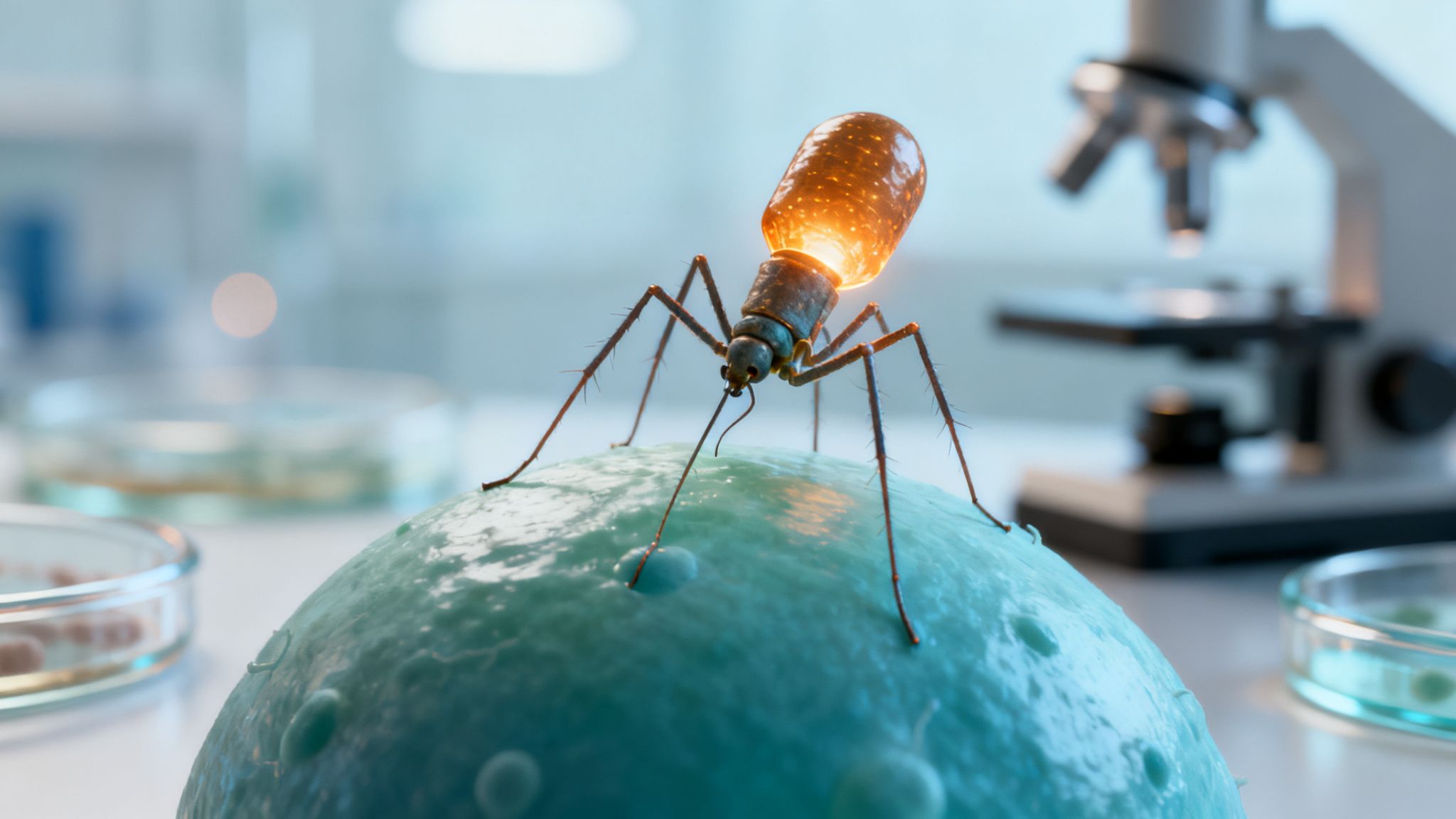
Imagine an enemy that our best antibiotics can't touch—a superbug. Now, picture a natural predator, a virus that has been perfectly sculpted by evolution to hunt and destroy that one specific type of bacteria. This is the world of bacteriophage therapy, a long-forgotten weapon that’s being dusted off to fight the growing crisis of antibiotic resistance.
A Forgotten Cure For Modern Superbugs
Think about a patient battling a persistent, life-threatening infection. Round after round of the strongest antibiotics has failed. Doctors are running out of options as the bacteria continue to multiply, unchecked. This isn't a rare sci-fi scenario anymore; it's becoming alarmingly common. The World Health Organization has even declared antimicrobial resistance (AMR) one of the top global public health threats we face today.
In this high-stakes fight, an old solution is making a remarkable comeback. Bacteriophage therapy, or phage therapy, uses naturally occurring viruses to target and kill specific bacteria. These viruses, known as bacteriophages (or "phages" for short), are the most abundant life forms on Earth. You can think of them as microscopic snipers, programmed to eliminate a single enemy without causing any collateral damage to the body's friendly bacteria.
The Rise And Fall Of Phage Therapy
This brilliant idea isn't actually new. Way back in 1917, long before penicillin was a household name, a French-Canadian microbiologist named Félix d'Hérelle discovered bacteriophages while studying dysentery patients. He noticed these tiny viruses showed up in their stools just before they started to recover, and he put two and two together: they were "eating" harmful bacteria like Shigella.
This incredible insight led to the first successful use of phage therapy in humans in 1921 to treat dysentery in children. The concept took off, and from the 1920s to the 1940s, phage research centers opened up around the world. But then, Alexander Fleming discovered penicillin in 1929, and sulfonamides followed in 1937. These new antibiotics were broad-spectrum, easy to mass-produce, and seemed like a miracle cure-all. By the 1940s, phage therapy had faded into obscurity in the West, though it never truly stopped in Eastern Europe.
Phage therapy harnesses a natural predator-prey dynamic that has been playing out for billions of years. It represents a total shift from the "carpet bomb" approach of antibiotics to a highly precise, surgical strike against pathogenic bacteria.
A New Hope In The Post-Antibiotic Era
Today, as our most reliable antibiotics lose their power, the medical community is looking at phage therapy with fresh eyes and a new sense of urgency. Its core advantages make it an incredibly compelling alternative:
- Extreme Specificity: Each phage is built to target a very specific bacterial strain, leaving the body’s helpful microbiome completely untouched.
- Self-Replicating: Once phages find their target, they multiply right at the site of the infection, growing their numbers until the harmful bacteria are wiped out.
- Low Side Effects: Because they have zero interest in human cells or beneficial microbes, phages have a fantastic safety profile.
This approach offers hope where there was none, turning a seemingly simple virus into a powerful ally against infections that were once considered untreatable. To really grasp this, it helps to understand the fundamental differences between these microscopic players. You can dive deeper with our guide on the difference between a virus and bacteria. As we explore bacteriophage therapy further, you'll see how this century-old marvel is being adapted for the challenges of modern medicine.
How Phages Hunt Down Bacteria
To really get what makes phage therapy work, you have to picture the battlefield. It’s microscopic, but it’s a warzone. Think of a phage not just as a virus, but as a biological smart missile, fine-tuned by billions of years of evolution for one job: to find and destroy a specific bacterial target.
This whole process is incredibly efficient, and it follows a clear, step-by-step kill sequence called the lytic cycle. Unlike antibiotics, which are more like chemical agents floating around, phages are active hunters. They don’t just stumble into bacteria; they’re drawn to them. It’s a fascinating story of infiltration, hijacking, and total annihilation.
This visual breaks down the core idea: matching a natural predator to a specific pathogen to get the job done.

Now, let's walk through exactly how this microscopic takedown happens, step by step.
Stage 1: Attachment And Injection
The hunt kicks off with attachment. A phage's tail fibers are like its landing gear, and they’re covered in proteins that recognize and lock onto specific molecules on a bacterium's surface. This connection is unbelievably precise—like a key fitting into a single, unique lock. It’s this specificity that explains why phages completely ignore our own cells and all the good bacteria in our gut.
Once it's latched on, the phage moves to the injection stage. Picture a microscopic syringe. The phage contracts its tail, punching a hole through the bacterial cell wall and injecting its own genetic material—its DNA or RNA—right into the bacterium. The phage's empty protein shell is left behind, its job done.
Stage 2: Hijacking And Replication
With its genetic code inside the host, the phage executes a hostile takeover. Its genes immediately shut down the bacterium's normal operations and seize control of all its internal machinery. The bacterium is essentially turned into a zombie, forced to follow new orders.
This is the replication phase. The hijacked cell is forced to tirelessly churn out hundreds, sometimes thousands, of copies of the phage’s genetic material and all its structural parts. It becomes an unwilling factory, dedicating every last resource to building a new phage army.
This biological hijacking is the engine of bacteriophage therapy. A single successful infection can lead to the creation of hundreds of new phages, amplifying the treatment's effect right at the site of the infection without needing a higher initial dose.
Stage 3: Assembly And Lysis
As all the new phage parts pile up inside the bacterium, they start to self-assemble into complete, functional phages. Each one is a perfect clone of the original attacker, armed and ready for its own mission.
Finally, the whole process ends with lysis—the grand finale. The phages produce special enzymes that start dissolving the bacterial cell wall from the inside out. The pressure from the hundreds of new phages trapped inside becomes too much, and the cell bursts open, releasing a new wave of viral soldiers.
This fresh army immediately starts hunting for more of the same bacteria, repeating the cycle until the entire pathogenic population has been wiped out.
Phages Versus Antibiotics: A Tale of Two Killers
When you’re fighting a bacterial infection, the goal is simple: eliminate the enemy. For decades, antibiotics have been our go-to weapon, but bacteriophage therapy offers a fundamentally different strategy. Understanding the contrast between these two is key to seeing why phages are making a major comeback in medicine.
At its core, the difference comes down to precision. Antibiotics are like a carpet bomb. They’re powerful and can wipe out a wide range of bacteria, but this broad-spectrum approach also destroys the beneficial bacteria living in your body—your natural microbiome. That collateral damage is why antibiotics often cause side effects like digestive upset or yeast infections.
Bacteriophage therapy, on the other hand, is like sending in a sniper. Each phage is naturally programmed to hunt and kill a very specific type of bacterium. This incredible specificity means it can zero in on the single strain making you sick while leaving the trillions of helpful microbes in your gut and on your skin completely untouched.

Comparing the Arsenals
To really understand the difference between these two bacterial killers, it helps to put them head-to-head.
Bacteriophage Therapy vs. Antibiotics at a Glance
This table breaks down the core distinctions between the two approaches, from how they work to how bacteria fight back.
| Feature | Bacteriophage Therapy | Antibiotics |
|---|---|---|
| Specificity | Highly Specific Targets a single bacterial species or strain. |
Broad-Spectrum Kills a wide range of bacteria, good and bad. |
| Microbiome Impact | Minimal to None Preserves the body's natural ecosystem. |
Significant Disruption Can lead to collateral damage. |
| Resistance | Co-evolutionary Phages can evolve to overcome resistance. |
Static Once bacteria resist, the antibiotic is ineffective. |
| Mechanism | Active Predator Replicates at the infection site. |
Passive Agent Requires consistent dosing to stay effective. |
The table makes the trade-off clear. Antibiotics offer a convenient, one-size-fits-most solution, while bacteriophage therapy provides a highly personalized and targeted weapon.
The elegance of bacteriophage therapy lies in its ability to co-evolve. If a bacterium develops resistance to a phage, it's often possible to find another phage in nature that can overcome that new defense—an arms race that medicine can continually leverage.
The Practical Challenges of Precision
While the precision of phage therapy is its greatest strength, it also creates its biggest practical challenge. You can't just prescribe a standard phage treatment like you would an antibiotic. First, you need a precise diagnosis to identify the exact bacterial strain causing the infection.
This crucial step, often called "phage matching," is all about finding the right viral sniper for the job.
Once the pathogen is identified, clinicians have to find a phage—or a combination of phages—that can effectively kill it. For stubborn or complex infections, scientists often create phage cocktails. These are carefully mixed blends of several different phages designed to attack the bacteria from multiple angles, which makes it much harder for the bacteria to develop resistance.
Beyond phages and antibiotics, researchers are also looking at other defenses our bodies naturally produce. For example, ongoing studies into the LL37 peptide's antimicrobial benefits show how our own immune system has its own microscopic weapons. This broader context helps situate phage therapy as one of several nature-inspired strategies being brought back to solve modern medical challenges.
The Eastern European Legacy: A Century of Experience
When antibiotics burst onto the scene in the mid-20th century, the Western world was completely captivated. But while doctors in the West were busy hailing the new "miracle drugs," phage therapy didn't just vanish—it simply moved east.
In countries like Georgia and Poland, phage therapy never went out of style. Instead, it became a trusted part of mainstream medicine, where it was continuously refined for decades while the rest of the world looked the other way. This created an incredible legacy. As Western researchers now scramble to rediscover phages, these Eastern European institutions are sitting on nearly a century of hands-on clinical experience. They have a deep, practical knowledge of how to find, prepare, and use phages to treat real infections in real people.
Georgia: The Global Epicenter of Phage Research
You can't tell the story of modern phage therapy without talking about the Eliava Institute of Bacteriophages, Microbiology, and Virology in Tbilisi, Georgia. Founded way back in 1923 by Giorgi Eliava—with a helping hand from Félix d'Hérelle himself—this institute became the world's command center for phage research. For decades, it was the Soviet Union's first call for fighting bacterial outbreaks.
The Eliava Institute was a powerhouse, creating phage treatments for everything from dysentery and typhoid to battlefield wound infections. They built one of the world's most extensive phage "libraries," a massive and meticulously cataloged collection of viruses ready to deploy against a huge range of bacteria. This wasn't some dusty archive; it was a living arsenal used to create custom therapeutic cocktails for patients across the region.
The work done at the Eliava Institute is not just a historical footnote. It's the longest-running clinical experiment in phage therapy, period. Their decades of patient data offer powerful, real-world proof that phages can be a safe, reliable, and life-saving treatment.
Today, the Institute is still going strong, treating patients who travel from all over the world and exporting its phage products. Their long track record completely dismantles the idea that phage therapy is some new or unproven novelty. In Georgia, it's been the standard of care for generations.
Poland: A Tradition of Therapeutic Innovation
Poland also played a pivotal role in keeping the phage flame alive. The Hirszfeld Institute of Immunology and Experimental Therapy, founded by the brilliant Ludwik Hirszfeld, established its own phage bank as early as 1945. For more than 70 years, Polish scientists have been treating thousands of patients and carefully documenting the results.
This Polish experience has been crucial for building a solid body of evidence that bacteriophage therapy works, and works consistently. The research of Dr. Stefan Slopek and his team is especially impressive. Between 1954 and 1987, they treated over 1,000 patients with severe infections like Staphylococcus bacteremia, reporting incredible success rates between 84-97%.
This legacy didn't just fade away. In 2005, the Institute opened the very first official Phage Therapy Unit in the European Union, operating under compassionate use protocols based on the Helsinki Declaration. For a deeper dive into this fascinating clinical history, you can explore this historical overview of therapeutic phage use.
The continuous, documented success in these regions provides a treasure trove of real-world data. It shows us that this isn't just a theory—it's a proven medical practice that was saving lives long before the antibiotic resistance crisis forced the rest of the world to pay attention.
Modern Success Stories in the Fight Against Superbugs
While phage therapy has a long, steady history in Eastern Europe, its recent comeback in the West is fueled by a series of dramatic, life-or-death successes. These are the stories of patients with no other options, the ones who have put phages back in the global spotlight and shown us what's possible in the age of antibiotic resistance.
These aren't just lab experiments or theoretical ideas; they're documented recoveries against what seemed like impossible odds. From last-resort treatments for superbugs to targeted attacks on chronic infections, phages are proving their worth in modern medicine.
The Case That Reignited Hope
No story has captured the public's imagination quite like Tom Patterson's. In 2016, Patterson, a professor at UC San Diego, was on the verge of death. A massive infection caused by a multidrug-resistant strain of Acinetobacter baumannii had put him in a coma, and every antibiotic had failed. As a final, desperate measure, his doctors assembled an experimental phage cocktail.
The result was nothing short of astonishing. Within days of receiving the phages intravenously, Patterson began to wake from his coma. His recovery became a landmark success in the United States, a powerful demonstration that a personalized phage therapy could win when conventional medicine couldn't. It proved that revisiting a century-old idea with modern science could change everything.
Tom Patterson's recovery was a turning point. It shifted phage therapy from a historical curiosity to a viable, life-saving intervention for the toughest superbug infections we face today.
Targeting Chronic and Complicated Infections
Beyond acute, life-threatening crises, phages are showing incredible promise for managing the kind of persistent bacterial infections that plague patients with chronic conditions. These are the fights where long-term antibiotic use often fails and can cause serious side effects.
Two areas where phages are making a real difference stand out:
- Cystic Fibrosis Patients: People with cystic fibrosis often battle chronic lung infections, especially from bacteria like Pseudomonas aeruginosa. These microbes form stubborn biofilms that are nearly impossible for antibiotics to break through. Phage therapy provides a direct assault on these biofilms, with some clinical reports showing infection resolution in over 80% of cases.
- Prosthetic Joint Infections: Once bacteria take hold on an artificial joint or medical implant, they are notoriously difficult to eradicate. They form a protective slime layer, shielding themselves from antibiotics and the immune system. Phages can be delivered right to the site of infection to dismantle these bacterial strongholds, often saving the implant and helping patients avoid complex removal surgeries.
These applications really highlight the versatility of phages. Of course, finding the perfect phages for the job is the critical first step, which is why advances in diagnostics are so important. You can get a better sense of how scientists identify specific pathogens in our guide on what is molecular diagnostics.
This renewed global interest isn't just based on anecdotes; it's backed by growing clinical data. Since the 2000s, huge leaps in genomics have allowed for far more precise matching of phages to bacteria, taking the field from educated guesswork to true precision medicine. While an earlier European trial in the 2010s (the Phagoburn trial) showed only modest results due to issues with the phage cocktail's stability, it provided invaluable safety data and helped pave the way for better, more rigorous trials. You can read more about the research driving modern phage therapy successes.
The Future of Phage Therapy: Hurdles and Horizons
While the potential of bacteriophage therapy is enormous, getting it into mainstream medicine is more of a marathon than a sprint. Before phages become a standard prescription, the field has to navigate some pretty significant real-world challenges. These hurdles aren't just scientific—they’re logistical and regulatory, forcing us to rethink what a "drug" can even be.
The biggest obstacle is the tangled regulatory pathway. Traditional drugs are single, stable molecules. You can test them in standardized trials, and they behave predictably. Phages, on the other hand, are alive. They evolve. This biological nature makes them a tough fit for the existing "one-size-fits-all" drug approval model, raising all sorts of questions about manufacturing consistency and personalized treatments.

Overcoming Modern Obstacles
Beyond untangling the red tape, the simple logistics of scaling up production are a massive challenge. To create personalized phage cocktails, you need two things: diagnostics that can identify the bacterial culprit in a flash, and a huge, well-cataloged library of phages to pull from. This is where tools like Nanopore Sequencing Technology become critical for rapidly identifying the right phage for the job and understanding bacterial resistance.
Building the infrastructure for Good Manufacturing Practice (GMP)-compliant phage production is the final piece of the puzzle. It’s what will take phage therapy from a last-resort compassionate use case to something widely available in clinics.
The greatest challenge—and opportunity—for bacteriophage therapy is shifting the medical paradigm from mass-produced chemical drugs to living, personalized biologics that can adapt alongside the bacteria they fight.
The Next Wave of Phage Innovation
Despite these hurdles, the future is incredibly bright. Scientific innovation is paving the way forward. Researchers aren't just finding new phages; they're building better ones. The next frontier is packed with exciting developments.
- Synthetic Phages: Using genetic engineering, scientists are designing "synthetic" phages with supercharged abilities. Imagine phages with a broader target list or new tools to bust through protective bacterial biofilms.
- Phage-Derived Enzymes: Scientists are now isolating the powerful enzymes that phages use to literally pop bacterial cells open. These enzymes, called endolysins, can be used as standalone antibacterial agents—acting like precise molecular scalpels to shred bacteria on contact.
- Phage Cocktails and Synergy: The art of creating smart phage cocktails is getting more and more sophisticated. Researchers are even finding that combining phages with antibiotics can create a synergistic effect, where the two treatments together are far more powerful than either one alone.
These advancements are what’s turning bacteriophage therapy from a rediscovered historical cure into a genuinely forward-thinking platform for fighting infections in a post-antibiotic world.
Frequently Asked Questions About Bacteriophage Therapy
As phage therapy steps back into the spotlight, it’s only natural for questions to pop up. Let’s clear the air and tackle some of the most common ones to give patients, doctors, and researchers a better handle on what this treatment is all about.
Is Bacteriophage Therapy Safe For Humans?
Yes, absolutely. Phage therapy has a fantastic safety record, built over nearly a century of clinical use in places like Eastern Europe. Phages are what you might call "specialists"—they are laser-focused on their target bacteria and completely ignore human cells.
They also leave our helpful gut bacteria alone, which is a huge advantage. This incredible specificity means phage therapy sidesteps the harsh side effects common with broad-spectrum antibiotics. Plus, modern phage preparations go through strict purification to remove any bacterial toxins before they ever reach a patient.
How Do Doctors Find The Right Phage For An Infection?
It all starts with identifying the culprit. A doctor will take a sample from the infection site, which then goes to a lab to grow and pinpoint the exact bacterial strain causing all the trouble. This step is non-negotiable because phages aren’t a one-size-fits-all remedy.
Once the bad guy is identified, it's tested against a library of different phages to find a perfect match. Think of it like finding the right key for a lock. If a match is found, it can be prepared for treatment. Often, scientists will create a "phage cocktail" by combining several different phages to hit the bacteria from multiple angles and prevent it from escaping.
Can Bacteria Become Resistant To Phages?
They sure can. It's a constant evolutionary arms race—the bacteria evolve to resist the phage, and the phage evolves to overcome that resistance. It's the same dynamic we see with antibiotics.
But here’s the game-changer with phages:
Because there are an estimated 10 quintillion phages on Earth, we have a virtually endless supply of new recruits. If a bacterium develops a new defense, scientists can almost always find a new phage in nature that can break through it. It allows clinicians to simply update the phage cocktail and stay one step ahead.
Where Is Phage Therapy Currently Available?
This really depends on where you live. In countries like Georgia and Poland, phage therapy has been a standard medical tool for decades. In the United States, the UK, and much of Western Europe, however, it's still mostly considered an experimental treatment.
But the tide is turning. Access is opening up through compassionate use programs for patients with life-threatening infections that no longer respond to antibiotics. As more clinical trials wrap up and regulatory bodies get more comfortable, we expect to see it become much more widely available. To fully grasp the nature of the microscopic targets involved, learn more about the 6 different types of pathogens in our related guide.
Leave a Reply