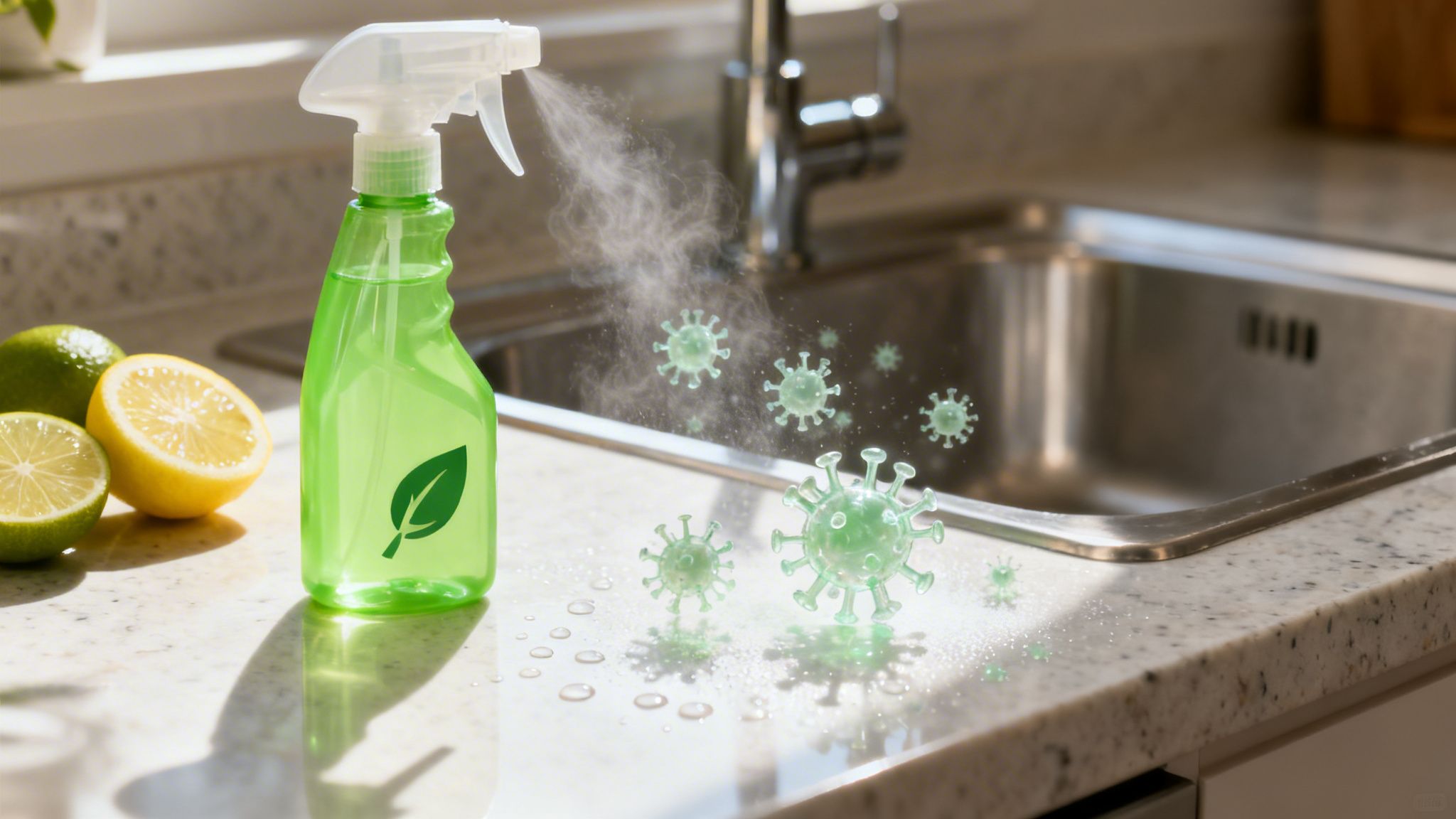
When you're trying to keep your home or workplace healthy, the last thing you want is to trade germs for harsh chemicals. You need a disinfectant that gets the job done without filling the air with bleach or ammonia fumes. This is where Simple Green's disinfectant stands out. It’s an EPA-registered product that both cleans surfaces and kills 99.9% of germs, all while using a botanically-derived active ingredient.
Your Guide to Effective Virus Protection
Choosing the right disinfectant is one of the most important decisions you can make to maintain a healthy space. You need something that cuts through everyday grime but also takes out the unseen viruses and bacteria that cause illness. For health-conscious families and professionals, Simple Green Disinfectant has become a go-to choice for this very reason.

Think of this as your guide to understanding exactly what this product does and how it works. We’ll break down its dual power as a cleaner and a potent disinfectant, so you can see why it’s such a versatile tool for your cleaning routine.
What Makes It a Top Choice?
Unlike a lot of conventional disinfectants, Simple Green’s formula isn’t built on harsh chemicals. Instead, it relies on a powerful, botanically-derived active ingredient to do the heavy lifting. This gives it a few key advantages:
- Broad-Spectrum Efficacy: It’s proven to kill a wide range of common germs, including Influenza A Virus (H1N1), SARS-CoV-2, and Herpes Simplex Virus Types 1 and 2.
- Multi-Surface Safety: The formula is safe for most hard, non-porous surfaces. You can use it on everything from kitchen counters to doorknobs without worrying about damage.
- Cleans and Disinfects: It saves you a step by tackling two jobs at once—wiping away dirt and killing germs.
This one-two punch of cleaning and disinfecting offers real peace of mind. It’s not just about making a surface look clean; it’s about actually reducing the number of pathogens that can linger and spread.
It’s also helpful to know the difference between disinfecting and sterilization. While daily disinfecting keeps germ levels down, sterilization is a process that eliminates all microbial life, a much higher standard typically used in labs or hospitals.
For a quick overview, this table breaks down the key features of Simple Green's disinfectant.
Simple Green Disinfectant At A Glance
| Feature | Description | Benefit for Virus Protection |
|---|---|---|
| Active Ingredient | Botanically-derived citric acid | Kills germs without the harsh fumes of bleach or ammonia. |
| EPA Registration | Registered as a broad-spectrum disinfectant | Confirms its efficacy against viruses and bacteria as claimed. |
| Kill Claim | Kills 99.9% of germs | Provides a high level of confidence in its disinfecting power. |
| Dual-Action Formula | Cleans and disinfects in one step | Streamlines your cleaning process, saving time and effort. |
| Surface Safety | Safe for most hard, non-porous surfaces | Versatile for use throughout your home or workplace. |
This at-a-glance summary highlights why so many people trust this product for their daily hygiene needs.
Foundational Knowledge for Modern Hygiene
This guide will give you the practical knowledge you need to use this disinfectant effectively. By understanding the science behind it, you'll feel more confident integrating it into your cleaning routine. You can learn more about general strategies in our complete guide on how to protect yourself from viruses.
Throughout this article, we’ll dig into its ingredients, explain how to read the virus kill claims, and show you the right way to use it for maximum effectiveness. You’ll have all the tools you need for a modern, smarter approach to hygiene.
How Citric Acid Disarms Viruses
When you spray a disinfectant, what’s actually happening on a microscopic level? With many products, you're using harsh chemicals to do the job. But Simple Green takes a different route, using an active ingredient that might surprise you: citric acid. Yes, this is the same stuff that makes lemons and oranges so tart, but when it's formulated into a disinfectant, it becomes incredibly effective at taking viruses apart.

Think of a virus as a fragile, microscopic egg. Many common viruses, like Influenza A, Human Coronavirus, and Hepatitis C Virus (HCV), are protected by a delicate outer layer called a viral envelope. This fatty, lipid-based shell is the key to their survival and their ability to infect our cells. Without it, they're useless.
The citric acid in Simple Green’s disinfectant is basically a shell-cracker. It’s specifically designed to dissolve that lipid envelope, causing the virus’s entire structure to fall apart. Once that protective layer is gone, the virus is neutralized—it simply can’t attach to a host cell and make you sick.
A Smarter Way to Disinfect
This botanical approach is a world away from how old-school disinfectants like bleach and ammonia work. Bleach, for example, uses aggressive oxidation to destroy just about any organic material it touches, which is effective but not very targeted. Ammonia-based products can also be harsh, often coming with strong fumes and the risk of damaging surfaces over time.
Citric acid, on the other hand, gives you a smarter mechanism with some real-world benefits:
- Low Toxicity: You don't get the overpowering fumes that you do with bleach, which makes it much more pleasant to use, especially indoors.
- Better for the Environment: Because it’s derived from botanical sources, citric acid is readily biodegradable and breaks down into harmless substances.
- Gentle on Surfaces: It’s far less corrosive than many conventional disinfectants, so you can use it on more household surfaces without worrying about causing damage.
This is the real connection between the "green" in the name and the science behind the product. It’s about getting powerful disinfection without all the usual drawbacks of harsher chemicals.
By targeting the lipid envelope—a specific weak point in many common viruses—citric acid offers a reliable and intelligent way to disinfect. This is what makes Simple Green disinfectant so effective against threats like Influenza A (H1N1) and SARS-CoV-2.
Why Not All Viruses Are the Same
It’s crucial to know that not all viruses are built alike. While citric acid is a powerhouse against enveloped viruses, some viruses are “non-enveloped,” meaning they don’t have that fatty outer layer. These tougher “naked” viruses, like Norovirus and Rhinovirus (the common cold), are instead protected by a hard protein shell called a capsid.
Breaking down this protein-only armor can be a bigger challenge for certain disinfectants. This is exactly why checking a product's EPA registration and kill claims is so important. Any Simple Green disinfectant with an EPA registration has been rigorously tested against both types of viruses to prove it works.
To go deeper on this, you can check out our article explaining the viral envelope and what it means for disinfection. Understanding this difference helps you move from just knowing that a product works to knowing how and why it works, empowering you to make smarter, healthier choices.
Understanding EPA Registration and Kill Claims
When you grab a disinfectant off the shelf, you’re putting your trust in its power to knock out invisible germs. But how do you know it’s not just scented water in a spray bottle? The answer comes down to three letters: EPA.
A product’s registration with the U.S. Environmental Protection Agency isn’t just some bureaucratic formality. It’s your guarantee that the product has gone through rigorous scientific testing and actually does what it claims.
For a disinfectant like Simple Green to get that EPA seal of approval, the manufacturer has to provide a mountain of lab data proving it kills the exact bacteria and viruses on its label. This process confirms that it works and exactly how to use it effectively—including the all-important contact time.
Decoding the EPA Label
Every EPA-registered disinfectant has a unique registration number on its label, usually written as “EPA Reg. No.” followed by a code. Think of this number as the product’s government-issued ID. It’s your direct line to a database full of verified information.
You can use this number to look up the product on the EPA's website, allowing you to independently fact-check its kill claims. It’s the ultimate way to see the full list of pathogens it’s proven to work against.
This system is a cornerstone of public health. The North American surface disinfectant market, valued at USD 6.23 billion in 2024, is built on the trust that agencies like the EPA and Health Canada create. Seeing that a product is approved and effective drives market growth, especially as we all become more hygiene-conscious. For instance, U.S. hospitals saw a 35% drop in healthcare-associated infections (HAIs) by using routine surface disinfection protocols—a statistic that continues to fuel the industry, as detailed in reports like this one on the market for surface disinfectants at Polaris Market Research.
Verifying Kill Claims for Specific Viruses
So, let's put this into practice. Simple Green disinfectant has been tested and proven to kill a wide range of viruses that are a major concern in both homes and healthcare settings. When you see a virus listed on that label, it means the product passed specific lab tests against that exact pathogen.
Here are some of the key viruses that Simple Green disinfectant is registered to kill:
- Human Immunodeficiency Virus Type 1 (HIV-1): Effective against this enveloped virus on pre-cleaned surfaces.
- Influenza A Virus: This includes nasty strains like H1N1 and H5N1 (Avian Influenza), main drivers of flu pandemics.
- Hepatitis B Virus (HBV) & Hepatitis C Virus (HCV): Crucial for disinfecting surfaces potentially contaminated with bloodborne pathogens.
- SARS-Related Coronavirus 2 (SARS-CoV-2): This is the virus that causes COVID-19. Simple Green disinfectant is included on the EPA’s List N for use against this specific virus.
- Herpes Simplex Virus 1 (HSV-1) & Herpes Simplex Virus 2 (HSV-2): These common viruses can easily be transmitted by touching contaminated surfaces.
- Norovirus (Norwalk Virus): A highly contagious non-enveloped virus, making this a significant kill claim.
This list isn’t just marketing fluff—it’s a legally binding declaration of efficacy. Each claim is backed by scientific data that the EPA has reviewed and approved, giving you the confidence that the product performs exactly as promised against serious germs.
Understanding these claims is crucial when choosing a product. If you need more help navigating your options, our guide on choosing the best disinfectant spray can point you in the right direction. The EPA label gives you the proof you need to make sure the disinfectant you choose will actually work on the germs you’re trying to eliminate.
How to Use Simple Green Correctly for Maximum Effect
Real disinfection is more than just a quick spray-and-wipe. To get the full virus-killing power out of your Simple Green disinfectant, you have to use it the right way. This isn't just about making a surface look clean; it's about making sure you've actually eliminated the invisible germs that can get you and your family sick.
The secret weapon in any good disinfection process is something called contact time. Think of it as the "soak time" for germs. It's the exact amount of time the disinfectant needs to stay visibly wet on a surface to kill the specific viruses and bacteria on its label. If you wipe it off too early, you’re pulling the product away before it has a chance to finish the job.
The infographic below walks you through the simple, two-step process for making sure any disinfectant is actually approved to kill the germs you're worried about.

Checking the EPA number is your best bet for confirming a product can do what it claims before you even open the bottle.
Your Step-by-Step Disinfection Process
To get a true, deep clean, there’s a simple three-step method you need to follow. Skipping any of these can leave germs behind.
- Pre-Clean the Surface: Disinfectants can't fight through a layer of grime. Heavy dust, food crumbs, or grease create a barrier that shields germs from the disinfectant. Always start by wiping away any visible dirt with an all-purpose cleaner or just soap and water.
- Apply and Wet Thoroughly: Once the surface is clean and dry, spray the Simple Green disinfectant until it’s completely wet. Don’t be afraid to use a liberal amount—the surface shouldn’t just be damp, it should be glistening.
- Wait for the Contact Time: This is the most crucial part. Let the disinfectant sit, undisturbed, for the entire contact time listed on the label for the germ you're targeting. Don't touch it, and don't wipe it.
After the time is up, you can either let the surface air dry or wipe it down with a clean cloth. For any surface that touches food, like countertops or high-chair trays, you must do a final rinse with clean, drinkable water after disinfecting.
Simple Green Contact Times for Common Viruses
The required contact time for Simple Green disinfectant changes depending on the virus you’re up against. Harder-to-kill germs, like the non-enveloped rhinoviruses that cause the common cold, often need more time than enveloped viruses like Influenza A.
The table below breaks down the label information into a practical guide for some of the most common viruses you'll encounter at home or work.
| Target Virus | Required Contact Time | Common Transmission Area |
|---|---|---|
| SARS-CoV-2 (COVID-19) | 1 minute | Doorknobs, light switches, countertops |
| Influenza A Virus (H1N1) | 1 minute | Faucets, remote controls, shared electronics |
| Human Immunodeficiency Virus Type 1 (HIV-1) | 1 minute | Healthcare settings, shared personal items |
| Herpes Simplex Virus 1 & 2 | 10 minutes | Bathroom surfaces, shared personal items |
| Rhinovirus Type 39 (Common Cold) | 10 minutes | Desks, phones, children’s toys |
| Norovirus (Stomach Flu) | 10 minutes | Food prep areas, bathroom fixtures |
Following these times is the difference between a surface that looks clean and one that's truly disinfected.
Following these specific contact times is not optional—it is the difference between simply wiping a surface and truly disinfecting it. A shorter time means you may not be killing the targeted viruses.
There's no question that people want effective disinfectants. The global disinfectant spray market is expected to jump from USD 11.57 billion in 2024 to USD 18.56 billion by 2030, led by products people can trust. Simple Green’s biodegradable formula, which is proven to kill 99.99% of viruses like SARS-CoV-2 in less than 60 seconds, has made it a go-to for both homes and hospitals. With North American EPA approvals confirming its power against over 50 different pathogens, it has become a reliable tool for modern virus prevention. You can dig deeper into this growing market in this industry report from Grand View Research.
Balancing Safety with Disinfecting Power
Let’s be honest—when you grab a disinfectant, there's always a nagging thought in the back of your mind. You want something strong enough to wipe out serious germs like Influenza A and SARS-CoV-2, but you don't want to fill your home with harsh fumes or use a product that could damage your countertops. It often feels like you have to choose between power and safety.
This is exactly where Simple Green disinfectant changes the game. It’s designed to provide serious disinfecting muscle without the usual trade-offs, giving you a way to keep your home healthy without worrying about what you’re leaving behind.
One of its biggest wins is its safety profile. The formula is non-abrasive and non-corrosive. That’s just a technical way of saying it won’t scratch, dull, or eat away at your surfaces. You can clean confidently, knowing you’re protecting your home, not just from germs, but from your cleaner, too.
Surface Compatibility Where It Matters Most
Knowing what you can and can't clean with a product is crucial for avoiding accidental damage. Because Simple Green disinfectant is so gentle, it’s a fantastic choice for most of the high-touch surfaces you deal with every day.
You can safely use it on hard, non-porous surfaces like:
- Sealed Stone: Think granite, marble, and quartz. It’s perfect for keeping those kitchen countertops, where so many germs hang out, clean and hygienic.
- Stainless Steel: Go ahead and use it on your appliance fronts, faucets, and sinks. It disinfects without causing streaks or corrosion.
- Plastics and Laminates: This makes it ideal for things like kids’ toys, high chairs, and laminated desks or tables.
- Glazed Tile: Use it freely on your bathroom walls and kitchen backsplashes to keep them sparkling and germ-free.
This kind of broad compatibility means you can stick to one product for most of your disinfection routine, from the kitchen to the bathroom.
Surfaces to Use with Caution
While Simple Green is incredibly versatile, no one product is perfect for everything. Its active ingredient is citric acid, and while that’s what makes it so effective and gentle, it’s not the right fit for a few specific materials.
It's best to avoid using it on these surfaces:
- Unsealed or Unfinished Wood: Porous wood can soak up the liquid, which might lead to swelling or stains. Always stick to cleaners made specifically for unfinished wood.
- Brass and Copper: Over time, even a gentle acid can cause these metals to tarnish.
- Specialty Coatings: If a surface has a special wax or a delicate finish, it's always smart to test the disinfectant on a small, hidden spot first.
The goal is always peace of mind. You need a product you can trust to knock out pathogens without introducing new risks from harsh chemicals or causing damage to your home. Simple Green delivers by solving that classic conflict between effective disinfection and household safety.
As you think about keeping your home safe, remember that this principle extends beyond just your disinfectants. It's smart to consider all the products you use, including things like non-toxic alternatives for home and yard.
For your everyday disinfection needs, however, the balance that a product like Simple Green offers is an effective, responsible solution. It lets you focus on your family's health without constantly worrying about the products you use to protect it.
Building Your Daily Disinfection Routine
Knowing what’s in the bottle is one thing, but making it part of your daily routine is what really counts. Turning your knowledge of Simple Green disinfectant into a real habit isn’t about scrubbing your house from top to bottom every single day. It’s about being smart and targeting the germ hotspots to stop viruses from spreading.
Think of it as your proactive hygiene plan. What surfaces does your family touch all the time? Especially when viruses like Influenza A, Rhinovirus, and Human Coronavirus are making the rounds, a quick daily wipe-down of these high-touch zones is one of the most powerful moves you can make to cut down on sick days.
Putting It Into Practice
A good routine is built for real life, not a lab. Let’s translate the science into simple, everyday actions that protect your home.
- Your 5-Minute Daily Wipe-Down: Every evening, take just five minutes to wipe down the germ superhighways in your home: doorknobs, light switches, TV remotes, and fridge handles.
- After Someone’s Been Sick: Once a family member is on the mend from something like the flu or a stomach bug (Norovirus), it's time for a more targeted disinfection. Use your Simple Green spray on the surfaces they used most, and be sure to let it sit for the full contact time to knock out any viruses left behind.
- Before and After Guests: When you have company over, do a quick disinfection of common areas. Wiping down the guest bathroom faucet and countertops is a simple act of courtesy that helps keep everyone healthy.
These small, consistent habits add up fast. They create a much safer environment without you having to douse your home in harsh chemicals.
Making Disinfection a Natural Part of Life
It's not just you—people everywhere are looking for safer, more effective ways to clean. The global market for surface disinfectants hit USD 6.25 billion in 2024 and is still climbing, showing a huge shift toward eco-friendly options that actually work. Disinfectants using ingredients like citrus extracts have become incredibly popular, and for good reason.
In fact, public health data showed that consistent use of green disinfectants helped slash hospital-acquired infections by up to 30% in major U.S. hospitals between 2020 and 2023. For VirusFAQ readers, this data confirms what we've been saying: choosing a product like Simple Green disinfectant is an easy way to take control. Spray it on high-touch spots, let it dwell, and you’ve just made a real dent in the viral load in your home. You can dig deeper into how these market trends connect to public health wins in this PR Newswire research summary.
The takeaway here is simple: effective virus prevention doesn’t have to be overwhelming. When you focus on the right areas with a product you trust, you build a powerful hygiene habit that sticks.
To round out your toolkit, it’s smart to have both the spray and wipes. The spray is perfect for covering surfaces during your daily routine, but having disinfecting wipes on hand is a game-changer for quick spills, messes on the go, or wiping down small items like phones and keys. With both, you’re ready for pretty much anything.
Frequently Asked Questions
Got questions about Simple Green disinfectant? You're not alone. Let's clear up some of the most common ones so you can use it correctly and safely.
Can I Use Simple Green All-Purpose Cleaner to Disinfect Surfaces?
No. This is probably the most important thing to know. Your classic Simple Green All-Purpose Cleaner is an amazing degreaser, but it is not an EPA-registered disinfectant. It won’t kill germs.
To actually kill viruses and bacteria, you have to use a product specifically labeled as a "disinfectant," like Simple Green Clean Finish Disinfectant Cleaner. Always check for an EPA registration number on the bottle—that's your proof it’s been tested and approved to kill pathogens like Influenza A, Rhinovirus, or SARS-CoV-2.
Is Simple Green Disinfectant Safe for Food Prep Surfaces?
Yes, you can use Simple Green disinfectant on hard, non-porous surfaces where you prep food—think sealed countertops, stainless steel sinks, or synthetic cutting boards. But you absolutely have to follow the right steps.
After spraying the surface and letting it sit for the required contact time, you must rinse it thoroughly with potable (drinkable) water. This final rinse washes away any leftover disinfectant residue, making the surface completely food-safe again. Don't skip it.
That final water rinse isn't just a suggestion; it's a non-negotiable step for food safety. It ensures the only thing left on your counter is a clean, germ-free surface.
How Does Simple Green Compare to Bleach or Ammonia Disinfectants?
The biggest difference is what's inside the bottle and how it affects your home. Simple Green disinfectant gets its power from citric acid, a botanically derived ingredient that kills a huge range of germs. In contrast, other common disinfectants use:
- Sodium hypochlorite (bleach): Incredibly strong, but also corrosive and known for its harsh, irritating fumes.
- Quaternary ammonium compounds (quats): These are effective, but they can leave behind a sticky or hazy residue.
Simple Green’s main advantages are its lower toxicity and the fact that it doesn't produce those strong, eye-watering fumes. It’s also much gentler on surfaces, so it’s less likely to damage metals or sensitive materials over time, all while providing hospital-grade disinfection against tough viruses like Human Coronavirus and Norovirus.
Do I Need to Clean a Surface Before I Disinfect It?
Yes, 100%. For any disinfectant to do its job properly, you have to get rid of the visible dirt and grime first. Think of dirt and gunk as a shield that germs can hide behind.
That’s why you always hear the phrase "clean and disinfect." A quick pre-clean with soap and water or an all-purpose cleaner removes that shield, allowing the Simple Green disinfectant to make direct contact with the germs and kill them. If you skip this step, you’re seriously reducing how well the product works.
Leave a Reply