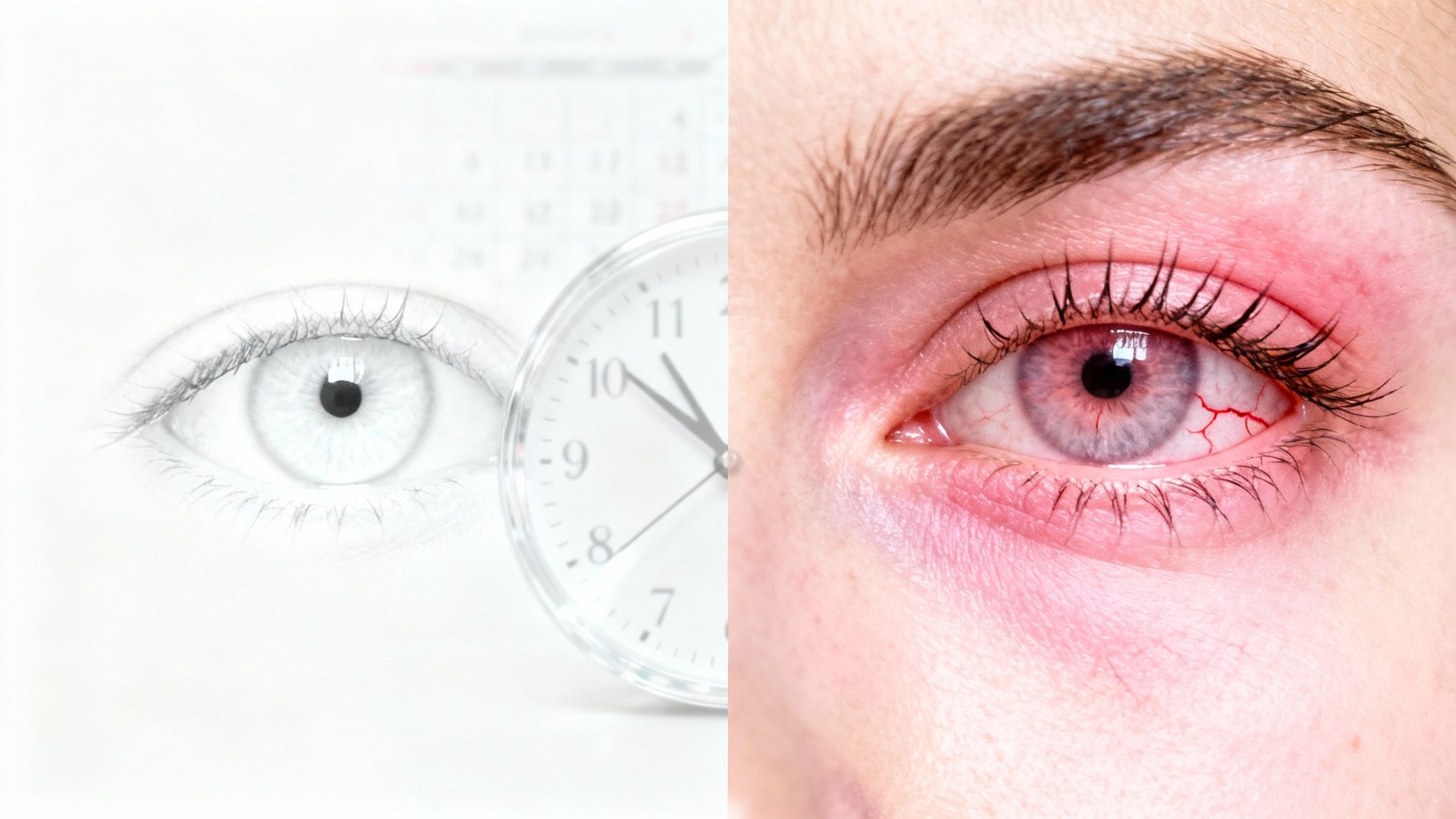
How long your pink eye is contagious really depends on what’s causing it. For the viral kind, you could be passing it around for one to two weeks. If it’s bacterial, you're generally in the clear after 24 to 48 hours of antibiotic treatment. Good news? Allergic and irritant-related pink eye aren't contagious at all.
Understanding The Pink Eye Contagious Timeline
When you or someone in your family wakes up with a red, goopy, itchy eye, the first question on everyone's mind is, "How long is this contagious?" There isn't a single answer because "pink eye" (the medical term is conjunctivitis) is really just a symptom, not one specific illness. The window of time it can spread is dictated entirely by the culprit behind it—whether that's a virus like Adenovirus, bacteria, or just an allergen.
This timeline gives you a quick visual of how long each type of pink eye can be passed on, making it easy to compare.
As you can see, viral pink eye sticks around the longest, while antibiotics dramatically cut down the contagious period for the bacterial version.
Viral vs. Bacterial: The Two Contagious Culprits
Viral and bacterial conjunctivitis are the two types you can actually spread to others, but they operate on very different schedules.
Viral pink eye is a marathon. It’s typically contagious for a full 7 to 14 days, sometimes even after the redness and tearing start to get better. This is because the adenoviruses responsible for most cases are incredibly persistent. Eye care experts warn that in some cases, these viruses can survive on surfaces for up to a month.
Bacterial pink eye, on the other hand, is a sprint. It spreads like wildfire until you start antibiotic eye drops. Once treatment begins, the contagious period plummets, and you’re usually no longer a risk to others within 24 to 48 hours. You can find more helpful advice for parents dealing with pink eye at EstrellaEyecare.com.
The key takeaway is simple: treatment drastically alters how long bacterial pink eye is contagious, while viral pink eye requires time to run its course. Knowing the difference is essential for preventing its spread at home, school, and work.
Understanding these distinctions is crucial for taking the right precautions. With viral cases, your main defense is relentless hygiene. That means washing hands frequently and disinfecting every high-touch surface you can think of—doorknobs, phones, light switches, and remote controls are all places where viruses like Adenovirus and even other pathogens such as Norovirus and Rhinovirus love to hang out.
Pink Eye Contagious Period At A Glance
To make things even clearer, here’s a simple table breaking down the contagious timelines for the most common types of conjunctivitis.
| Type of Pink Eye | Contagious Period | Transmission Method |
|---|---|---|
| Viral | 7 to 14 days from when symptoms appear. | Direct contact with eye fluids; touching contaminated surfaces. |
| Bacterial | Contagious until 24-48 hours after starting antibiotics. | Direct contact with eye fluids from an infected person. |
| Allergic | Not contagious. | Triggered by allergens like pollen, dust, or pet dander. |
| Irritant/Chemical | Not contagious. | Caused by exposure to smoke, chlorine, or other irritants. |
This at-a-glance view helps reinforce the most important point: only viral and bacterial pink eye can spread. If your red, itchy eyes are due to allergies or an irritant, you don't have to worry about passing it on to anyone else.
The Hidden Spread of Viral Pink Eye
When you think of pink eye, the viral kind is the one that really lives up to the contagious reputation. It spreads with shocking ease. This version is usually caused by adenoviruses, which happen to be the same family of viruses that give us the common cold. It’s best to imagine the virus leaving a microscopic, invisible trail everywhere it goes, starting right at the infected eye.

Someone with pink eye rubs their irritated eye—a nearly unavoidable reflex—and the virus instantly transfers to their hands. From there, it’s deposited on every single surface they touch. Doorknobs, remote controls, smartphones, and keyboards all become unwitting accomplices in its journey. The virus can patiently wait on these surfaces for hours, sometimes even days, for the next person to come along. This is exactly why understanding how long viral pink eye is contagious is so critical for keeping it contained.
The Pre-Symptom Contagious Window
One of the trickiest things about controlling viral pink eye is that the infectious period often kicks off before anyone knows there's a problem. A person can be contagious for about a day before their eye even starts to look red or feel gritty. This pre-symptomatic spread means the virus is already on the move before anyone thinks to take precautions.
Once the symptoms finally show up, the person remains highly contagious for the entire duration of the illness, which can drag on for up to two full weeks. During this whole time, the infected eye is producing a watery discharge that is absolutely teeming with viral particles.
The ability of adenoviruses to spread before symptoms show up and linger on surfaces is what makes them so successful. This highlights the vital importance of proactive and consistent hygiene, especially in shared spaces like homes, schools, and offices.
This long contagious window, starting even before that first tell-tale watery eye, creates a perfect storm for outbreaks. It isn't just about direct contact; it's about the entire shared environment becoming a reservoir for the virus.
Why Surface Disinfection is Non-Negotiable
Because adenoviruses are so tough, a quick wipe-down often isn't enough to stop them. They can survive on dry surfaces for a surprisingly long time, turning everyday objects into transmission hotspots. This stubborn persistence is what makes thorough disinfection a crucial line of defense.
Experts point out that viral pink eye is infectious from roughly one day before symptoms appear all the way through 7 to 14 days of active signs. AMA physicians stress how this fuels rapid spread in U.S. daycares, where kids' hands-on habits amplify transmission and contribute to an estimated 3 million missed school days each year. You can learn more about this by reading insights from the AMA on what doctors wish patients knew about pink eye.
This really underscores the need for a targeted game plan:
- Identify High-Touch Zones: Focus your cleaning efforts on surfaces that get touched constantly by multiple people, like light switches, faucet handles, and shared electronics.
- Use an Effective Disinfectant: Make sure your disinfecting wipes are rated to kill viruses like adenovirus. Not all cleaners are created equal.
- Clean Consistently: When someone in the house has an active infection, disinfecting these key areas daily can break the chain of transmission and protect everyone else.
By understanding the invisible trail left by viral pink eye, you can take direct action. Consistent handwashing paired with diligent surface disinfection is the most powerful strategy you have to halt the spread in its tracks and keep your home safe.
How Antibiotics Shut Down Bacterial Pink Eye
If you’ve ever woken up with your eyelids practically glued shut from a thick, goopy discharge, you know bacterial pink eye. It’s often more dramatic than the viral kind, but there’s a silver lining: we can fight it directly. Unlike viral infections that just have to run their course, bacterial conjunctivitis responds incredibly well to antibiotic eye drops or ointments.

This medical intervention is the game-changer for how long bacterial pink eye is contagious. Left alone, you could be infectious for up to 10 days. But once you start antibiotics, they get to work immediately, targeting and knocking out the bacteria causing all the trouble.
Because of this rapid response, the contagious window shrinks dramatically. Most people are no longer considered infectious just 24 to 48 hours after their first dose. This is huge—it means a much faster and safer return to work or school, minimizing the disruption to your life.
How The Drops Work So Fast
So, what's happening in your eye? Think of the bacteria as an army of invaders setting up camp. They multiply fast, causing all that redness, inflammation, and sticky discharge. Antibiotic eye drops are like sending in a special forces team directly to the source of the problem.
The drops either kill the bacteria on contact or stop them from reproducing. By applying the medicine right where it's needed, it reaches a high concentration that overwhelms the infection. This gives your body’s own immune system the backup it needs to win the fight.
Basically, the contagious clock for bacterial pink eye is almost entirely reset the moment you start treatment. It's a stark contrast to viral pink eye, which can keep you sidelined and contagious for a week or two. While bacterial pink eye isn't quite as wild in its community spread, it’s still a major risk for anyone you live with. In fact, pediatric transmission within a single household can be as high as 12%.
The key takeaway here is that treatment changes everything. Starting antibiotic eye drops is the single most important thing you can do to stop the spread and get back to normal.
Hygiene Is Still Your Best Friend
Even while the antibiotics are working their magic, good hygiene is non-negotiable, especially during that initial 24-hour contagious window.
- Wash your hands like you mean it. Use soap and warm water every time you touch your eyes or apply your drops.
- Wipe down high-touch surfaces. Your phone, doorknobs, and remote controls are prime real estate for germs. A quick wipe with a disinfecting wipe can make all the difference.
- Don't share personal items. This is not the time to share towels, pillowcases, or makeup. Keep them to yourself until the infection is completely cleared.
When you pair effective antibiotic treatment with smart hygiene, you can shut down a bacterial pink eye infection in no time.
When Pink Eye Isn't Contagious At All
The moment someone says "pink eye," we all tend to take a step back. But here's a huge piece of good news: not all red, goopy eyes are a public health risk. If your symptoms are from allergies or a simple irritant, you have zero risk of passing it on.
That means no need to lock yourself away or keep your kid home from school unnecessarily. Figuring out what's really going on is the key to managing your symptoms without putting your life on hold.
Allergic Conjunctivitis: When Your Immune System Overreacts
Does your pink eye show up like clockwork every spring, right along with your sneezing and stuffy nose? If so, you're almost certainly dealing with allergies. This type of conjunctivitis is just your body having a dramatic overreaction to something completely harmless.
Think of it as a false alarm. Your immune system spots a speck of pollen, panics, and hits the big red button, releasing a flood of histamines. Those histamines are what cause all the misery.
The usual suspects for allergic conjunctivitis include:
- Pollen from trees, grass, and weeds (this is why it's so common in spring and fall).
- Pet dander from our furry friends like cats and dogs.
- Dust mites that live in carpets, bedding, and furniture.
- Mold spores lurking in damp spots around the house.
The dead giveaway for allergic pink eye is an intense, relentless itch. Your eyes will also be red, watery, and maybe a bit puffy, but you won’t have that thick, sticky discharge that’s so common with bacterial infections.
Irritant Conjunctivitis: A Simple Reaction to Your Environment
The other non-contagious version is irritant conjunctivitis. This is what happens when something physically gets in your eye and bothers it—no germs involved, just a straightforward inflammatory response.
A perfect way to think about irritant pink eye is to remember the last time you got bonfire smoke in your eyes or felt the sting of chlorine at the pool. The redness and watering are just your body's natural defense, trying to flush the problem out.
Common culprits include:
- Chlorine from swimming pools
- Smoke from a campfire or cigarettes
- Fumes from harsh cleaning supplies
- Something as simple as a stray eyelash or a bit of dust
With irritants, the main complaint is usually a gritty, sandy feeling in the eye or watery discharge, not the crazy itching you get with allergies. And the best part? Once you rinse your eyes and get away from the irritant, the symptoms usually clear up pretty fast.
Your Practical Guide To Preventing The Spread
Knowing how long pink eye is contagious is the first step, but putting up a solid defense to contain it is the real game-changer. This is your action plan for stopping the spread of viral and bacterial conjunctivitis to family, friends, and coworkers. We'll go beyond just telling you what to do and explain why these habits are so effective at stopping germs in their tracks.

The single most powerful tool you have? Good old-fashioned handwashing. Viruses and bacteria travel from an infected eye to the hands, and from there, to every single surface you touch. Breaking that chain of transmission starts right at the sink.
Frequent, thorough washing with soap and water physically removes and neutralizes these invisible troublemakers before they can find a new home. To make sure you're getting rid of the maximum number of germs, you can learn more about the proper hand washing technique that healthcare professionals rely on to stay safe.
Creating A Hygienic Barrier At Home
Your home should be a safe zone, not a breeding ground for germs. When someone has infectious pink eye, your focus needs to shift to creating a defensive barrier through meticulous hygiene and targeted cleaning. It's all about being mindful of personal items and wiping down shared surfaces.
Start by isolating anything that touches the face. This is non-negotiable, as direct contact with contaminated objects is one of the fastest ways for pink eye to jump from one person to another.
- Towels and Linens: The infected person needs their own set of towels, washcloths, and pillowcases. Make sure to wash these items daily in hot water to kill any lingering germs.
- Makeup and Eye Care: Absolutely no sharing of eye makeup, brushes, or contact lens solution. An infection is a clear sign to toss out any eye cosmetics that were used recently.
- Contact Lenses: It’s best to switch to glasses until the infection is completely gone and a doctor gives you the all-clear. For anyone who wears contacts, impeccable hygiene is paramount. Learning about proper contact lens cleaning methods can help protect your eyes long-term.
Disinfecting High-Touch Surfaces
While personal hygiene is vital, you also have to tackle the environment itself. Adenoviruses—the culprit behind most viral pink eye cases—are surprisingly resilient and can survive on dry surfaces for days, just waiting for their next host. Disinfecting high-touch surfaces wipes out these hidden reservoirs of infection.
Think of disinfecting wipes as your secret weapon against the invisible trail left by pink eye. Each wipe erases the viral and bacterial footprints on surfaces, effectively shutting down common pathways for transmission and protecting everyone in your household.
Focus your cleaning efforts on the things people touch most often throughout the day. Your goal is to create an environment where the virus simply can’t survive long enough to find a new person to infect.
To make things simple, here's a checklist to keep your home a pink eye-free zone.
Pink Eye Prevention Checklist
This quick checklist breaks down the most important habits for preventing the spread of infectious conjunctivitis at home and in public.
| Action Item | Why It's Important | Frequency |
|---|---|---|
| Clean High-Touch Surfaces | Removes viruses from doorknobs, light switches, phones, remotes, and faucets. | At least daily during an active infection. |
| Avoid Touching Eyes | Prevents transferring germs from your hands directly into your eyes. | Be mindful of this habit constantly. |
| Isolate Personal Items | Stops the direct spread of germs through shared towels, pillows, and makeup. | Immediately when an infection is present. |
Following these simple but effective steps can make a massive difference in containing an infection and keeping everyone else in your orbit healthy. It's all about being proactive and consistent.
When Can You Safely Return To School Or Work?
Figuring out when it’s safe to end your self-imposed isolation is a huge source of stress, whether you're a parent with a sick kid or a professional trying to get back to the office. The right answer really depends on what kind of pink eye you’re dealing with. Knowing the difference helps you make a responsible choice that protects everyone around you without keeping you sidelined longer than necessary.
With bacterial pink eye, the rule is pretty straightforward. Most schools and workplaces are on the same page here: you can usually go back 24 to 48 hours after starting antibiotic eye drops. The medicine gets to work fast, knocking out the bacteria and making you much less contagious.
Navigating The Return With Viral Pink Eye
Viral pink eye is a different beast altogether. Since there’s no quick-fix medication to shorten the contagious window, you just have to let the virus run its course. This can take up to two weeks.
A good rule of thumb is to wait until your symptoms have really started to clear up, especially the watery discharge.
Most places will want you to stay home until:
- The redness in your eyes is noticeably fading.
- That goopy or watery discharge is completely gone.
- Your eyes aren't crusted over in the morning anymore.
The most infectious period for viral pink eye is usually the first 3 to 5 days after symptoms show up. It’s absolutely critical to stay home during this time to avoid spreading it, especially if your job or school involves close contact with others.
General Guidelines For A Safe Return
Ultimately, the decision comes down to a mix of medical advice and good old-fashioned common sense. If your eyes are still bright red and weeping, you're better off staying home. This period of staying away from others is a simple but effective public health measure.
If you’re a bit confused by the terminology, our guide on the difference between isolation and quarantine can help clear things up.
Before you head back out, make sure you can get through the day without constantly touching your eyes. And even as you feel better, keep up with the handwashing—it’s still your best defense. Always check the specific policies for your workplace or your child's school, as they might have their own rules for coming back.
Answering Your Top Questions About Pink Eye
Even when you know the basics, pink eye can bring up a lot of specific questions. Let's tackle some of the most common ones that people ask when they're dealing with an infection.
How Can I Tell If Pink Eye Is Viral Or Bacterial?
This is the million-dollar question, and it can be tough to tell the difference on your own since both make your eyes red and angry. The biggest clue is usually the discharge.
Viral pink eye tends to produce a thin, watery discharge. In contrast, bacterial pink eye is notorious for a thicker, yellow or green pus-like gunk that can practically glue your eyelids shut overnight.
But symptoms can be sneaky and overlap. The only way to know for sure is to consult a doctor specializing in pink eye. Getting a real diagnosis is the key to getting the right treatment and knowing exactly how long you need to be cautious about spreading it.
Can You Get Pink Eye In Both Eyes?
Absolutely. In fact, it's pretty common for pink eye to show up in one eye and then spread to the other a day or two later. It happens so easily—you rub your infected eye, then touch your other eye without even thinking about it. That's all it takes to transfer the germs.
This is exactly why a strict no-touching policy is so critical when you have pink eye.
Remember, the viruses and bacteria that cause pink eye are invisible. Your hands might look clean, but they can easily carry the infection from one eye to the other, or to doorknobs and countertops, starting the cycle all over again.
How Should I Clean My Home During An Outbreak?
When someone in the house has pink eye, you need to go on a cleaning offensive to keep it from spreading to everyone else. Your main targets are all the high-touch surfaces that people share.
- Disinfect Daily: Grab some disinfectant wipes and hit the doorknobs, light switches, faucets, TV remotes, and phones at least once a day. This simple action disrupts the transmission of pathogens like adenovirus.
- Isolate Linens: The person with pink eye needs their own set of towels, washcloths, and pillowcases. Make sure these get washed in hot water every single day.
- Handle with Care: Always wash your hands like you mean it after putting in eye drops or touching any of the infected person's things.
Leave a Reply