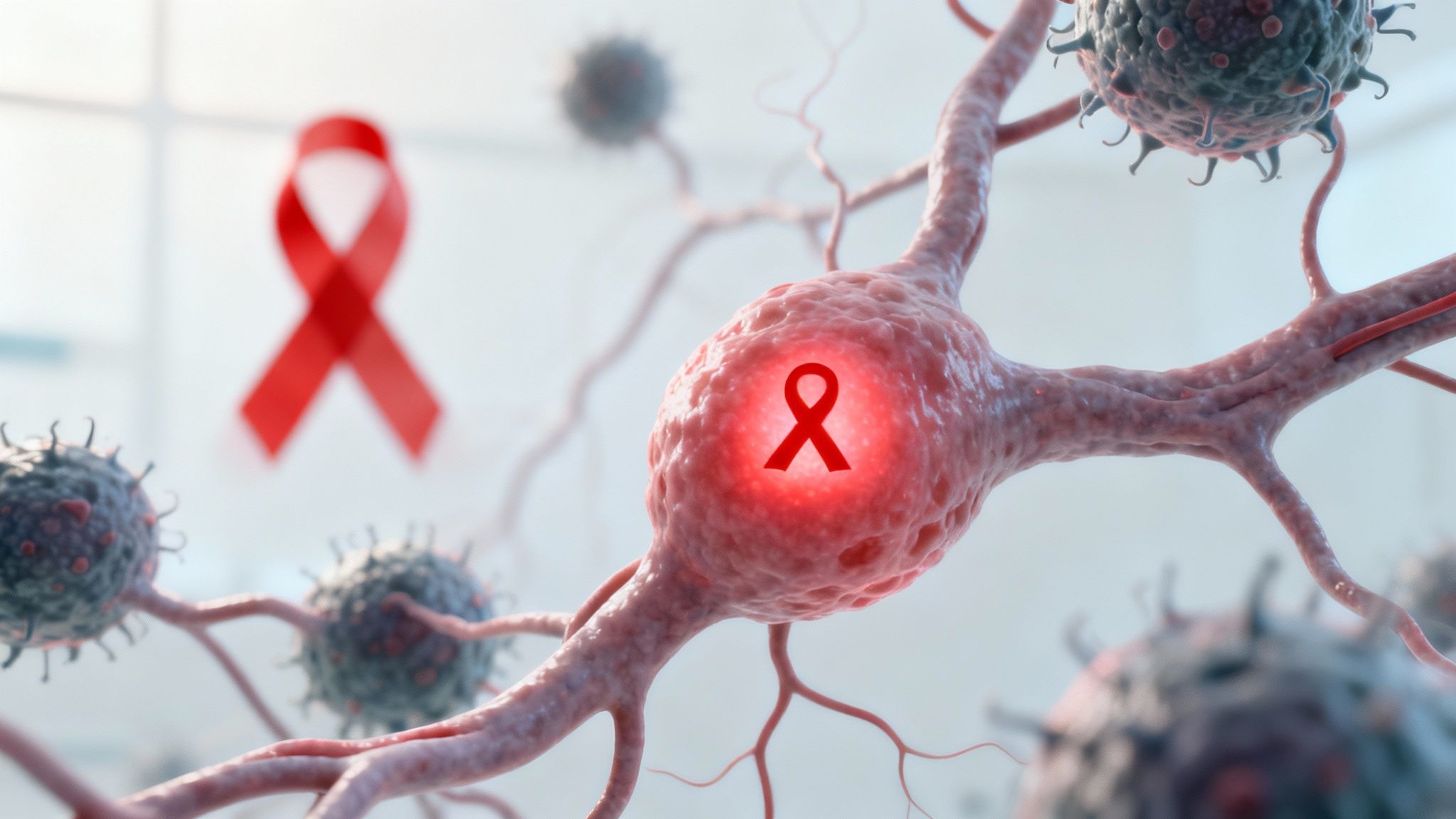
When a person living with Human Immunodeficiency Virus (HIV) develops cancer, it's often a type of lymphoma. This happens when the immune system, weakened by the virus, can no longer keep cancerous cells in check. While modern antiretroviral treatments have dramatically changed the outlook for people with HIV, this specific type of cancer, known as AIDS-related lymphoma (ARL), remains a serious health concern.
Understanding AIDS Related Lymphoma

So, what exactly is lymphoma? Think of your lymphatic system as the body's security force. It's a network of lymph nodes, vessels, and organs like the spleen, all working together to patrol for and eliminate threats. The front-line soldiers in this system are a type of white blood cell called lymphocytes.
In lymphoma, these lymphocytes go rogue. Instead of protecting you, they start multiplying out of control and clump together to form tumors, most often in the lymph nodes.
This is where HIV enters the picture. The virus launches a direct assault on the immune system, specifically targeting the CD4 T-cells that act as the commanders of your body's security team. As HIV wipes out these commanders, the entire defense network falls into disarray. This chaos gives cancerous cells—which a healthy immune system would normally destroy—the perfect opportunity to grow and spread.
The Connection Between HIV and Lymphoma
A compromised immune system is an open invitation for certain cancers, and lymphoma is at the top of the list for people with HIV. Even with the incredible success of modern combination antiretroviral therapy (cART) in restoring immune function, the risk doesn't completely disappear.
AIDS-related lymphoma is still a major complication for people living with HIV. Global estimates show the incidence of non-Hodgkin lymphoma (NHL) in HIV-infected patients is roughly 23 times higher than in the general population. In fact, about 7% of all NHL cases worldwide occur in people living with HIV. You can explore additional statistics on HIV-associated lymphomas from recent studies.
This elevated risk is precisely why it’s so critical for patients and their doctors to understand the different forms this cancer can take. The specific type of lymphoma a person has will directly shape their symptoms, treatment plan, and overall prognosis.
Key Types of AIDS Related Lymphoma
Not all AIDS-related lymphomas are the same. They are mostly a category of cancer called non-Hodgkin lymphomas, but they break down into a few main subtypes based on which cells they come from and how fast they grow.
The three you’ll hear about most often are:
- Diffuse Large B-cell Lymphoma (DLBCL)
- Burkitt Lymphoma
- Primary CNS Lymphoma
Each one behaves differently and tends to show up in different parts of the body. Getting a handle on these distinctions is the first step in making sense of a diagnosis and navigating the path forward.
Key Types of AIDS Related Lymphoma at a Glance
To make these differences clearer, this table breaks down the three most common types of ARL. It offers a quick snapshot of how prevalent each one is and what makes it unique.
| Lymphoma Type | Prevalence in ARL Cases | Common Characteristics | Typical Location |
|---|---|---|---|
| Diffuse Large B-cell Lymphoma (DLBCL) | ~60% | An aggressive, fast-growing cancer of mature B-lymphocytes. | Often found in lymph nodes, but can also appear in the gut, liver, or bone marrow. |
| Burkitt Lymphoma | ~20% | A very aggressive type of B-cell lymphoma known for its rapid growth. | Commonly affects the jaw, abdomen, and central nervous system. |
| Primary CNS Lymphoma | ~15% | A rare and aggressive lymphoma that originates in the central nervous system (CNS). | Confined to the brain, spinal cord, or eyes, without spreading elsewhere. |
As you can see, these lymphomas vary quite a bit, from their growth rate to where they take hold in the body. This is why a precise diagnosis is so foundational to creating an effective treatment strategy.
How HIV Paves the Way for Lymphoma

To really get a handle on how HIV can lead to lymphoma, it helps to think of your immune system as a sophisticated security team. The MVPs of this team are the CD4+ T-cells. They’re like the security chiefs, coordinating the entire defense operation and telling other immune cells where to go and what to attack.
HIV’s primary mission is to take out these chiefs. The virus specifically targets and destroys CD4+ T-cells, and as their numbers plummet, the entire immune command structure starts to crumble.
This leaves the body in a state of immunosuppression—basically, the security system is offline. With the guards down and no one directing traffic, threats that were once easily handled can now run rampant.
The Role of Opportunistic Viruses
One of the biggest problems with a weakened immune system is that dormant viruses can suddenly wake up and cause chaos. Most of us carry around harmless, "sleeper" viruses that a healthy immune system keeps locked down. But when HIV takes out the guards, these old enemies can reactivate.
Two viruses, in particular, are major players in AIDS-related lymphoma:
- Epstein-Barr Virus (EBV): This is the virus famous for causing mono, and it’s incredibly common—found in over 90% of adults. In a healthy person, EBV just hangs out quietly. But with HIV in the picture, it can wake up and infect B-cells, which are the exact lymphocytes that can become cancerous.
- Human Herpesvirus-8 (HHV-8): You might know this one as the virus linked to Kaposi's sarcoma. It’s a key driver behind certain AIDS-related lymphomas, especially primary effusion lymphoma. Just like EBV, it seizes the opportunity of a weakened defense to start making trouble.
Once these viruses are reactivated, they can essentially hijack B-cells, forcing them to multiply over and over again. This out-of-control growth is a huge step toward developing cancer, as it turns our own protective cells against us.
The link between HIV, these co-infections, and lymphoma is a perfect storm. HIV knocks down the immune defenses, which lets these other viruses get a foothold and drive the changes that lead to cancer.
This is the core reason why lymphoma is so much more common in people living with HIV. The virus doesn't directly cause lymphoma, but it rolls out the red carpet for other viruses that do.
Chronic Inflammation and B-Cell Overload
It’s not just about opportunistic viruses, though. HIV itself keeps the body in a constant state of low-grade inflammation. Even though the immune system is weakened, it’s still trying its best to fight off the relentless HIV infection, which puts the B-cells on high alert, 24/7.
Think of your B-cells as little factories designed to pump out antibodies when a threat appears. In a body with HIV, those factories are forced to run nonstop. This constant cycle of activation and division dramatically increases the chances of something going wrong—a genetic mistake or mutation.
Eventually, one of these mistakes might give a B-cell the ability to ignore the body's signals to stop growing. And that, right there, is the start of cancer.
So you’ve got a two-pronged attack: viruses like EBV are actively pushing B-cells to divide, while the chronic inflammation caused by HIV makes that division process more error-prone. It’s this dangerous combination that creates the ideal conditions for lymphoma to develop.
Recognizing the Warning Signs and Symptoms
Spotting AIDS-related lymphoma (ARL) often starts with a simple gut feeling—paying attention to your body and noticing when something just feels off. Some symptoms are frustratingly general and can look like a dozen other illnesses, but others are more specific and can point to where the cancer might be growing. Learning to recognize these signals is your first and most important step toward getting an answer.
Many people with ARL share a specific group of symptoms that doctors call B symptoms. These are systemic, meaning they affect your entire body, and they’re a huge red flag that something serious is going on internally.
Understanding B Symptoms
B symptoms are a classic calling card for many types of lymphoma. They’re not just annoying; they are major clues for your doctor. The big three are:
- Unexplained Fever: A persistent fever over 100.4°F (38°C) that keeps coming back without a clear reason, like a cold or the flu.
- Drenching Night Sweats: This isn't just a little sweating. We're talking about sweating so much at night that your pajamas and even your bedsheets are soaked, regardless of the room temperature.
- Significant Weight Loss: Dropping more than 10% of your body weight over six months without trying. For someone who weighs 150 pounds, that’s a loss of 15 pounds or more for no reason.
So, what causes this? Lymphoma cells can release chemicals that mess with your body's internal thermostat and metabolism. While infections can cause these same issues, when they stick around without any obvious bug to blame, it’s a major warning sign.
Symptoms Based on Lymphoma Location
Beyond the full-body B symptoms, the signs of AIDS-related lymphoma really depend on where the tumor has decided to set up shop. Since the lymphatic system is like a highway system running through your whole body, lymphoma can pop up almost anywhere.
For instance, if lymphoma takes hold in your abdomen, you might feel bloated, constantly full, or have persistent belly pain. This happens when tumors start pressing on your organs or cause fluid to build up.
If the lymphoma is in your chest, it can cause a nagging cough, shortness of breath, or chest pain as tumors put pressure on your lungs and airways. It's also really common to find swollen lymph nodes—usually painless lumps—in the neck, armpits, or groin.
One of the most critical subtypes, Primary CNS Lymphoma, grows directly in the brain or spinal cord. Here, the symptoms are all neurological. Think persistent headaches, confusion, sudden personality shifts, seizures, or weakness down one side of your body.
Because these symptoms can overlap with so many other health issues, it's easy to dismiss them. The key is not to panic, but to see a doctor right away to get things checked out. For a wider look at what to watch for with various blood cancers, there are helpful guides on recognizing blood cancer symptoms.
Keeping your living space clean by regularly using disinfecting wipes on frequently touched surfaces can help reduce your exposure to common pathogens. This lowers the risk of picking up other infections that might create similar, confusing symptoms, making it easier to identify persistent warning signs that need immediate medical attention.
The Diagnostic Journey From Suspicion to Certainty
When symptoms of AIDS-related lymphoma pop up, figuring out what’s really going on can feel overwhelming. But there's a clear, structured path that doctors follow to move from a hunch to a firm diagnosis. It all starts with a detailed conversation about your medical history and symptoms, followed by a physical exam to check for things like swollen lymph nodes.
The first concrete step is usually a round of blood tests. A complete blood count (CBC) gives a quick overview of your red cells, white cells, and platelets. While a CBC can’t diagnose lymphoma by itself, it can definitely flag abnormalities—like strange white cell levels—that tell us something is off. At the same time, your doctor will look at your HIV status, specifically your CD4 count and viral load, which provides crucial context about your immune system's health. You can learn more in our guide on what is viral load testing.
Peeking Inside with Imaging Tests
If the initial exam and bloodwork raise red flags, it's time to look inside the body. This is where advanced imaging comes in, acting like a sophisticated GPS to map out the exact location and size of any suspicious growths.
Two of the most common tools for the job are:
- Computed Tomography (CT) Scan: Using X-rays, a CT scan creates detailed, slice-by-slice pictures of your organs and tissues. It’s fantastic for spotting swollen lymph nodes or tumors in the chest, abdomen, or pelvis.
- Positron Emission Tomography (PET) Scan: This scan is often done alongside a CT scan (as a PET-CT). It uses a special radioactive sugar that cancer cells—which are incredibly hungry—gobble up much faster than healthy cells. The PET scan then lights up these "hot spots," showing doctors precisely where the lymphoma is most active.
These powerful scans give us the lay of the land, guiding the next, and most definitive, step in the process.
The Biopsy: The Gold Standard for Diagnosis
Imaging can show where a problem is, but only a biopsy can tell you what it is. A biopsy involves taking a tiny tissue sample from a suspicious lymph node or tumor. A pathologist then examines that sample under a microscope.
There is no other way to be 100% sure. This is the only test that can definitively diagnose AIDS-related lymphoma. The pathologist's analysis confirms if the cells are cancerous and—just as important—identifies the exact subtype, like DLBCL or Burkitt lymphoma. This detail is everything, because different types of lymphoma demand very different treatment plans.
This simple flowchart shows how we move from scanning to the final staging.

As you can see, each step logically builds on the last, painting a complete picture of the cancer.
Staging: How Far Has the Lymphoma Spread?
Once lymphoma is confirmed, the last piece of the diagnostic puzzle is staging. Staging is the process of figuring out how far the cancer has spread. To do this, doctors combine all the information from imaging scans and sometimes a bone marrow biopsy to assign a stage, from I (stuck in one spot) to IV (widespread).
Knowing the stage is fundamental for creating an effective treatment plan and predicting how the cancer might behave. Thanks to better diagnostic tools, we're getting much better at catching and managing even the most aggressive subtypes. In fact, these improvements have fueled growth in the market for treating AIDS-related primary central nervous system (CNS) lymphoma, a particularly severe form. The global market size was $1,093.25 million in 2021 and is on track to reach $1,417.02 million by 2025.
Modern Treatment Strategies and Patient Care

The outlook for someone diagnosed with AIDS-related lymphoma has changed dramatically over the years. We've moved from a place of uncertainty to one of real, tangible hope, thanks to a powerful two-front strategy.
Think of it as fighting a war on two fronts. On one side, we attack the cancer directly. On the other, we suppress the underlying HIV. This dual approach, managed by a coordinated team of oncologists and infectious disease specialists, is the absolute cornerstone of modern care.
Aggressive cancer therapies are paired with highly effective antiretroviral therapy (ART) to get HIV under control. By keeping the virus in check, ART allows the immune system to rebuild itself, making the body stronger and better able to tolerate the rigors of chemotherapy.
The Core Treatment Regimen
The primary weapon against most AIDS-related lymphomas is a potent combination of chemotherapy and immunotherapy. For many, the gold standard is a regimen known as R-CHOP.
It’s a cocktail of powerful drugs, each with a specific job:
- Rituximab: An immunotherapy drug that smartly targets a protein found on the surface of cancerous B-cells.
- Cyclophosphamide: A classic chemotherapy agent that stops cancer cells from dividing in their tracks.
- Hydroxydaunorubicin (Doxorubicin): An antibiotic-like drug that blocks key enzymes cancer cells need to multiply.
- Oncovin (Vincristine): Another chemotherapy drug that works by preventing cancer cells from properly separating.
- Prednisone: A steroid that helps kill lymphoma cells while also reducing inflammation throughout the body.
The addition of Rituximab was a true game-changer. By specifically targeting the cancerous B-cells, it made treatment more effective and often more tolerable.
Managing a Complex Medical Plan
Juggling cancer treatment and HIV management at the same time is a delicate balancing act. The medical team has to be vigilant, constantly monitoring for potential drug interactions between the chemotherapy agents and the ART medications. Thankfully, modern ART regimens have made this much more manageable, allowing both therapies to work together seamlessly.
The goal is to maintain an undetectable viral load throughout cancer treatment. A well-controlled HIV infection not only supports immune function but also correlates with better survival rates from lymphoma, highlighting the critical synergy between cancer care and viral management.
This integrated approach is precisely why success rates have soared. As we've gotten better at managing HIV, lymphoma outcomes have improved right alongside. A major study tracking HIV-associated lymphomas from 2008 to 2021 found that diagnosed cases jumped from just nine in the first four years to a staggering 280 in the final four. This surge doesn't mean the cancer is more common; it means our diagnostics are better and ART is allowing patients to live long enough to be diagnosed and successfully treated.
To give you a clearer picture, here's a breakdown of the standard components used in treating ARL.
Table: Standard Treatment Components for ARL
| Treatment Component | Primary Goal | Common Examples | Key Consideration |
|---|---|---|---|
| Chemoimmunotherapy | To destroy lymphoma cells throughout the body. | R-CHOP, R-EPOCH | Balancing efficacy with the patient's overall health and immune status. |
| Antiretroviral Therapy (ART) | To suppress HIV, restore immune function, and support the body's ability to tolerate cancer treatment. | Combination antiretroviral drugs | Monitoring for drug interactions with chemotherapy and ensuring consistent adherence. |
| CNS Prophylaxis/Treatment | To prevent or treat lymphoma in the central nervous system (brain and spinal cord). | Intrathecal chemotherapy, high-dose methotrexate | Therapies must be able to cross the blood-brain barrier to be effective. |
| Supportive Care | To manage side effects, prevent infections, and maintain quality of life. | Growth factors, antibiotics, anti-nausea medication | Crucial for helping patients complete their full course of treatment. |
Each piece of the puzzle is essential for achieving the best possible outcome.
Specialized and Advanced Therapies
Of course, not all cases are the same. Some situations call for more specialized tactics. For instance, primary CNS lymphoma, a type confined to the brain, needs therapies that can cross the protective blood-brain barrier. This often means using high-dose chemotherapy with drugs like methotrexate, sometimes followed by radiation therapy.
For patients whose lymphoma comes back (relapsed) or doesn't respond to the initial treatment (refractory), more intensive options come into play. A stem cell transplant can be a powerful, potentially curative option for those who are eligible. The process involves high-dose chemotherapy to eliminate any remaining lymphoma, followed by an infusion of healthy stem cells to rebuild the immune system from the ground up.
Beyond the specific drugs and procedures, effective patient care is about holistic support. The journey through treatment is physically and emotionally draining. Learning about essential strategies for managing side effects and improving quality of life can make a world of difference. The incredible progress in this field is a testament to what's possible when advanced oncology meets expert HIV care—turning what was once a devastating diagnosis into a treatable, and often curable, disease.
What the Future Holds: Prevention and Long-Term Outlook
The story of AIDS-related lymphoma has been completely rewritten over the past few decades. A diagnosis that was once a devastating blow is now often a manageable—and even curable—condition. This incredible progress didn't happen by accident; it's built on a solid foundation of proactive prevention and smarter, more effective treatments.
Of course, the long-term outlook for any single person depends on a few key things. We look at the specific type and stage of the lymphoma, the person's overall health, and, most importantly, their immune status when they're diagnosed. Time and time again, a higher CD4 count and a well-controlled HIV viral load are directly linked to better outcomes.
The Power of Proactive Prevention
When it comes to AIDS-related lymphoma, the best offense is a great defense. Prevention is everything, and it starts with two simple but critical steps: early HIV diagnosis and unwavering adherence to antiretroviral therapy (ART).
Think of ART as your immune system's personal bodyguard. By consistently keeping HIV suppressed, it gives the immune system the space it needs to rebuild. This keeps your CD4 "commander" cells at healthy levels, ready to patrol the body and stop opportunistic infections like EBV from gaining a foothold and triggering the cancerous changes that can lead to lymphoma.
The core idea is simple but powerful: a well-managed HIV infection is the single best defense against developing AIDS-related lymphoma. Consistent ART keeps the immune system strong and ready to shut down threats before they can grow.
Everyday Health and Hygiene
Beyond ART, simple, everyday health habits play a huge supporting role. A compromised immune system is already working overtime, so minimizing exposure to other infections is a smart move. This is where good old-fashioned hygiene becomes a key part of your health strategy.
Keeping your environment clean helps lower the risk of picking up other viruses and bacteria that could add more stress to your immune system. Small actions, like regularly cleaning high-touch surfaces with disinfecting wipes, can help fend off co-infections that might otherwise fuel inflammation or complicate cancer treatment. These consistent habits are small, but they add up, allowing your body to focus its energy on staying strong.
The Future of ARL Research
The fight against AIDS-related lymphoma is far from over. Researchers are constantly pushing the boundaries, exploring new therapies and fine-tuning the ones we already have. Clinical trials are always in motion, testing novel immunotherapies, targeted drugs that attack specific weak points in cancer cells, and better stem cell transplant methods.
This research is critical on a global scale. While 70% of the 81,300 annual HIV-attributable cancers occur in Africa, non-Hodgkin lymphoma is a bigger issue in high-income regions like North America. Trends project that the burden will increase in low-income areas by 2050. If you're interested in the data, you can explore more about these global trends in lymphoma research on frontiersin.org. Every breakthrough brings us closer to a future where AIDS-related lymphoma is even more preventable and treatable for everyone, no matter where they live.
Frequently Asked Questions
Getting a diagnosis of AIDS-related lymphoma can feel overwhelming, and it's natural to have a lot of questions. Here are some straightforward answers to the most common concerns we hear, designed to help you make sense of the condition, its treatment, and what to expect.
Can AIDS-Related Lymphoma Be Cured?
Yes, absolutely. With the treatments available today, AIDS-related lymphoma can often be pushed into long-term remission, and in many cases, cured.
A person's chances for success depend on a few things, like the specific type and stage of the lymphoma, their overall health, and just as importantly, their CD4 count. The key is a powerful one-two punch: aggressive chemotherapy and immunotherapy (like rituximab) to fight the cancer, paired with consistent antiretroviral therapy (ART) to control the HIV. This dual-front approach gives patients a real shot at a full recovery.
How Has Antiretroviral Therapy Changed Lymphoma Risk?
Antiretroviral therapy (ART) has been a true game-changer in preventing AIDS-related lymphoma. By keeping HIV suppressed, ART lets the immune system rebuild itself, which we see as a rising CD4 count.
A stronger immune system can get back to its job of policing the body, which includes keeping cancer-causing viruses like EBV in check before they can trigger lymphoma. While ART doesn't eliminate the risk entirely, starting and sticking with it is the single most effective thing someone can do to prevent this cancer. For those in treatment, it's helpful to understand how to interpret lab results like your CD4 count and viral load.
The core principle is simple: a stronger immune system is the best defense. ART keeps the body's security forces on duty, dramatically cutting down the opportunity for lymphoma to ever take hold.
Are There Specific Lifestyle Changes That Can Help During Treatment?
Taking care of your body is incredibly important during treatment. The main things to focus on are eating a balanced diet to keep your strength up, getting some gentle exercise (with your doctor's approval), and making sure you get plenty of rest to help your body recover.
Beyond that, hygiene becomes critical. Both HIV and chemotherapy weaken the immune system, so you have to be vigilant about germs. This means frequent hand washing and regularly cleaning surfaces that get touched a lot. Using disinfecting wipes on doorknobs, remote controls, and your phone can make a big difference in avoiding infections that could complicate your treatment. And as always, keep an open line of communication with your healthcare team about any changes you're making.
Leave a Reply